*
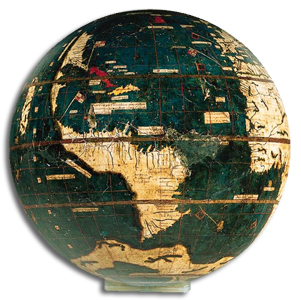
* In the north, far inland, and twice in the south, the cartographer of the day penned the name of the new continent—the one associated not with Christopher Columbus, but with Amerigo Vespucci (1454–1512), the Italian navigator who was the first to declare that America was "not an island, but a continent."
The outline of the east coast of this brand-new America matches the surveys made by the Florentine navigator during his four expeditions, while the straight-line depictions of rivers such as the Amazon and the Orinoco strike us as somewhat naïve today. This magnificent object is attributed to the canon and cartographer Martin Waldseemüller (1470–1520), a leading figure in the "Gymnasium Vosagense of Saint-Dié." In 1507, this group published Cosmographiae introductio, which included both a translation of Ptolemy’s mathematical method of cartography and accounts of voyages by… Vespucci, no less. Printed in Saint-Dié (Vosges), the volume came with a vast twelve-sheet world map and, as a bonus, a tiny painted globe just ten centimeters in diameter—a true multimedia work ahead of its time.