Oil: a peak… in demand
-------------------------------
The bell-shaped curve describing the production of any raw material is named after Marion King Hubbert (1903–1989), an American geophysicist. Mathematics explains why: the reserves of a non-renewable resource on Earth, measured in a given unit, form a finite quantity; the area under the resource's consumption curve, which corresponds to the total quantity consumed, is finite; the function represented by the curve tends to 0 at infinity; and, if the function is continuous, it reaches a maximum.
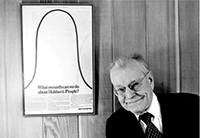
It was in 1956 that Hubbert conceptualized peak oil. Sixty years later, the debate still rages! New deposits keep being discovered. For instance, in the spring of 2018, a field of 80 billion barrels of oil was discovered off the small archipelago of Bahrain (Middle East). To put this in perspective, this amount alone is equivalent to two and a half years of global consumption. As time goes on, proven reserves, at the current rate of production, tend to increase. The most commonly cited estimate is around fifty years. The peak, if it exists, will instead be a peak in demand!
-
Oil prices… disconnected from the market
------------------------------------------
By 2030, because of the greenhouse-gas reduction targets set by the world's major powers, oil consumption could decline as electricity use rises, driven by new uses. But how are oil prices actually determined?
In less than a year, the price of Brent crude, the benchmark in Europe, rose from 45 to nearly 80 dollars a barrel (still far from the 140-dollar peak of 2008). Oil prices do not simply reflect the state of supply and demand (the "market"), but also analysts' expectations and the advice they give speculators. These speculators make their money from price volatility, not from the price level! They watch for every signal: the collapse of Venezuelan production, geopolitical risks (Iran, Yemen), the strategy of the major producers (Saudi Arabia, Russia)… Every day, the volume of virtual oil traded amounts on average to thirty-five times the production of real oil.