One Saturday afternoon, sitting at his desk, surrounded by documents and data, Claudi Alsina Català became certain. Not a vague hunch, not one more coincidence to add to the list — a genuine discovery. The mathematician from the University of Barcelona had just got hold of the Sagrada Família's hidden system of proportions: a 7.5-metre module and the ratios between the divisors of 12. As he writes in his memoirs, quoted in the Slate.fr article republished from The Conversation, "the 7.5-metre module and the ratios between the divisors of 12 (1:4, 1:3, 1:2, 3:4, 2:3, 1) seemed to explain a multitude of things."
2026 marks the centenary of Antoni Gaudí's death — the perfect occasion to look afresh at Spain's most visited building, no longer as an extravagant cathedral, but as a numerical puzzle whose instructions someone has finally recovered.
Why 12? Because 12 is generous
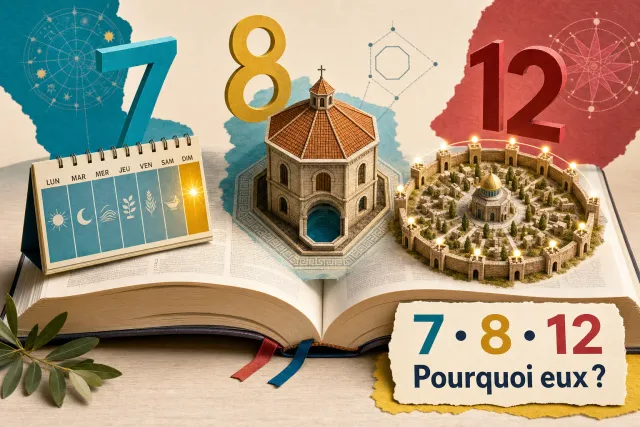
Before getting into the numbers, let's ask the question: why 12, and not 10 or 8? The answer is both religious and mathematical.
On the symbolic side, 12 is everywhere in the Bible: the twelve sons of Jacob, the twelve tribes of Israel, the twelve apostles, the crown of twelve stars in Revelation. Gaudí, who conceived the basilica as a synthesis of architecture and religious symbolism, had no reason to look elsewhere. But on the mathematical side, 12 is also a remarkably practical choice. Its divisors are 1, 2, 3, 4, 6 and 12 — six divisors for such a small number is a lot. By comparison, 10 has only four (1, 2, 5, 10). This richness makes it possible to build simple ratios: halves, thirds, quarters, two-thirds, three-quarters... For an architect who wants his columns, vaults and towers to fit together visually, that's a treasure trove.
That is exactly what Alsina Català's study published in the journal Suma demonstrates: the basilica can be reread as a grid of simple ratios drawn from the divisors of 12, organized around a base unit of 7.5 metres.
7.5 metres: the invisible brick
Take 7.5 metres. Multiply by 12: you get 90 metres, the total length of the basilica. Multiply by 8: 60 metres, its width. By 6: 45 metres, the width of the main nave. The heights follow the same principle — the apse vault peaks at 75 metres (7.5 × 10), the transept vault at 60 metres (7.5 × 8), the nave at 45 metres (7.5 × 6), the side aisles at 30 metres (7.5 × 4), the choir at 15 metres (7.5 × 2).
The multipliers are exactly the divisors of 12 and their multiples: 2, 4, 6, 8, 10, 12. Nothing is arbitrary.
The Tower of Jesus, the centerpiece of the building, reaches 172.5 metres — that is, 7.5 × 23. According to the basilica's official documentation, this height echoes that of Montjuïc, the hill overlooking Barcelona. The upper arm of its cross — 17 metres high, 13.5 metres wide — was installed on 20 February 2026, according to Vatican News, just in time for the centenary. Jordi Faulí, the site's chief architect — and a former doctoral student of Alsina Català — said that this completion "represents far more than the end of a construction phase: it is the result of years of work and study of Gaudí's legacy."
A forest of twisted columns, roofs made of curved straight lines
The proportions are only the surface of the problem. Inside, Gaudí deployed a geometric arsenal well worth pausing over.
The columns of the nave are double-twisted helicoidal columns — a forbidding name for an immediately clear visual idea. Picture two Solomonic columns (those spiral columns found in Baroque baldachins) turning in opposite directions, then merging. Their base takes the form of a polygonal star with rounded contours. As they rise, each column branches like a tree, its branches meeting the vaults and towers. The result looks less like a cathedral than a petrified forest. As modeling studies published in Automation in Construction detail, this geometry is generated by two counter-rotating rectangles about a shared axis — an operation Gaudí carried out physically, with plaster, before computers existed.
The vault skylights, for their part, are one-sheet hyperboloids. This is a curved surface — a shape like a barrel pinched in the middle — that can nonetheless be built entirely out of straight lines. Stretch threads between two circles offset by rotation, and you get exactly this surface. The practical upshot: simpler to build than any Gothic vault, and remarkably efficient at diffusing light. As a study by Silvia Benvenuti on ruled surfaces in Gaudí's architecture notes, these shapes — hyperboloids, hyperbolic paraboloids, helicoids — form a geometric signature that places Gaudí between the Catalan Gothic legacy and an anticipation of modern topological architecture.
The hanging chain that becomes an arch
Here is the most beautiful idea in the whole of the Sagrada Família's architecture, and the simplest to grasp. Hang a chain between two points. It takes on a natural shape, dictated by gravity: a curve called a catenary. Now mentally flip that chain over. The resulting curve is the ideal shape for a load-bearing arch, because it works entirely in compression — no tension, no risk of cracking. Gaudí had understood this, and he built models of strings and weights to work out the directions of his columns and arches graphically.
As a study published by the Institut d'Estudis Catalans, co-authored by Alsina Català, Jordi Faulí and Josep Gómez, details, Gaudí had even tried out this method at the Colònia Güell before applying it to the Sagrada Família. In his own words, as recorded by the architect Cèsar Martinell: "I found the funiculars of the Sagrada Família graphically, and those of the Colònia Güell experimentally; but the two methods are the same, and one is the child of the other." The result: no massive buttresses, no flying buttresses. The Gothic cathedral needed external props to keep from collapsing. The Sagrada Família stands on its own.
33, the number that signs the Passion façade
One last, almost mischievous detail. On the Passion façade is a magic square — a grid of numbers in which every row, every column and every diagonal add up to the same sum. A classic 16-cell magic square using the integers 1 to 16 has a constant (that identical sum) of 34. The Sagrada Família's has a constant of 33 — the traditional age of Christ at the Passion. To achieve this, the sculptor Josep Maria Subirachs took the structure of Albrecht Dürer's famous square from his engraving Melencolia I (1514), rotated it 180° and reduced four of its numbers by 1. The Royal Institution confirms it: the Sagrada Família's square is not strictly speaking a "normal" magic square, since some integers are repeated in it — but the symbolic constraint takes precedence over mathematical purity. It's not a cheat: it's a choice.
This is what a mathematical reading of the Sagrada Família reveals. Not a building decorated with religious symbols, but a system in which every proportion, every curve and every number points simultaneously to a structural necessity and a symbolic intention. The two languages speak to one another. That may be Gaudí's true genius: having found a vocabulary in which God and geometry say the same thing.
Key takeaways
What the divisors of 12 really do to proportions
To grasp why choosing the number 12 as the base of a modular system is mathematically effective, you need to understand what an architectural system of proportions is. The idea is simple: you pick a base length m (here 7.5 metres), then generate every important dimension of the building from expressions of the form k × m, where k is an integer or a simple ratio. For these ratios to be "harmonious" — that is, visually legible and practical to build — the fractions involved need to be simple: 1/2, 1/3, 1/4, 2/3, 3/4.
Now, these fractions are precisely the ratios between the divisors of 12. The divisors of 12 are {1, 2, 3, 4, 6, 12}. The ratios that can be formed between them are: 1/12, 1/6, 1/4, 1/3, 1/2, 2/3, 3/4, 1. Restricted to ratios less than or equal to 1 and involving "small" divisors, we get exactly the list identified by Alsina Català: 1:4, 1:3, 1:2, 3:4, 2:3, 1.
Compare this with 10, whose divisors are {1, 2, 5, 10}: the only simple ratios available are 1/2 and 1/5. With 1/5 = 0.2, you get lengths such as 1.5 m or 3 m from a 7.5 m module — not very practical for visual proportions. The number 12, by contrast, is what number theorists call a highly composite number (in the informal sense): for its size, it has an exceptional number of divisors. The first number with more divisors than 12 is 24 (which has 8). Using 12 as the base of a system of proportions maximizes harmonic richness at zero symbolic cost — since 12 is already there, in the sacred texts.
In terms of the magic constant, let's finally recall that for a normal magic square of order n using the integers 1 to n², the constant equals n(n² + 1)/2. For n = 4: 4 × 17 / 2 = 34. The Sagrada Família's square breaks this formula by repeating some integers and omitting others, so that the sum of each row stays at 33. This is not a magic square in the strict sense of combinatorial theory — but it is a coherent mathematical object, built through an explicit transformation (a 180° rotation and the subtraction of 1 on four cells) from Dürer's square, as the analysis by the Royal Institution establishes.