
Collective urine testing to save test strips (and time)
---------------------------------------------------------------------
In the 1960s, at certain army selection centres, collective tests were introduced for reasons of economy. Groups of eight boys were formed to undergo medical tests that would decide their fitness. After the physical measurements (height, weight, visual acuity, etc.) each boy was given a small flask to fill in the toilets. The medic would then take about one cubic centimetre from each flask and mix it all together in a single test tube.
He dipped a test strip into the tube and waited about a minute for the reaction.
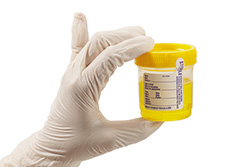
If the result was negative, he threw everything away, confident that the result held for each of the eight boys. In that case, a single strip is used instead of eight; the saving is clearly significant. But if the test is positive, what then? A simple idea is to split the flasks into two groups of four and test each group, which takes two strips, and we continue with the positive group (or groups). This generally narrows things down to a group of two positives, which are then tested separately. In all, if only one person out of the eight is positive, six strips are used.
If the test for the initial group of eight is negative, only a single strip is used; otherwise, six strips are used. If the probability that a person is positive is 5‰, a group of eight contains at least one positive individual with a probability of 1 – 0.9958, or a little under 4%. Out of a hundred groups, on average 96 use a single strip and 4 use six. In all, that makes 120 strips for 800 people, or three for every twenty. The saving justifies the method used.