The chronophotographic gun
-----------------------------
==========================================================================================
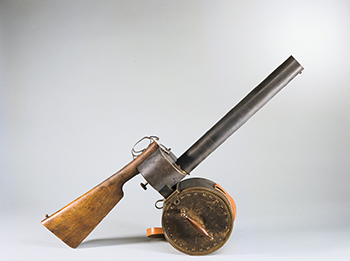
Étienne-Jules Marey, 1882.
As part of his research into human and animal locomotion, the physiologist Étienne-Jules Marey (1830–1904) replaced the graphical method with photography to record the phases of movement. The graphical method, based on chronography, sometimes produced imprecise results. Drawing on the research of Eadweard Muybridge (1830–1904) and Jules Janssen (1824–1907), Marey invented the photographic gun to study the flight of birds and bats. He shortened exposure times by using the gelatin silver bromide process. Equipped with a shutter and a circular magazine containing the light-sensitive plates, the gun captured twelve instantaneous photographs per second of the animal in its sights. This produced a series of images on a single light-sensitive plate, creating a research record suitable for analysis. Marey used the gun to study locomotion in various animal species (horses, donkeys and dogs) and in humans.
An early home-use device
----------------------------