The museum of the Conservatoire national des arts et métiers (Cnam) houses a collection of inventions, each more spectacular than the last. Before it had a museum, however, the CNAM, founded in 1794 by Abbé Henri Grégoire, was a venue for teaching and demonstrations, with machines used to sharpen students' reasoning. Mathematics and mechanisms were part of the institution from the very beginning. Alexandre-Théophile Vandermonde (1735–1796) helped establish it, while Charles Dupin (1784–1873) established its first chair in applied mechanics.
Combining motion
The word "mechanics" entered the mathematical vocabulary in the 16 th century; its derivative, "mechanism," appeared later. The latter naturally recalls the original sense of "mechanics," namely a machine, since a mechanism is commonly understood as a device that combines movements, even when motion is not its purpose. A lock, for example, is a mechanism for securing a door. That is the feature of a lock we chiefly notice, but its construction is defined by a mechanism that transmits the motion of the hand to the bolt. From the Mechanics collections through Transport to Communications, visitors to the Musée des arts et métiers encounter mechanisms at every turn.
A device that transmits information by means of an electric current is, according to the semantics of the 16 th century, a mechanism. Of course, that is not generally how we understand the word today. And yet the motion of electrons lies at the very heart of electric current. The word "current" inevitably evokes a stream, a river, or the flowing waters of La Fontaine. All these meanings offer different laws or maps of the concept of motion. The lock mechanism belongs to solid mechanics and involves both dynamics—turning the hand applies a force that transmits motion—and, once the bolt is in place, the statics of forces and the strength of materials, which ensure that the locked door will withstand a malicious crowbar… until something breaks.
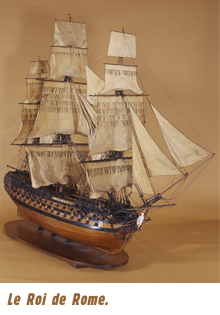
Mechanisms involving fluids are prime examples of the complexity of representing such systems: understanding them requires far more than just the fluid mechanics at work within them. The first-rate ship Le Roi de Rome illustrates this complex interplay particularly well. The interaction between something akin to a moving fluid—the wind—and the structures formed by the sails sets the ship in motion; but the interaction of the hull and rudder with the water, together with their geometry—including the distribution of mass—steers the ship or makes it easier for it to move. What role does mathematics play in motion? The fundamental law of dynamics, which combines forces, moments, and second derivatives, lets us use a priori estimates to infer properties of motion. Exact solutions are possible in a few classic cases, but they are usually of pedagogical interest only.
Mathematics in the museum
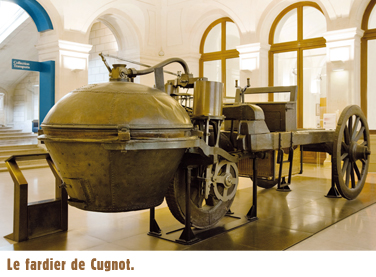
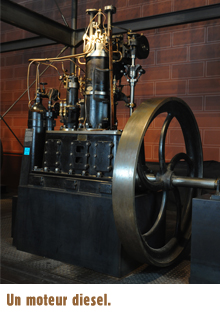
Let's return to the basic observation of motion: it is a change in an object's position. When we study how position varies over time, we speak of velocity—first average velocity, then, when that concept and model prove inadequate, instantaneous velocity. Of course, velocity—the derivative of position with respect to time—may or may not exist. The best-known mathematical model of the motion of pollen on the surface of water is Brownian motion, for which instantaneous velocity has no meaning. Perhaps this is a shortcoming of the model, since pollen particles really do move, but their motion is punctuated by collisions… But the model is rich enough to encompass the concept of heat, which diffuses and can be viewed as a macroscopic quantity characterizing the collisions of microscopic particles. The museum's steam engines are fine examples of machines that use heat. When the engine of Cugnot's steam wagon or one of the Diesel engines in the museum chapel is running, it harnesses thermodynamic properties that are intimately linked to those particle collisions. In the former, heat causes water to change phase; the resulting steam, treated as a gas, uses its pressure to move two pistons (a mechanism!). In the Diesel engine, however, diesel fuel ignites under compression as its temperature rises, producing exhaust gases rather than steam; their pressure pushes the piston back down (another mechanism…).
In short, modelling, mathematics and motion—and therefore technology and mechanisms—are intimately connected.
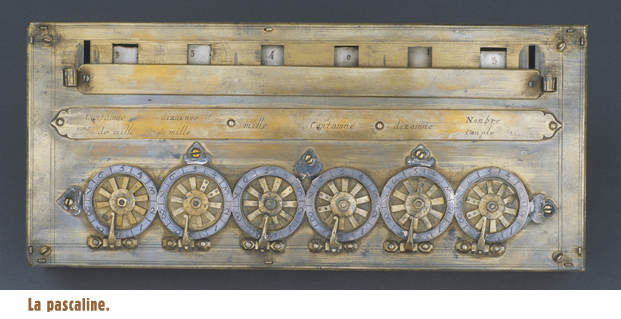
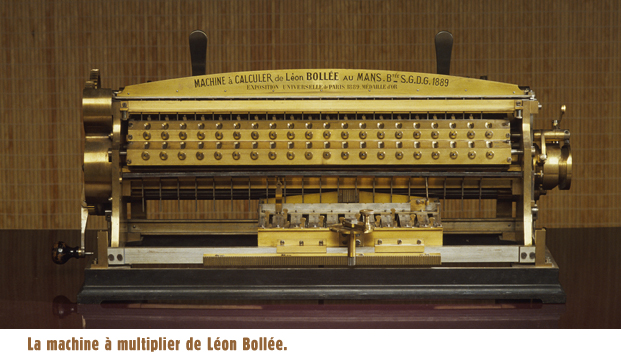
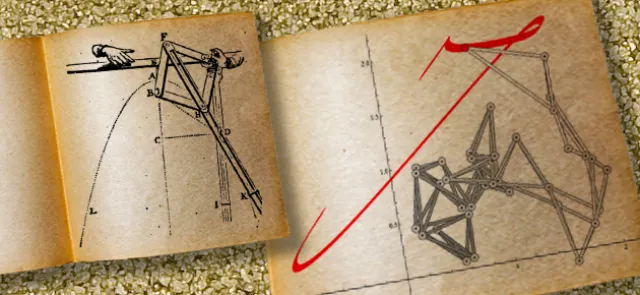
The Musée des arts et métiers is a veritable showcase of original mathematical illustrations. Visitors can spend hours on a treasure hunt, wondering where mathematics is hidden in each object. Mechanisms—and the motion they produce—are everywhere. We've already encountered Brownian motion there, but that is only the beginning. Look closely and you can find Darboux geometry (see also page 42), the stabilization of dynamical systems (again through a mechanism), image processing, shape optimization and signal processing… The slide rule, and with it the logarithm, are on display, along with the Pascaline and Léon Bollée's incredible multiplying machine. Amusingly, these latter two machines use gear mechanisms to produce the result of a calculation (see the following pages). These motions must be carried out with absolute precision. The Pascaline's jerky action made it difficult to use. Designing this ingenious positive-drive system is no simple matter: for it to operate as accurately and efficiently as possible, the gear teeth need a very particular shape, one described mathematically by differential geometry…