



Jean-Jacques Dupas
107 articles published in Tangente
 Math for everyoneN°181Mar 28, 2018
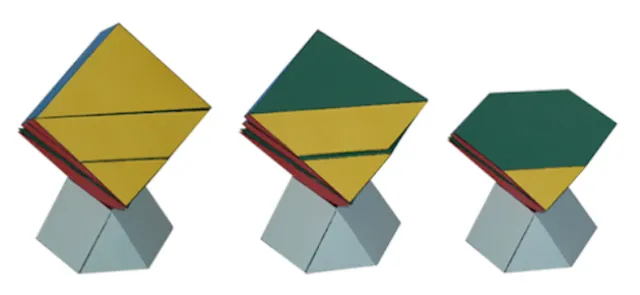
Build a sliced cube
Theory done—now for the hands-on part! Build your own sliced cube. A photo sequence illustrates each stage of the process step by step. Grab some glue and scissors, download and print the pieces to cut out, and... have fun!
Read → Math for everyoneN°181Mar 20, 2018
The cube’s geometric tricks
The cube is such a familiar object that few people know its formal name: the regular hexahedron. Yet that familiarity is deceptive... To see why, let’s slice a cube into sections: this old familiar shape still has a few surprises in store!
Read → History and CultureN°181Mar 19, 2018
Objects that embody knowledge
A mathematical object is a concept arising from... mathematics. The objects featured in this saga are physical ones, of interest not only mathematically but also historically, educationally and aesthetically. They illustrate concepts and make them easier to understand.
Read → Math for everyoneN°180Jan 27, 2018
Mobile phones: our friends, our enemies
A spy's dream would be for the target—the person under surveillance—to carry a microphone and a camera and be locatable. In fact, this is no longer a dream: everyone now owns a smartphone, complete with a microphone, a camera and GPS. The spy's life has become so easy…
Read → Math for everyoneN°65Jan 03, 2018
Linear maps: the "hard core" of linear… algebra
Linear maps are an essential concept in the theory of vector spaces. They have many uses, including designing and solving games.
Read → Math for everyoneN°65Dec 30, 2017
First examples of vector spaces (2)
Every good vector space E needs a base field K. But what exactly is a field?
Read → History and CultureN°65Dec 29, 2017
First examples of vector spaces (1)
Before we get to the heart of the matter, it is worth remembering that we have all encountered a vector space at school.
Read → History and CultureN°179Nov 22, 2017
The fascination of gears
Gears are both objects of fascination and symbols of mechanics. Determining the shape of their teeth is a sophisticated mathematical problem. Yet this long history, which stretches back to antiquity and is still being written, remains remarkably little known!
Read → Math for everyoneN°64Sep 12, 2017
The seven types of frieze
A tiling covers the plane, extending infinitely in two dimensions; a frieze extends in just one direction. The quintessential decorative motif, it is the decorative border you can put above your wallpaper. There can be only seven different types.
Read →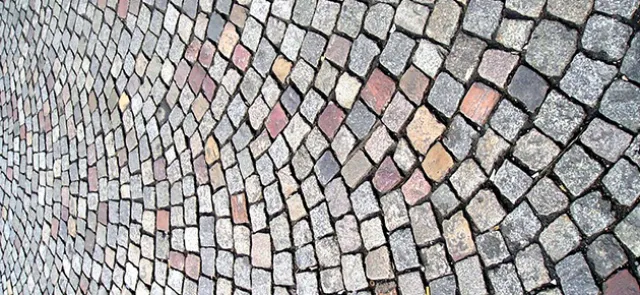 Math for everyoneN°64Sep 12, 2017
Seventeen groups that tile the plane
The plane tiling theorem states that the weight of a motif must equal 2. This small value makes it possible to consider every possible wallpaper symmetry: there are only seventeen wallpaper groups.
Read →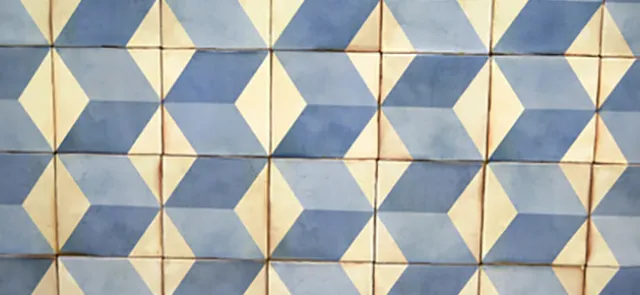 Math for everyoneN°64Sep 12, 2017
Signature and the tiling theorem
Have you ever noticed? In friezes, tilings and other periodic patterns that repeat or exhibit symmetries, the artist's range of possibilities is actually quite limited. A fundamental theorem provides a complete enumeration of these patterns.
Read → Math for everyoneN°64Sep 12, 2017
Squaring the square
The search for perfect squared squares has inspired many attempts, some of them very elegant.
Read →