



Amazing Math
Surprising or counterintuitive mathematical results and proofs
 Podcast
This papyrus buried by Vesuvius in 79 AD was read unopened
Researchers have succeeded in reading a papyrus scroll charred by Vesuvius in 79 AD, using tomography, phase contrast, and artificial intelligence.
 Podcast
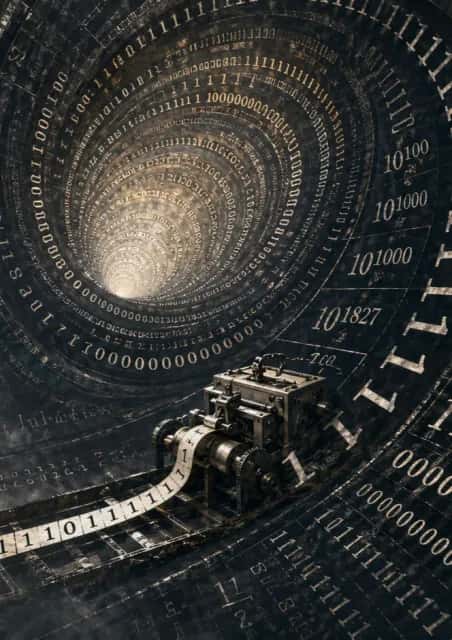
Busy Beaver: the function beyond all computability
The Busy Beaver function grows faster than any computable function. Discover why some numbers are mathematically inaccessible.
 Podcast
Two locally identical yet different tori break 150 years of geometry
Two tori plainly impossible to tell apart locally yet topologically distinct: a discovery that breaks a rule geometry has accepted for 150 years.
 Podcast
Ackermann-Péter function: recursion without bounds
With a surprisingly simple definition, the Ackermann–Péter function generates numbers of a staggering size. This mathematical construction, born out of research into computability, shows how quickly a recursive procedure can exceed all the usual bounds.
 Podcast
Mersenne primes: discover perfect numbers
The search for Mersenne primes very quickly leads us to examine gigantic numbers.
 Podcast
The Boltzmann equation: from molecular chaos to macroscopic equilibrium
Formulated in 1872 by the Austrian physicist Ludwig Boltzmann (1844–1906), this equation describes how a gas or fluid evolves toward equilibrium. It bridges molecular collisions at microscopic scales and the macroscopic world.
 Podcast
Regular polygons with integer-coordinate vertices: one proof for all n
Discrete geometry is a recent field of research concerned with "discrete objects," such as graphs and tilings. But it also offers a fresh perspective on problems that are difficult to solve in a continuous setting, including the existence of regular polygons with integer-coordinate vertices.
 Podcast
Integer points on a line: methods of solution
Many problems in discrete geometry are simply stated and can be used in teaching to make certain concepts easier to understand. Searching for points with integer coordinates on a line naturally leads to applications of theorems from number theory.
 Podcast
Moving on the discrete plane: generating sets and minimality
Exploring how one can move around a grid leads to the concepts of generating sets and minimality. This example shows the power of discrete geometry as a tool for better visualizing and exploring complex ideas from classical geometry or algebra.
 Podcast
Knuth and Conway notations for mind-boggling numbers
When it comes to representing extremely large numbers, the standard operations, including exponentiation, are no longer enough. With considerable imagination, Donald Knuth and John Conway devised notations to overcome this limitation.

Skewes's numbers: enormous bounds in number theory
Skewes's numbers are among the large numbers encountered in arithmetic.
 Podcast
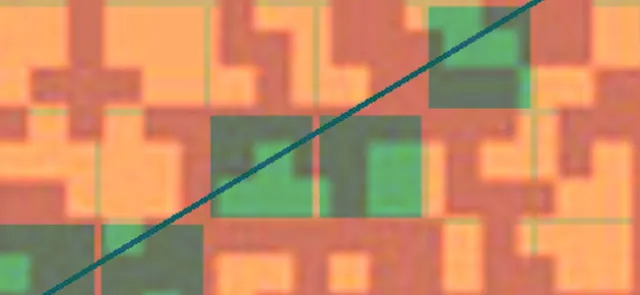
Discrete lines: the birth of a new geometry
Problems involving representation on a pixelated screen belong to discrete geometry. But beyond mere aesthetic considerations, are these new subjects of study—including discrete lines—tools for exploring Euclidean geometry more deeply, or objects of a new geometry?
 Podcast
666: When the devil shows up in math | Tangente
From the biblical 666 to the Belphegor number, certain numbers send a shiver down the spine… and bring a smile to mathematicians' faces. Behind these "cursed" objects, the creativity and ingenuity of recreational mathematics run wild, ranging from number games to diabolical curiosities.
 Podcast
Mathematical properties of 2026 | Tangente
Let's not break with our start-of-year tradition and explore together a few charming quirks of the new vintage!
 Podcast
Vampire numbers and their fangs | Tangente
Yes, vampire numbers really do exist! And they have fangs!
 Podcast
Parasitic numbers and permutations | Tangente
How do you multiply 105,263,157,894,736,842 by 2? Simple: just move the final digit, 2, to the front of the number, giving 210,526,315,789,473,684. And there you have it!
 Podcast
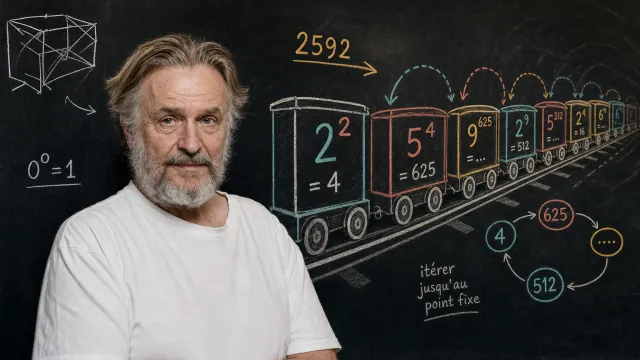
Conway's power trains | Tangente
Power trains are iterated functions introduced by Conway.
 Podcast
Multiplicative persistence of numbers | Tangente
Adding or multiplying together the digits of an integer is an activity a curious child might feel like doing. But they probably have no idea that it is the source of problems still unsolved in 2025!
 Podcast
Prime numbers and changing digits | Tangente
Unlike some composite numbers, it is hard to tell whether a number is prime just by looking at it. So what happens to a prime number if we make a change to its digits — for example, by permuting them or removing some of them? Can it stay prime? Or, on the contrary, does it stop being prime?

Narcissistic numbers and their secrets | Tangente
In the 1960s, while teaching at the University of Rochester in New York State, Mike Armstrong became particularly interested in k-digit numbers equal to the sum of the kth powers of their digits.