



Curiosity
Patterns, crafts, magic squares and fun mathematical content not part of the school curriculum
And you find that funny? Humor and mathematics
Sexist stereotypes die hard, even in mathematics, which one might have thought immune to such irrational fears and baseless preconceptions. Let's turn them on their heads with a little humor!
Inclusive writing: a linguistic and mathematical issue
What is inclusive writing, one of the initiatives aimed at combating sexism?
Big news briefs: digital technology, Big Data and French
Everything you always wanted to know about Big Data but were afraid to ask.
Trompe-l'oeil geometry: razzle dazzle camouflage
Hard though it may be to believe, geometry has sometimes helped to fight the enemy in wartime—or at least to limit the severity of its attacks.
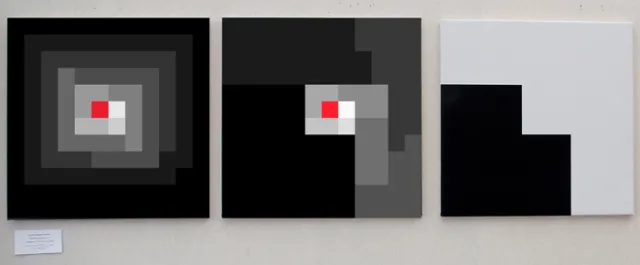
Fibonacci in concrete art: mathematics and aesthetics
The famous Fibonacci sequence begins 1, 1, 2… and each term is the sum of the previous two. It abounds in surprising properties. Has it finally yielded all its secrets? That remains a mystery, as some artists are now working with it and exploring it from every angle.
Maths as an accessory: briefs and curiosities
The latest trendy creations for mathematical fashion lovers
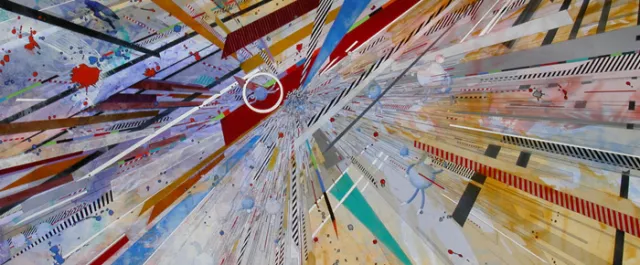
Linear equations and linear recurrences are one and the same!
One of a mathematician's skills is recognizing the same structures in different guises. A similarity in the calculations used in two ostensibly separate areas is often an early sign of this… Let's look at certain differential equations and sequences.
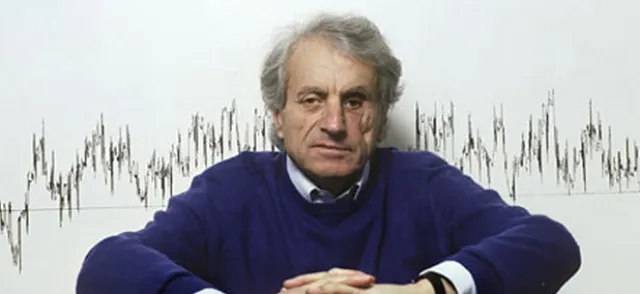
Yannis Xenakis's "musical vector spaces" | Tangente
In 1963, the celebrated composer Yannis Xenakis introduced a kind of arithmetic for musical composition, based on the notion of mathematical structure—in particular, that of a vector space. This artistic contribution lends itself wonderfully to scientific analysis.
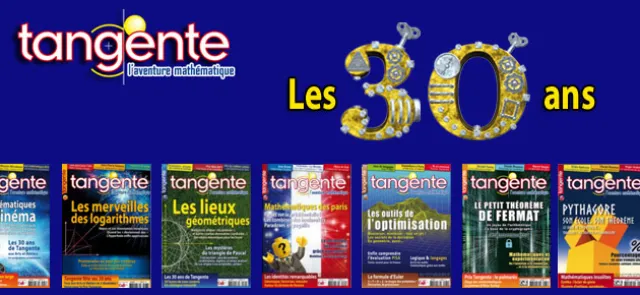
A remarkable story: 30 years of making mathematics accessible
Who would have wagered in 1987, when a handful of enthusiasts had the outlandish idea of creating a professionally produced magazine devoted to the place of mathematics in the world, that Tangente would still be going thirty years later—and would become the leading reference for mathematical culture?
2017 Tangente Awards: the winners
The Tangente Awards are becoming an increasingly well-known fixture in publishing and education. A look back at the 2017 awards, which were just presented on December 4 at the Palais du Luxembourg.
Two magnificent reissues: Fenouillard, Camember, Cosinus
Two recent—and entirely different—initiatives deserve attention.
An interactive journey through mathematical history
Reading Tangente already lets us travel through mathematical time and space—but have you ever thought of taking a virtual tour around the world and, at each stop, discovering the full history of mathematics rooted there?
Best illusion of 2017: Dynamic Müller-Lyer
The 2017 edition of the Best Illusion of the Year Contest, an annual international optical-illusion competition, took place in early October.
Publimath turns 20: the mathematics database
Publimath is a treasure trove of bibliographic resources for mathematics enthusiasts and educators alike.
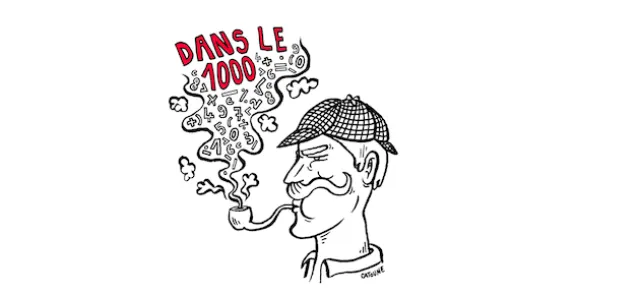
Bull's-eye: the results
Tangente's 30th anniversary coincides with another milestone: the 20th anniversary of Affaire de Logique, the weekly column in Le Monde, which celebrated its 1,000th installment with a competition run weekly for 26 weeks that drew… 1,000 participants!
Mathematics to make you think: games and mental arithmetic
To celebrate Tangente's 30th anniversary, here are a few small mathematical challenges to get you thinking carefully...

Hands-on mathematics: maths at your fingertips
Mathematics can be hands-on too! Such activities will be on offer on December 3, for Tangente's 30th anniversary.
Tangente at 30: lectures on surprising mathematics
For Tangente's 30th anniversary, on Sunday, December 3, renowned experts will talk about the mathematics they love. Here are the summaries.
The Ramanujan–Hardy duo on screen | Tangente Magazine
Area briefs
Discover different ways to calculate the areas of polygons