



Math for everyone
Mathematical content accessible to everyone
The geometry of complex numbers
René Descartes dreamed of turning a problem in pure geometry into an algebraic one. It took more than a century to realize that dream! Complex numbers opened up a new way to explore geometric figures and constructions.
Another transformation: inversion
Isometries (and more generally similarities) are not the only plane transformations that can be easily described using complex numbers. The same is true of inversion.

Some interesting similarities...
Isometries can be studied very neatly using complex numbers. But they are not the only transformations that can be described by simple formulas! Once we dispense with preserving lengths, the vast family of similarity transformations opens up before us.
Isometries of the plane
Studying isometries of the plane—reflections, translations, rotations, and so on—can sometimes be dizzying. What happens to a point or figure when several transformations are applied in succession? Complex numbers provide a representation that is as elegant as it is illuminating.
Complex numbers aren't so complicated
What do complex numbers really represent? How can we "picture" i² being equal to −1? A striking visual answer comes from interpreting multiplication geometrically. The icing on the cake is that the same model explains why "a negative times a negative makes a positive."
Conjugates, moduli and arguments
Once we accept the existence of a number i such that i² = −1, do we risk losing touch with physical reality? Quite the opposite: a profound and fruitful correspondence emerges, allowing questions of pure geometry to be solved through simple algebraic manipulations.

Online algorithmsMaking decisions without knowing the future
The gift of foreseeing the future would obviously be a considerable advantage. Who has never dreamed of it? Without a crystal ball, mathematics allows us to make decisions that cost us relatively little, even though we do not know what the future holds. Welcome to the world of online algorithms.
Poincaré, geometry and robotics | Tangente
Mathematics, and geometry in particular, is an essential component of that most technical of fields: robotics. The concept of space, which the mathematician Henri Poincaré (1854–1912) explored in depth, lies at the heart of the robotics engineer's work.
Logjam flaw in the HTTPS protocol | Tangente
A Franco-American team of researchers has just cheated… but for a good cause! Their goal? To verify the cryptographic mechanisms used to secure communications on the Internet.
The luthiers' secret code decrypted | Tangente
The luthiers of the Parisian house Gand & Bernardel, a famous dynasty of violin makers from 1795 to the Second World War, had a code that let them work on their slips with complete discretion.
Tangente turns 30: 30 ways to support it
The magazine Tangente, which is about to celebrate its 30th anniversary, has become an international benchmark and a fixture in the world of mathematics. Yet your support is more vital than ever to keep it going.
Betting on the presidential election: readers vs. the polls
Many of you took part in the challenge of coming as close as possible to the presidential election result. The winner is Élisabeth Pietravalle. Far behind, Ipsos proves to be the best polling institute.
Numbers in a triangle: math puzzles to explore
The arrangement of numbers in Pascal's triangle obviously lends itself to play, and many mathematical recreations refer to it.
Complex numbers of modulus 1
Initially mere formal symbols used in algebraic calculations, complex numbers came into widespread use from the 19th century onward thanks to their geometric interpretation... in almost every branch of mathematics! They therefore arise naturally in number theory.
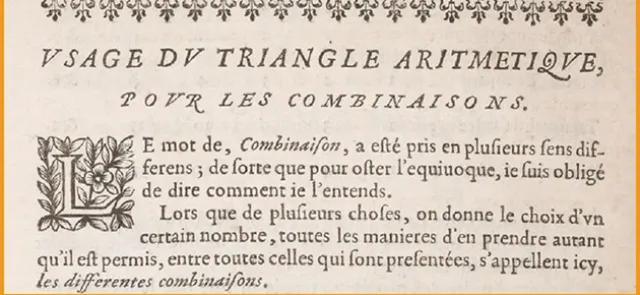
Journey into the heart of a mathematical classic
If you know how to fill in Pascal's triangle, you may be less aware of the treasures it contains. Arithmetic, geometric, combinatorial: it has no shortage of astonishing mathematical properties! And there are undoubtedly many more still to be discovered…
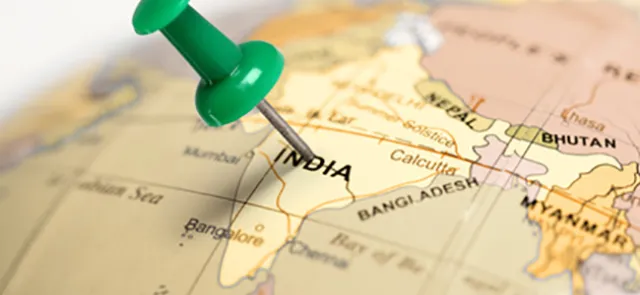
Pascal's triangle: a thousand-year history | Tangente
"Pascal's triangle" may have been discovered by Indians more than two thousand years ago. It reached the Arab-Muslim world and China as early as the 11th century. It did not appear in Europe until the 16th century, when Blaise Pascal began to study it rigorously.
Speeding up integer multiplication | Tangente
Complex numbers seem very far removed from the modern world’s concerns about profitability. Yet they underpin methods used to speed up the multiplication of large integers. They save time—a great deal of time—and therefore money!
Perpendicular bisectors, angle bisectors & beyond | Tangente
Equidistance is introduced very early in geometry. Perpendicular and angle bisectors are the simplest examples. Let us go further and consider points equidistant from a line and a circle, from two circles, or even from two more general curves. How far can we take this?
? is an algebraically closed field
The field ? of complex numbers was constructed to provide solutions to every quadratic equation. Surprisingly, it also contains the solutions to all algebraic equations with coefficients in ?. In technical terms, it is algebraically closed.
What is a complex number?
The set of complex numbers gained acceptance—with difficulty—when it became necessary to look beyond the real numbers for all the solutions of a quadratic equation. What no one had anticipated was its richness and the links it would forge with mathematics as a whole. Early discoveries.