



Famous figures
Portraits of famous mathematicians, historical and contemporary
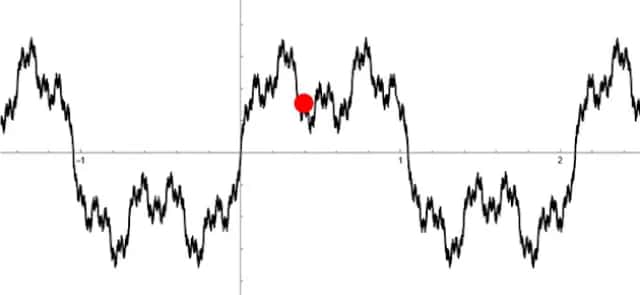
Fractal dimension
The construction of fractal objects called for new definitions of distance.

The man of fractures
For millennia, straight lines, circles, parabolas, and other smooth surfaces had reigned supreme and unchallenged over geometry. Then Mandelbrot unleashed the "mathematical monsters" of the early 20th century, transforming our picture of the world forever.
The Mandelbrot–Zipf–Estoup law
The polymath Benoît Mandelbrot took an interest in many subjects before becoming famous for his research on fractals.

Mandelbrot, a free spirit | Tangente
In the centenary year of his birth, we look back at the life of Benoît Mandelbrot, the "father of fractals": those strange geometric entities with which he adorned mathematics and which he managed to uncover even in nature.
New numbers with Richard Dedekind
The real numbers include the rational numbers—the quotients of two integers—and the irrational numbers, of which √2 and π are two well-known examples. This gives us one way of classifying the reals. But another classification is possible, based on numbers known as algebraic numbers.
The story of e
At the beginning of the 17th century, Galileo's telescopes and Newton's theories sparked an explosion in observations of the heavens. New mathematical tools were devised to handle the associated calculations, which were astronomical in every sense. Euler's number emerged naturally from this work.
Liouville, Hermite and Lindemann: paving the way | Tangente
A tribute to the pioneers who blazed the trail for others to follow.
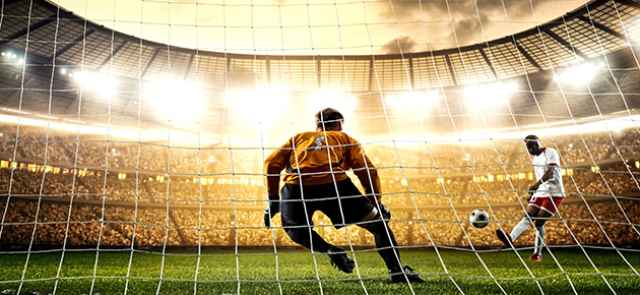
Nash and penalty shootouts: maths article | Tangente
When a penalty is taken in football, the player wants to put the ball in the net; the goalkeeper has to stop him. Can mathematics help maximize the chances of scoring—or of saving that fateful shot? The affirmative answer illustrates the work of John Nash.

2024 Abel Prize awarded to French mathematician Michel Tal… | Tangente
The fifth French laureate to receive the Abel Prize, mathematics' equivalent of the Nobel Prize, Michel Talagrand was born in 1952 and spent his career at the CNRS, developing an early interest in random processes.

Billiards and water-pouring problems
One facet of mathematical creativity is finding an original representation of a problem that makes it easy to solve. Thus, an elementary Diophantine equation can be solved by studying trajectories on a billiard table, turning billiards into an effective tool.
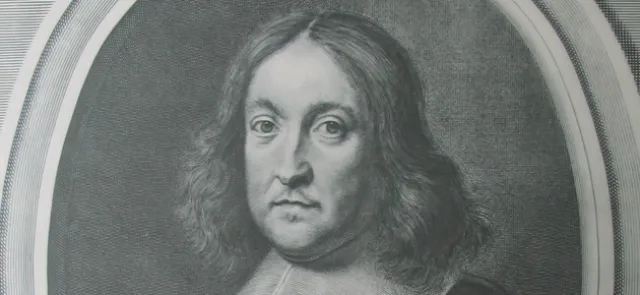
A historical example involving Fermat: article by m… | Tangente
Through his marginal notes in Bachet's edition of Diophantus's books on arithmetic and through his correspondence, the mathematician Pierre de Fermat spurred the study of integers with new results and methods. He both transmitted ideas and drove the subject forward.
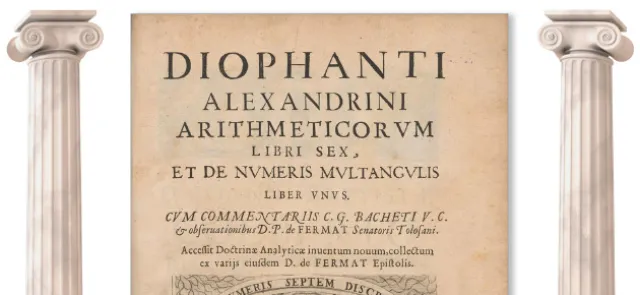
Diophantus of Alexandria, the unknown: article by… | Tangente
As noted on www.diophante.fr, which has just celebrated its 20th anniversary, the Greek mathematician Diophantus left us some remarkable works on arithmetic. A journey into history will reveal his extraordinary talent.
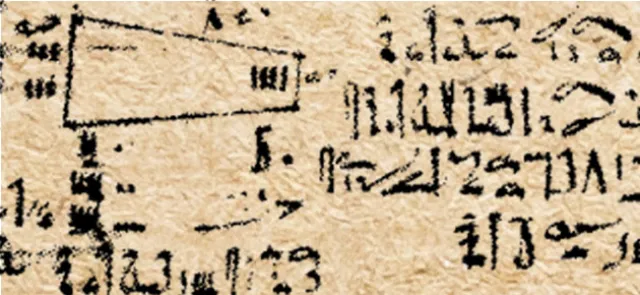
Integers: stars of equations: article by… | Tangente
In ancient Egypt, puzzles and problems were already being framed in terms of equations over the integers. Although the methods used to solve them have changed, the underlying question remains the same. These equations would go on to transform mathematics.

The weight of social inequalities in mathematics | Tangente
While gender inequalities in mathematics are now widely recognized, other forms of exclusion remain less studied: people from the working classes are also notably absent. This finding challenges the idea that mathematics is socially neutral and open to everyone, as it is often assumed to be.
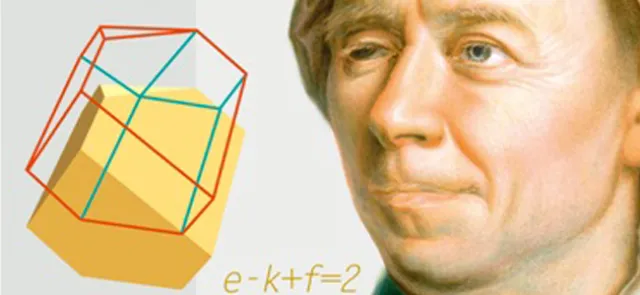
Geometric delights with Euler’s formula
Euler’s formula, a fundamental relation in mathematics, offers an opportunity to explore the properties of objects in three dimensions—and in higher dimensions as well. Along the way, we will encounter a classic of operations research: the simplex algorithm.

Fractions: word origins and history | Tangente
The word fraction seems to have appeared in its modern sense in 1549, in an arithmetic book published that year by the mathematician and Pléiade poet Jacques Peletier du Mans (1517–1582).
Descartes' way
How can fractions be handled geometrically? At the beginning of his most famous work, Descartes shows us how.
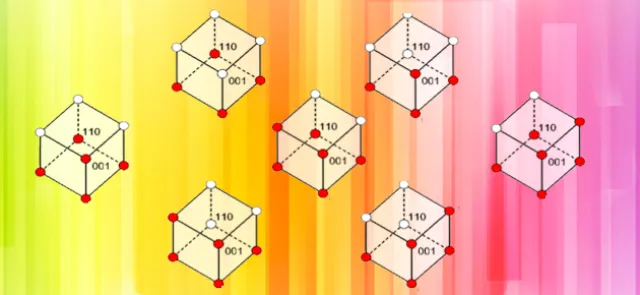
The ninth Dedekind number
Some well-known number sequences have thousands of terms, or even more, that can be calculated without the slightest difficulty. Others put up more resistance. Here is one whose ninth term mathematicians have only just managed to calculate!
A genealogy of fractions
A beautiful construction due to Calkin and Wilf, foreshadowed a century earlier, provides an elegant and deep way to list all fractions. Beginning with 1 / 1, each fraction in this construction gives birth to two new ones.
Denominators without end
Continued fractions—stacks of fractions that never end—have been studied by some of the greatest mathematicians, including Euler and Lagrange, as well as Galois. Let's take a closer look at these fractions and their strange denominators.