



Mathematical Themes
Explore the major mathematical themes: geometry, algebra, analysis, arithmetic, logic, and many other fascinating fields.
Charred manuscripts and maths | Tangente
The devastating eruption of Mount Vesuvius in AD 79, described by Pliny the Younger (61–c. 113), not only destroyed Pompeii but also ravaged the nearby city of Herculaneum.

Optimal control and Zermelo problems | Tangente
A particularly important class of optimal control problems consists of Zermelo-type problems: their applications have proved rich and fruitful in mathematics… and beyond. They are studied using a combination of geometric and numerical methods.
The sphere effect
The sphere came to be seen as a model of the world because of its perfection. Greek mathematicians soon sought to measure its properties, laying the groundwork for calculation techniques that would not bear fruit until centuries later.
Mapping and the geometry of the Earth | Tangente
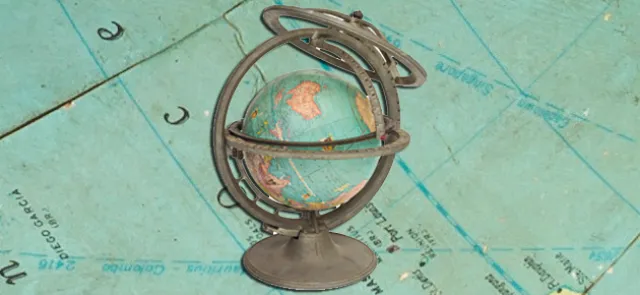
Understanding the shape of the planet we live on, and then depicting it, has been an adventure since the earliest days of antiquity. At every stage, the model has been refined and improved, drawing ever closer to the one we use today: the geoid.
Links and graphs: a two-way connection | Tangente
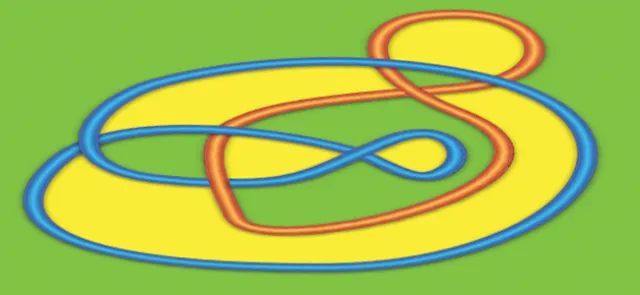
What do links and planar graphs have in common? They are connected by a relationship that associates a graph with any given link and, conversely, provides a simple way to encode—and therefore draw—any link using a graph.

Identifying knots with Gauss codes | Tangente
A visual encoding introduced by Gauss to make knots easier to recognize and manipulate leads to surprising developments in combinatorics, algebra and topology. Armed with paper, pencil and a few pieces of string, let's explore this world.

Classifying knots: topology and invariants | Tangente
Knots can be combined to form new ones—or, conversely, simplified. We can borrow the vocabulary of number theory and classify them rather like the chemical elements. What varied and unexpected facets knot theory has!
École polytechnique’s maths special | Tangente
La Jaune & La Rouge, the monthly magazine of the École polytechnique alumni and graduates association (AX), devotes its February 2023 feature section to mathematics.
Charles V's letter finally deciphered | Tangente
An encrypted letter from Charles V (1500–1558), Holy Roman Emperor, addressed in 1547 to Jean de Saint-Mauris, his ambassador to the king of France, and housed in the autograph collection of the Bibliothèque Stanislas in Nancy (Meurthe-et-Moselle), has just been not merely read but deciphered. Long passages in the letter are encoded.
AI improves the general algorithm for matrix multiplication
Every science student knows how to multiply two matrices. So why call it an "open problem"?
Sédimath: an initiative for promoting mathematics | Tangente
A new mathematics outreach initiative has just been launched: Sédimath, an online seminar organized by Aurélien Alvarez (ÉNS-Lyon) and Élise Raphael (Université de Genève, Switzerland).
Ada Lovelace honored: pioneer of coding | Tangente
Every year, on the second Tuesday in October, an event celebrates women innovators in computing. In 2022, a postage stamp bearing Ada Lovelace's likeness was issued.
Grenoble math center: local authorities pull out | Tangente
La Grange des Maths is an association founded in 2015 to renovate an old barn in Varces (Isère) and turn it into a place where people can meet and share mathematics.
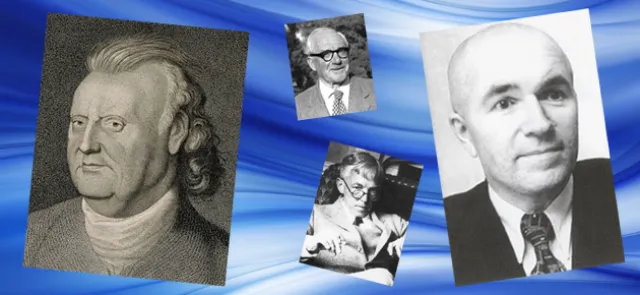
Waring's problem: 250 years of research | Tangente
Since the 18th century, a famous problem—Waring's conjecture—has challenged mathematicians. Every integer N is a sum of at most four squares, or of at most nine cubes. Likewise, given an integer n, can every N be expressed as a sum of at most g(n) nth powers, and if so, what is the smallest possible value of g(n)?

When Euler gets it wrong
Even the greatest mathematicians sometimes make mistakes. It is only human! It even happened to one of mathematics’ legendary figures, the great Leonhard Euler, in connection with sums of powers.
Assigning a value… to a divergent series!
Beyond the "classical" convergence of numerical series, many methods—some particularly powerful—can accelerate the convergence of a series or even assign a value to the "sum of a divergent series." Here are a few notable examples.

The triumphs and tribulations of summing a series
Every convergent series can be assigned a sum—but what about divergent series? Mathematical orthodoxy holds that they cannot be assigned a value. Yet Leibniz and Euler suggested a few possible approaches. Poisson, Frobenius and Borel later crossed that forbidden line.
Converging to a number: is there only one way?
Traditional mathematics provides a precise definition of convergence for a numerical series, explored in the main body of this article. But this should not rule out less conventional approaches, discussed in the box and in several articles in this special issue.
Infinite sums: a matter of convention
Equality between two numbers poses no difficulty when both are defined by "finitary"* methods. But as soon as infinity enters the picture—represented by ellipses in formulas—the door opens to all manner of paradoxes. (* Finitism is an approach to mathematics that considers only finite objects.)
Catalan's problem
In 1844, Franco-Belgian mathematician Eugène Catalan published his famous conjecture in Crelle's Journal.