



Mathematical Themes
Explore the major mathematical themes: geometry, algebra, analysis, arithmetic, logic, and many other fascinating fields.

Plane coloring and the minimum chromatic number | Tangente
In 1950, American mathematician Edward Nelson (1932–2014) proposed an entertaining coloring problem.

The moving sofa problem
Moving house always brings a host of problems... including mathematical puzzles! One of them was formalized by Leo Moser in 1966.

Matrimonial mathematics
Sets of points can give rise to some delightful optimization problems.

Word histories: maximum, minimum and Latin | Tangente
"Optimum," "maximum," "minimum," "extremum": Latin vocabulary has certainly been plundered for terms denoting the extreme values of a function.

Brachistochrone:
Is the shortest path always the fastest? Mathematicians have known since the 17th century that it is not. Skateboarders, too, have learned this through experience, ever since the profiles of their half-pipes began to follow the shape of a "brachistochrone" curve.

The art of avoiding crossings
Artists using mathematics: nothing new there. But artists posing optimization problems that mathematicians still cannot solve: now that is surprising! One seemingly innocuous conjecture about drawing graphs has resisted all attempts at proof for fifty years.

Graph vertex degree constraints | Tangente
What is the smallest graph with a given set of degrees? Forty years ago, an article provided an elegant, constructive answer to this question.

Randomness to the rescue of satisfiability
The Boolean universe is a small mathematical world in which only two values exist: True and False. Yet achieving satisfaction is already complicated! Fortunately, randomness comes to our rescue: choosing by a coin toss can sometimes bring us surprisingly close to the maximum we seek.
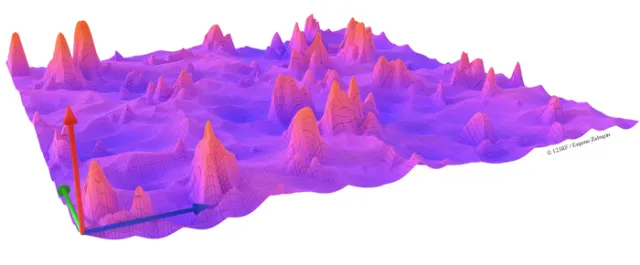
Hills and valleys
A real-life situation or a physics experiment generally depends on several parameters, not just one. We therefore need a deeper understanding of variation in this multidimensional setting. Partial derivatives provide just that.
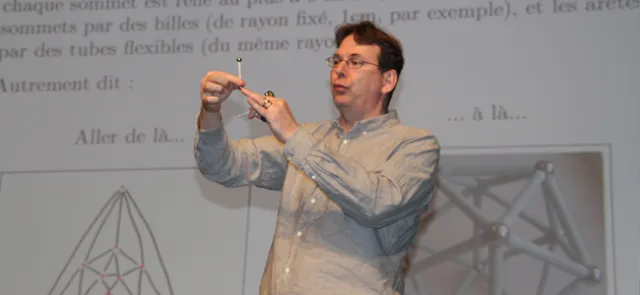
Expander graphs
Combinatorial graphs are among the most intuitive and universal concepts in mathematics and computer science. Graphs crop up everywhere, modeling all kinds of relationships between a wide variety of objects.
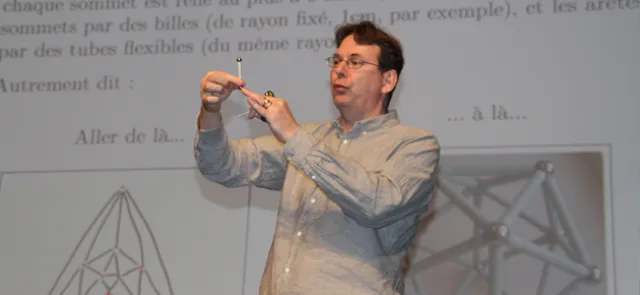
Expander graphs – Network theory | Tangente
The notion of a combinatorial graph is one of the most intuitive and universal in mathematics and computer science. Graphs crop up everywhere, modelling an extraordinarily wide range of relationships between all kinds of objects.

Kurt Hensel, father of p-adic numbers | Tangente
Kurt Hensel is best known for his work on p-adic numbers.

Kurt Hensel, the father of p-adic numbers
Kurt Hensel is best known for his research on p-adic numbers.

Editorial
The scientific committee that coordinated this issue consists of Christian Artigues, Nadia Brauner Vettier, François Clautiaux and Pierre Fouilhoux.

Patrick Dehornoy: a tribute to the mathematician | Tangente
The specialist in ordered braids also made numerous videos popularizing mathematics.

Christian Mauduit, number theorist, has died | Tangente
The number theorist was an expert on representing integers in different bases.

Number theorist Christian Mauduit has died
The number theorist was an expert on representing integers in different bases.

42 as a sum of three cubes: the conjecture | Tangente
The last integer below 100 to withstand number theorists' onslaught has finally surrendered!

42 can finally be written as a sum of three cubes
The last integer below 100 still resisting number theorists’ efforts has finally surrendered!

Reuleaux: a triangle that rolls – Curves | Tangente
A circular roller may always seem ideal for moving an object. Yet this is not so: a kind of equilateral triangle with rounded sides is actually better suited to certain everyday situations.