



Les origines des pliages à plis courbes
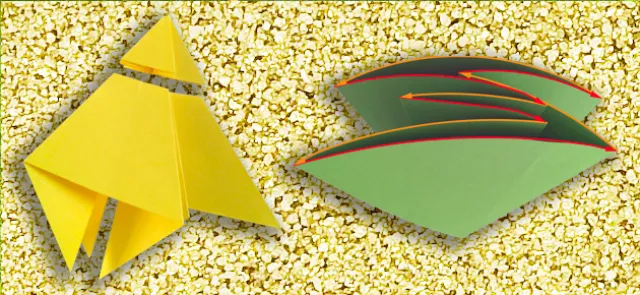
Ces œuvres reposent souvent sur des plis droits bien traditionnels. Mais d’autres artistes se sont lancés dans la réalisation d’étonnants plis courbes. On en trouve des traces à la fin des années 1920 parmi les travaux d’un étudiant de Josef Albers (1888—1976), peintre et enseignant au Bauhaus, la fameuse école d’architecture de Weimar à l’origine de tout un courant artistique traversant plusieurs champs disciplinaires. L’objet produit est constitué d’un disque à l’intérieur duquel les plis ont des formes circulaires concentriques alternant les plis montagne et vallée. Une fois plié, le modèle prend naturellement une forme de selle. L’idée a été reprise ensuite à maintes reprises au fil des années, notamment en évidant le disque initial, formant ainsi un anneau plissé prenant des formes élégantes.
Le Museum of Modern Art (New York) a ainsi exposé une sculpture d’Irene Schawinsky (1903—1990) dans les années 1940 et le maître japonais Kunihiko Kasahara (né en 1941) a publié au début des années 2000 un ouvrage baptisé Extreme Origami qui reprend aussi cette idée.
Entre science et artisanat
David Albert Huffman (1925—1999) est surtout connu pour ses travaux en informatique. On lui doit notamment la création des codes de Huffman, utilisés quotidiennement aujourd’hui et permettant de compresser des données sans pertes. L’idée s’appuie sur la construction d’un arbre dans lequel apparaissent, par exemple, tous les caractères utilisés dans un texte en leur affectant un certain poids en fonction de leur fréquence d’apparition. Chaque nœud de l’arbre code alors un caractère, la longueur de ce code étant d’autant plus courte que le caractère est fréquent.