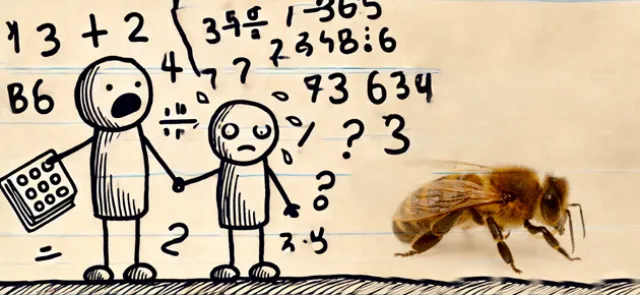




Les mathématiques sont certainement l’un des exemples les plus frappants de la discontinuité cognitive entre les humains et les autres animaux. En effet, qu’il y a-t-il de plus abstrait que la manipulation de symboles mathématiques ? Cependant, les capacités de raisonnement mathématique, bien qu’elles s’acquièrent au travers de l’éducation par transmission culturelle, reposent néanmoins sur un ensemble de compétences mathématiques préscolaires d’origine biologique, partagées entre autres par les primates non humains. En effet, les chimpanzés peuvent dénombrer et ordonner de petites quantités, résoudre des problèmes arithmétiques simples sur la base d’additions et de soustractions et associer des symboles tels que les chiffres arabes à des quantités. Ces facultés pourraient donc être considérées comme les racines biologiques de nos mathématiques.
Étant donné la grande valeur adaptative d’une capacité à dénombrer dans des situations aussi diverses que pour choisir une quantité de nourriture, évaluer les rapports de forces entre groupes sociaux selon leur taille ou encore aider à se repérer dans l’environnement ou à reconnaître des objets, il n’est peut-être pas surprenant de retrouver cette capacité chez de nombreuses espèces de vertébrés, des poissons aux mammifères en passant par les oiseaux. Seuls les reptiles en semblent dépourvus. Il est vrai qu’en proportion de leur taille, leur cerveau est plutôt petit mais il faut reconnaître qu’il n’est pas évident pour les chercheurs de motiver un serpent ou un crocodile à lui montrer ses capacités intellectuelles ! Par contre, apprendre que même des insectes peuvent évaluer des quantités surprendra peut-être plus, ne serait-ce que de par leur cerveau miniature (eh oui, les insectes ont bien un cerveau !) mais aussi, bien sûr, par leur distance évolutive à l’humain. Or certaines espèces de fourmis peuvent compter leur nombre de pas pour évaluer les distances ou se baser sur un nombre de repères visuels ; elles se montrent aussi plus agressives si elles sont dans un groupe de taille plus importante en cas de conflit. Les vers de farine sont attirés par un substrat avec l’odeur d’un plus grand nombre de femelles, les bourdons peuvent évaluer un niveau de compétition suivant le nombre d’autres bourdons visitant une source de nourriture ou les grillons plus facilement s’enfuir vers une zone avec le plus grand nombre d’abris potentiels. Au-delà des insectes, des araignées sont aussi capables de mémoriser le nombre de proies prises dans leur toile ou les seiches choisir de chasser le banc avec le plus grand nombre de crevettes.
L’intérêt d’étudier les abeilles
Mais est-ce que ces exemples sont vraiment des preuves d’un « sens du nombre », c’est-à-dire la capacité à reconnaître une quantité précise d’objets et ce, indépendamment d’autres paramètres physiques qui sont liés aux quantités comme la densité, la surface cumulée ou la quantité de mouvement ? Pour vérifier l’existence d’un réel sens abstrait du nombre, tel que le nôtre, il est nécessaire de passer par des procédures expérimentales contrôlées. Les capacités des abeilles ont ainsi été particulièrement étudiées ces dernières années. Pourquoi les abeilles ? Pour trois raisons principales.
Premièrement, le comportement de butinage des abeilles requiert de bonnes capacités d’apprentissage, ce qui en fait un modèle idéal pour étudier toutes formes d’intelligence. En effet, les abeilles doivent être capables d’apprendre à reconnaître les fleurs d’intérêt parmi toutes les options disponibles, de mémoriser l'endroit où les retrouver et le moment de la journée où elles fournissent du nectar, mais aussi de se repérer dans l’environnement car retrouver sa ruche, située souvent à plusieurs kilomètres des fleurs exploitées, revient à trouver une aiguille dans une botte de foin !