This ambitious encyclopedia demonstrates this especially well. It covers twelve-tone technique, serialism and its combinatorics, the growing importance of structures, the rise of spectral music made possible by technological advances, the advent of chance, and the use of computers. Yet the gradual breakdown of music into abstract parameters (rhythm, pitch, intensity, melody, timbre, notation systems, harmony, tonality, temporality, duration, sound effects, tempo scales across different instruments...) opened up new horizons. Mathematical methods were sometimes enlisted, going beyond elementary arithmetic, semantic coding, graphical representations, symmetries and transformations.
A certain obsession with number or space led Ivan Wyschnegradsky to ultrachromaticism, John Cage to his square-root method, and Dennis Gabor to granular sound synthesis. Milton Babbitt and Allen Forte revisited set theory. Lejaren Hiller used Markov chains.
Armando Gentilucci drew on linear algebra and matrices. A stochastic school of composition emerged in France. Electroacoustic music gives pride of place to harmonic analysis, algorithms, Fourier theory (filtering, modulation and convolution), signal theory and information theory (modular synthesis, musical sampling...). The theorist
Ian Quinn draws on fuzzy set theory in his analyses of a work by Steve Reich.
The book explores the search for "universal laws" of composition through a wealth of examples in some seventy fascinating, meticulously written chapters.
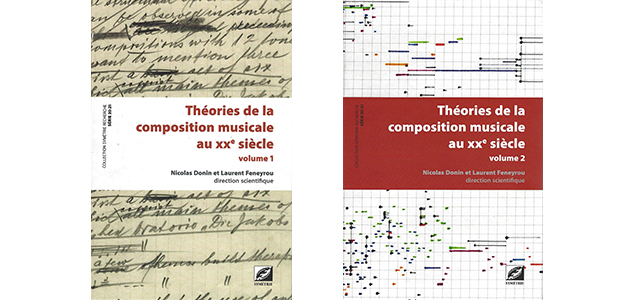
Théories de la composition musicale au XXe siècle (Theories of Musical Composition in the Twentieth Century). Edited collection by Nicolas Donin and Laurent Feneyrou, Symétrie, 1,830 pages, 2013, 220 euros (volume I), 190 euros (volume II).