You've probably thrown a pétanque ball before. Most of the time, its trajectory is quite close to a parabola. If we neglect drag and assume a uniform gravitational field, the coordinates of a projectile launched at initial speed v0 and angle α satisfy z = (tan α) x – g2 v02 cos2(α) x2. This elegant formula applies equally to cannonballs or, more peacefully, fireworks and fountain jets. It follows that the projectile's range is v02 g sin(2α), and is therefore greatest at a launch angle of 45°. Its maximum height is v02 2g sin2(α). More interesting still, all these parabolas are bounded by another curve, the safety parabola, whose equation is z = v02 2g – 2gv02 x2, and whose focus is none other than the launch point. In three dimensions, of course, this becomes a safety paraboloid. In the real world, air resistance is not always as negligible as we might wish. The resulting curves are then "damped parabolas"—which are not actually parabolas at all, but transcendental curves.
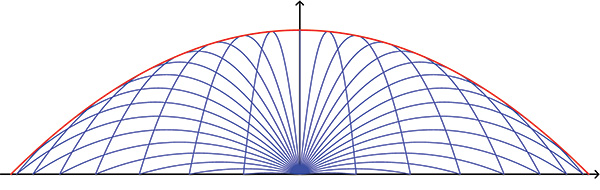
All trajectories with the same initial speed (in the absence of drag) lie below the parabola of safety.
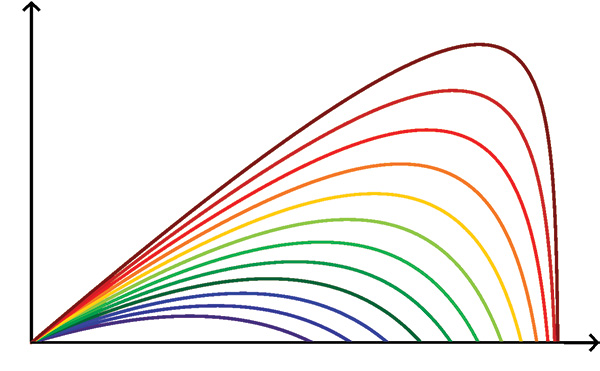
Various damped parabolas with different drag coefficients.
A liquid mirror!
-------------------
Place a liquid in a cylinder resting on its base. Then spin the cylinder about its axis at a constant angular velocity and watch: the liquid takes the shape of a paraboloid! The effect persists regardless of the shape of the base. Spinning a reflective liquid such as mercury produces a perfect parabolic mirror, making it possible to build an inexpensive telescope. Isaac Newton (1643–1727) is said to have considered the idea in his day, as did Ernesto Capocci (1798–1864) in 1856, but it took several centuries for the technology to become operational. Since then, mirrors more than 3 meters in diameter have been built. The largest, decommissioned in 2016, measured 6 meters in diameter (with an angular velocity of 8.5 revolutions per minute) and was installed 70 km from Vancouver.
An architectural asset
----------------------
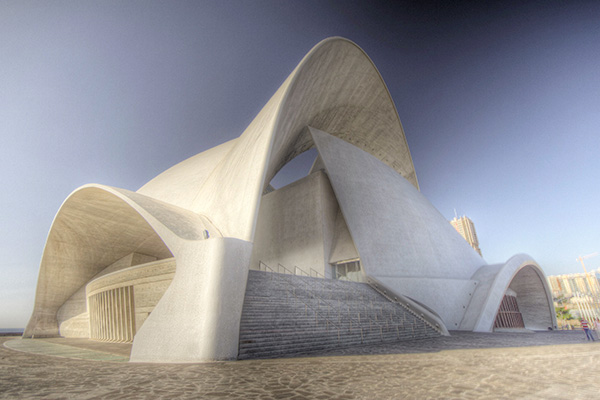
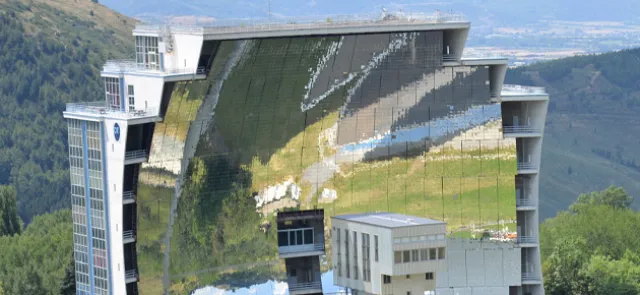
For architects, the parabola is far more than an abstract curve: it is a source of inspiration, a material with which to play, poised between balance and light. Oscar Niemeyer (1907–2012), for example, said that in the early 1940s he sought to "tropicalize" Le Corbusier's style with his church in Belo Horizonte, Brazil. His Mexican contemporary Félix Candela (1910–1997) made the parabola his signature. Santiago Calatrava Valls (born 1951) took up the torch, making extensive use of the parabola as a visual emblem. From one architect to the next, the parabola bridges geometric rigor and poetic potential.