All triangles are isosceles!
----------------------------------
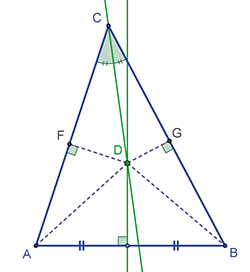
Yes, you read that correctly: all triangles are isosceles! In fact, when you think about it, they are even all equilateral… Why is this result kept from us throughout our school years, when it would make so many exercises much easier? Such a claim cannot be accepted without proof, however. Here it is.
There is nothing devious about the argument. Let D be the intersection of the perpendicular bisector of [AB] and the angle bisector. \raisebox{10pt}{\widehat\mathrm{C}.} "\"\" Let F and G be the points on [AC] and [BC] such that triangles CDF and CDG are right-angled at F and G.
Since D lies on the angle bisector of \widehat\mathrm{C} "\widehat\mathrm{C}", angles \widehat\mathrm{GCD} "\widehat{GCD}" and \widehat\mathrm{DCF} "\widehat\mathrm{DCF}" are equal, and so are angles \widehat\mathrm{GDC} "\widehat\mathrm{DCF}" and \widehat\mathrm{CDF} "\widehat\mathrm{CDF}". Thus, the right triangles CDF and CDG have the same angles and the same hypotenuse, so CG = CF.
Let us continue: in the same way, we also have DF = DG. Moreover, DA = DB because D lies on the perpendicular bisector of [AB]. Considering the right triangles DFA and DGB, we deduce that GB = FA.
The hard part is over! Since CG = CF and GB = FA, we have CB = CG + GB = CF + FA = CA. Triangle ABC is indeed isosceles at C.
The same argument applies at A or B: ABC is equilateral! So where is the trick? Try drawing the figure yourself and see where the intersection of the perpendicular bisector of a side and the angle bisector of the opposite angle lies…
A dishonest induction argument
------------------------