Groups abound in Tangente!
------------------------------------------
To see that groups are among the most fascinating objects in mathematics, you need look no further than the Tangente Library collection!
*Issue 35, Les Transformations, de la géométrie à l’art (Transformations: From Geometry to Art, 2009), uses numerous examples to illustrate just how ubiquitous groups are in geometry: behind every symmetry lies a group, and this issue has hunted them down for you! The same goes for issue 47, La Magie des invariants mathématiques (The Magic of Mathematical Invariants, 2013), and issue 64, Découpages et Pavages (Dissections and Tilings, 2018).*
Are calculations more your thing? Les équations algébriques (Algebraic Equations)*, issue 22 (2012), is for you! But if a more formal, abstract or axiomatic approach appeals to you, make a beeline for Les Démonstrations (Proofs, 2015) and Les Ensembles (Sets, 2017), issues 55 and 61 in the collection, and continue your journey.*
Finally, if cryptography mesmerizes you, perhaps issue 26, Cryptographie et Codes secrets (Cryptography and Secret Codes) (2006), will cast its spell on you too…
Going further: two issues of Tangente SUP
---------------------------------------------------
For fifteen years, from 1999 to 2014, the magazine *Tangente SUP delighted readers eager to go "further" into the topics covered in the pages of Tangente*.
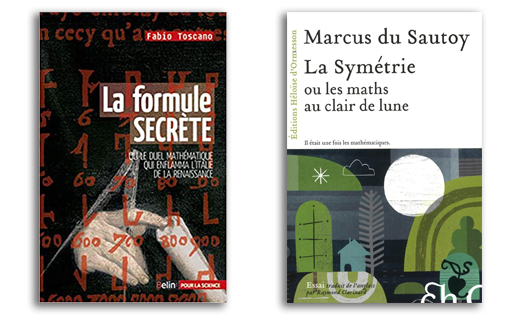
The double issues in particular, now much sought after, offered ample fare for the most insatiable appetites. One of them is devoted specifically to groups (Tangente SUP 57–58, 2010). Alongside further material on transformation groups and the group law on a cubic curve, it includes an in-depth article on a profound subject: Lie theory applied to ordinary differential equations (ODEs). In a sense, this is the counterpart for ODEs of Galois theory for polynomial equations.
But the best-known issue is undoubtedly Tangente SUP 60 (2011). Over its forty-eight pages, it delves into the inner workings of Galois theory using Évariste Galois's own vocabulary, knowledge and words. Coordinated by Gérard Cohen-Zardi, the feature "Galois… by Galois" invites readers to follow, line by line and word for word, the last letter written by the young mathematician who would die in a duel the following day—and to carry out every calculation and fill every gap that Galois had "no time" to set down on paper.
These issues can still be ordered today (from the Librairie INFINI*MATH website)*
Two books everyone should read
---------------------------------------------
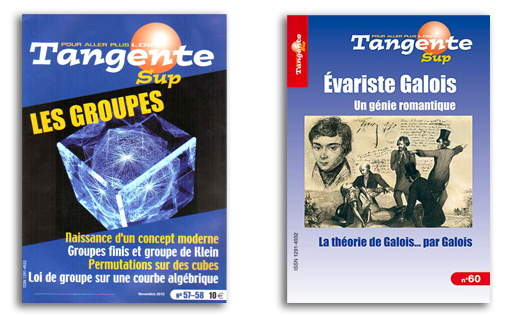
There is no shortage of excellent popular mathematics books, and group theory is no exception. For readers interested in the centuries-long quest to determine whether polynomial equations can be solved—a quest that reached its climax in Renaissance Italy—one book is indispensable: *La Formule secrète, ou le duel mathématique qui enflamma l’Italie de la Renaissance* (The Secret Formula, or the Mathematical Duel That Set Renaissance Italy Ablaze; Belin–Pour la science, 2011). It is a sweeping, gripping investigation by Fabio Toscano, based on the many documents from the period that have come down to us!
Finally, if you would like a deeper journey through the world of groups, Marcus du Sautoy (*La Symétrie ou les maths au clair de lune* (Symmetry, or Maths by Moonlight), Héloïse d’Ormesson, 2012) offers an engaging, highly readable, novelistic account of the mathematical landscapes—often related to symmetry—that you may have encountered while reading this special issue. The early stages of the classification of finite simple groups, culminating in the discovery of the Monster, make for particularly memorable chapters, especially as the author recounts the lives of all the major figures involved at each stage of this wonderful journey.