The founders' group
-------------------------
Following Gauss's work on quadratic forms, which introduced the notion of a binary operation, the subject truly began with the solution of polynomial equations, that is, equations of the form P(X) = 0 (where P is a polynomial). Why are some equations of this kind solvable by radicals while others are not? The aim is to express the solutions of the polynomial equation P(X) = 0 in terms of the coefficients of P, using only the four elementary operations and root extraction. Just as the solutions of the quadratic equation aX2 + bX + c = 0 can be expressed in terms of a, b and c using the four elementary operations and square roots, Italian mathematicians found methods for polynomials of degrees 3 and 4 in the 16th century. Joseph-Louis Lagrange, who took an interest in this question, sought to understand why generalizations of these methods seemed unavailable for higher degrees. The Norwegian mathematician Niels Abel pursued this line of inquiry and provided the answer for degree 5.
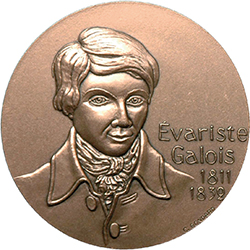
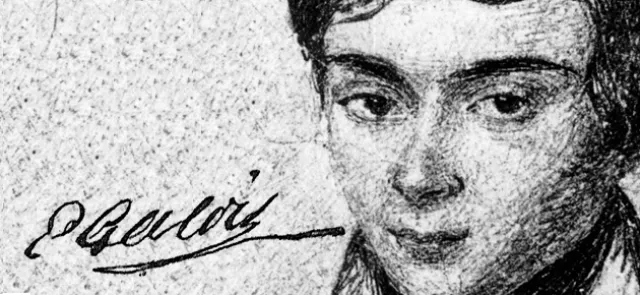
Yet it was Évariste Galois who provided the complete explanation in remarkable work that went unrecognized during his lifetime: the equation is solvable by radicals if a group associated with the equation has a particular property.