In the wider family of flexagons, tetraflexagons, square in shape, are less well known. On one hand they were studied after hexaflexagons by the flexagon committee (see the article "The Little History of Flexagons") and in particular by John Tukey; on the other hand, a number of them had already been discovered decades earlier. But Tukey did not manage to establish a general theory of tetraflexagons, as had been done for hexaflexagons.
These square flexagons still resist mathematicians. For instance, no one can say how many tetraflexagons exist for a given number of stable positions. Moreover, their dynamic behavior is sometimes quite complex and can seem erratic compared with the fairly tame cycles of hexaflexagons.
The incomplete cycle
----------------------
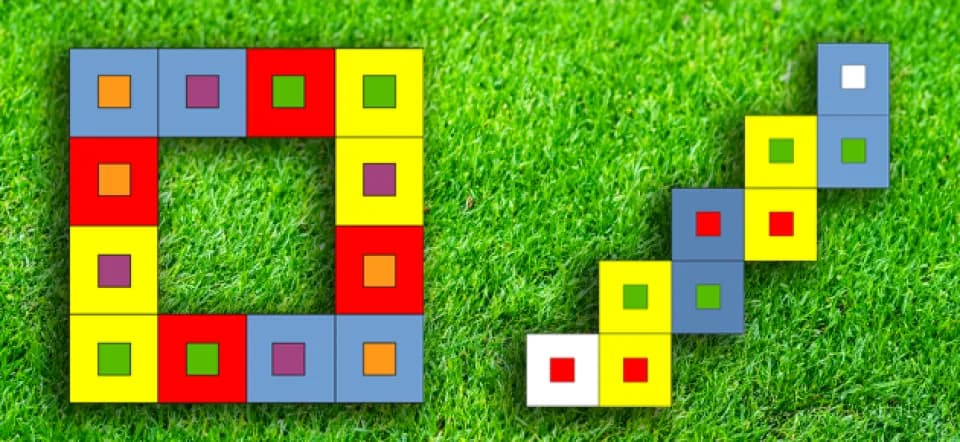
The simplest tetraflexagon is the tritetraflexagon with 2 stable positions and 3 colors. Readers are strongly encouraged to try building one before reading on (see the box).