-
In the Euclidean plane with a coordinate system, let (C) be a curve with equation f (x) = 0, and let M0 and M be two points on the curve, with respective x-coordinates x0 and x. The slope of the secant line (M0M) is given by the difference quotient between M0 and M: it is equal to .
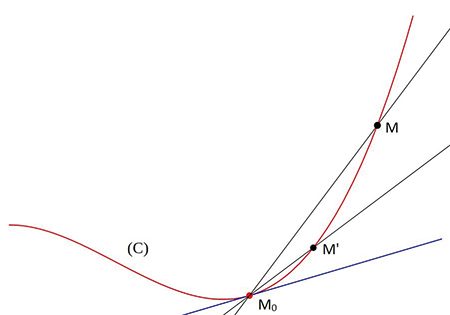
As M approaches M0, the secant line (M0M) generally tends toward the tangent line to (C) at M0 (shown in blue on the graph). Even without defining this limit precisely, we can see from the graph that the line (M0M') is "closer" to the tangent at M0 than the line (M0M), because M' is "closer" to M0 than M is. Special cases can arise at points where there is no tangent, or for particularly "pathological" curves.
The slope of the tangent is generally the limit of the slope of the line (M0M)—that is, the limit of the difference quotient between M0 and M as M approaches M0, or equivalently as x approaches x0. This limit is the derivative of f at x0: