The Turkish language
----------------
Until 1918, the adjective "Turkish" was applied to all the peoples from Anatolia to Central Asia who shared one feature: they spoke a language belonging to the family of… Turkic languages. Mustafa Kemal (1881–1938) named the state he built on the remnants of the Ottoman Empire "Turkey"; he promoted the language spoken in Anatolia as its official language, and this is what we now call Turkish. To signal his desire to embrace modernity, and therefore the West, he imposed the Latin alphabet. The vowel system plays a fundamental role in Turkish, whereas the Arabic alphabet does not indicate short vowels.
Vowel harmony
--------------------
Turkish has eight vowels: a, e, i, ı, o, ö, u and ü. To pronounce ı (the dotless i), position your lips as for "ee", but move the articulation farther back, as if pronouncing "oo". The other vowels will sound familiar to anyone who knows German.
| Vowel | a | e | i | ı | o | ö | u | ü |
|---|---|---|---|---|---|---|---|---|
| Pronunciation | a | è | i | between i and oo | o | ö | oo | ü |
Each vowel is characterized by three features, so the vowels can be placed on a cube:
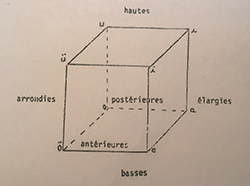
• backness, or tongue position, in the mouth: the tongue is positioned farther back when producing a, u and o—hence their name, back vowels—than when producing e, i, ö and ü (front vowels). Başı bozuk (ş is pronounced sh) means "bad head" and was the name given to troops made up of former convicts; it contains all four back vowels;
• height, according to whether the tongue is lowered (a, e, o, ö) or raised toward the palate (u, ö, i, ı);
• lip rounding, depending on whether the lips are spread (a, e, i) or rounded (u, ö, u, ü).
Turkish follows several rules of vowel harmony: each syllable contains exactly one vowel; all the vowels in a word have the same backness; low rounded vowels (o, ö) occur only in the first syllable; and if a syllable contains a high vowel (u, ü, i, ı), its lip rounding is the same as that of the vowel in the preceding syllable. Exceptions do exist, especially in words borrowed from other languages (such as kuaför and şoför…), but they are rare.
Geometric projections for conjugation and declension
-------------------------------------------------------
Turkish is an agglutinative language: most grammatical information is conveyed by suffixes, sometimes as many as five or six in succession. The plural, for example, is marked by the suffix lar or ler. To choose between them, take the word's final vowel and project it onto the line (a e) on the cube. Thus, the plural of yol ("the road") is yollar, whereas köprü ("the room") gives köprüler. The locative—the case used to indicate location—is marked by da or de, following the same rules; oda means "the room", while odada means "in the room". This even applies to numbers: given that yedi, on and yüz mean 7, 10 and 100 respectively, 7/10 is onda yedi ("in ten, seven"), and 7/100 is yüzde yedi.
To indicate possession (the genitive familiar to Latinists and Germanists), the suffix un, ün, in or ın is added; the choice is made by projecting the final vowel onto the plane of the high vowels. An n is inserted if the word ends in a vowel. The genitive of yol is therefore yolun, whereas that of oda is odanın; the genitive of yollar, meanwhile, is yolların, obtained through two successive projections.
A suffix attached to an adjective takes the place of the verb "to be". Thus, büyük means "tall"; "I am tall" and "he is tall" are expressed as büyüküm and büyüktür, respectively—as though the adjective büyük were being conjugated! Similarly, güzel means "beautiful", while güzelim and güzeldir mean "I am beautiful" and "he is beautiful": once again, the vowel is projected onto the face of the high vowels!
Possession, too, is expressed by a suffix. For the third person, u, ü, i or ı is added, with an intervening s if the word ends in a vowel. Thus, in Istanbul you will find Mustafa Kemal köprüsü (literally, "Mustafa Kemal, his bridge"). As for the real name of Turkish Airlines, it is Türkiye Hava Yolları (THY), meaning "Turkey, the sky, its roads".