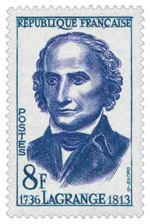
On 11 Pluviôse, Year III (30 January 1795), Joseph-Louis de Lagrange (1736–1813) opened his course for students at the École normale, established three months earlier by decree of the Convention, with these words: "Today is devoted to a lecture on arithmetic."
Addressing an audience drawn from the elite ranks of the fledgling Republic's future educators, Lagrange began by explaining the advantages of the decimal system. But prime numbers caught his attention along the way, and he cited a theorem which, he said, "is of no use in the search for prime numbers, but is highly remarkable for its simplicity and generality".
Here is how he presented it: "If a number is prime, such as 5, the product of all the smaller numbers, 2, 3 and 4, plus one, will be divisible by 5. If the number in question is 7, we multiply 2 by 3 by 4 by 5 by 6, which gives 720; adding one gives 721, which is divisible by 7. Take 11 as another example: 2 by 3 by 4 by 5 by 6 by 7 by 8 by 9 by 10 equals 3,268,800; adding one gives 3,628,801, which is divisible by 11, the quotient being 329,891.
This theorem is one of the finest yet discovered; it is especially remarkable because it always holds when the number in question is prime and does not hold when the number is not prime, as is easy to verify." (Mathématiques et Mathématiciens, Pierre Dedron and Jean Itard, Magnard, 1959).