In the 17th century, Pierre de Fermat introduced the method of "infinite descent," a particularly ill-chosen name since the "descent" is, in fact, finite. Mathematical induction, by contrast, might be described as an "ascent to infinity" (see In Brief, "Pierre de Fermat, a famous contemporary"). Around the same time, Pascal devised a remarkable and closely related tool. Strangely, he would use it only rarely in his mathematical writings, often preferring to prove results "by example" and seeing no need to spell out the ascent to infinity. Was this lack of rigor peculiar to Pascal? No: in the 17th and 18th centuries, mathematicians often settled for "proof by example" when intuition allowed, as though there were "clear and distinct ideas" (as Descartes put it) that need not be analyzed any further than necessary, but merely conveyed to readers. The 19th century would expose the limitations of these practices and bring far greater rigor to mathematics.
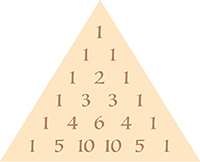
Pascal's triangle (see the article "Properties of the arithmetic triangle").
The cells forming the two sides of the triangle that meet at its vertex contain only the digit 1. The integer appearing in any cell
(6, for example) is the sum of the integers in the two cells above it (3 + 3). The number in "column" p (an oblique column containing one element from each row, numbered from 0) and row n (with the rows numbered from 0) gives the number of possible combinations of p elements from a set of n elements and is therefore also denoted , namely
The origins of mathematical induction
---------------------------------------