



Hervé Lehning
90 articles published in Tangente
 Math for everyoneN°61Sep 30, 2016
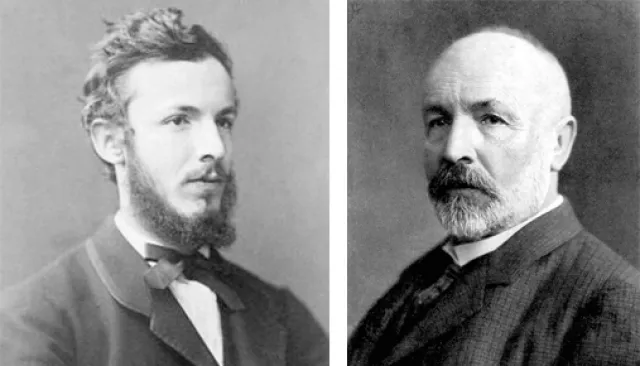
Georg Cantor: from finite to infinite
To extend useful results about finite sets to infinite sets, Cantor defined equality of cardinalities in terms of bijections, and hence inequality in terms of injections and surjections. Remarkably, this yields an order relation.
Read →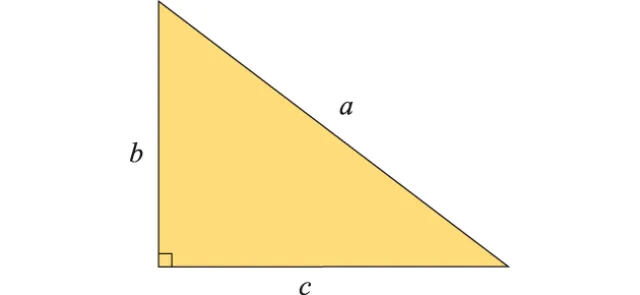 Math for everyoneN°172Sep 15, 2016
Pythagorean triples
In a right triangle, the square of the hypotenuse equals the sum of the squares of the two sides forming the right angle. When three integers satisfy this relation, they are called a Pythagorean triple. What are these numbers, and how can they be characterized?
Read →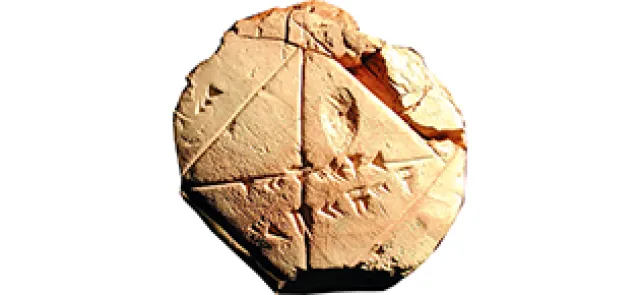 History and CultureN°172Sep 15, 2016
Proofs of the Pythagorean theorem through the ages
The Pythagorean theorem began as a result about squares constructed on the sides of a right triangle. Those geometric squares later became arithmetic squares, before the theorem ventured into abstract spaces. Would Pythagoras recognize his theorem if he came back to life today?
Read → Math for everyoneN°172Sep 13, 2016
The pitfalls of rates
Our thinking seems naturally additive. If we add 10% and then another 10%, we expect the total to be 20%. Yet that is wrong! Rates are not added; they are multiplied. How can we avoid the pitfalls of percentages? How can we work out the cost of a loan?
Read →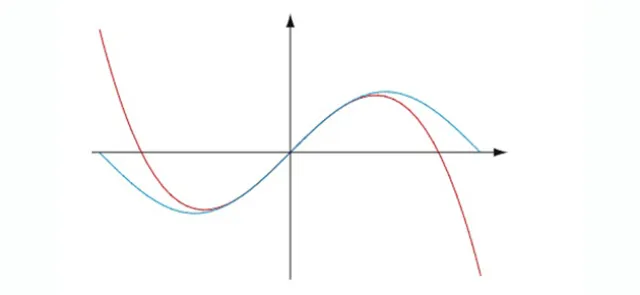 Math for everyoneN°171Jul 29, 2016
Approximating a function and following its curve
Assuming that a function is a polynomial yields useful approximation formulas. A complicated function can thus be replaced by a polynomial, simplifying most calculations. More surprisingly, interpolation lies at the heart of a secret-sharing technique.
Read → Math for everyoneN°171Jul 07, 2016
Between algebra and analysis: an indispensable world
Polynomials belong to both algebra and analysis, which can lead to all kinds of confusion! This dual nature offers a simple way to explain the subtle differences between variables, unknowns and indeterminates.
Read → Math for everyoneN°171Jul 07, 2016
The inexhaustible prime number theorem
Prime numbers are an endless source of mathematical surprises: they are infinite in number yet rare, and attempts to count them bring transcendental functions into play, such as the Riemann zeta function, which at first glance seem far removed from arithmetic.
Read → Math for everyoneN°170May 06, 2016
Division algorithms
From the abacus to the counting frame, what a long way we have come to reach our present-day algorithm, so well known to schoolchildren.
Read → Math for everyoneN°59Apr 25, 2016
Drawing a line on a computer
What could be simpler than drawing a line between two points? All you need is a ruler and a pencil! But how do you do it on a computer screen? How does graphics software manage it? The task is to turn certain points on the screen black. But which ones?
Read → Math for everyoneN°59Apr 25, 2016
Surfaces… made of straight lines!
A plane is generated by straight lines, and one might think it is the only surface that can be constructed in this way. But that is not so! Surfaces generated by straight lines even have a name: ruled surfaces.
Read →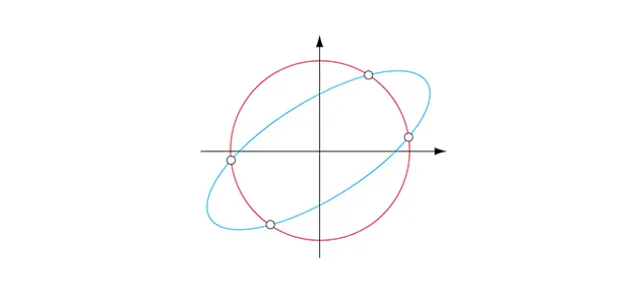 Math for everyoneN°169Mar 14, 2016
From Bézout's theorem for polynomials to the intersection of conics
Étienne Bézout is known for two theorems. One generalizes Bachet's theorem from integers to polynomials; the other concerns the intersection points of algebraic curves. The two are in fact related, but in a subtle way.
Read → KnowledgeN°58Feb 23, 2016
Connected health devices
Connected devices that monitor our health and allow doctors to intervene before an illness even develops seem to be the future of medicine. Yet they raise serious security concerns: via smartphones, they communicate over the Internet, a realm where hackers thrive…
Read →