



History and Culture
History of mathematics and cultural connections
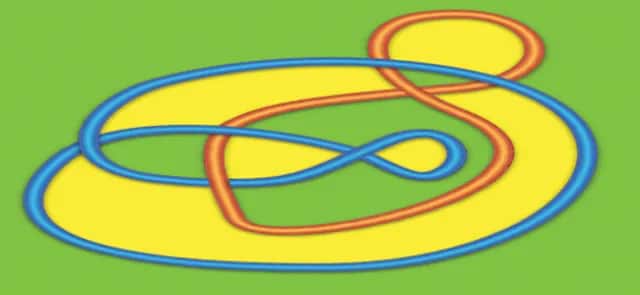
Links and graphs: a two-way connection | Tangente
What do links and planar graphs have in common? They are connected by a relationship that associates a graph with any given link and, conversely, provides a simple way to encode—and therefore draw—any link using a graph.
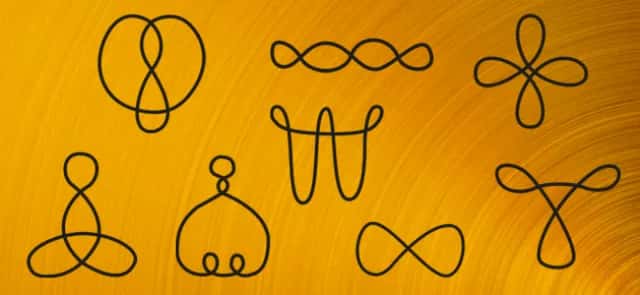
Identifying knots with Gauss codes | Tangente
A visual encoding introduced by Gauss to make knots easier to recognize and manipulate leads to surprising developments in combinatorics, algebra and topology. Armed with paper, pencil and a few pieces of string, let's explore this world.
Ada Lovelace honored: pioneer of coding | Tangente
Every year, on the second Tuesday in October, an event celebrates women innovators in computing. In 2022, a postage stamp bearing Ada Lovelace's likeness was issued.
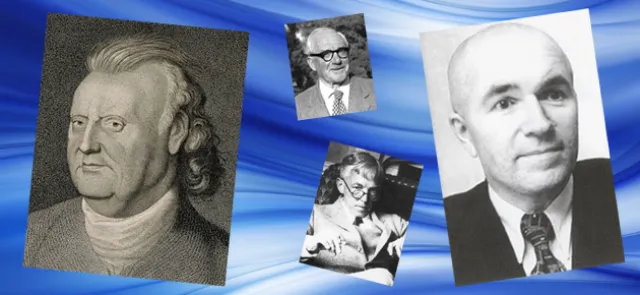
Waring's problem: 250 years of research | Tangente
Since the 18th century, a famous problem—Waring's conjecture—has challenged mathematicians. Every integer N is a sum of at most four squares, or of at most nine cubes. Likewise, given an integer n, can every N be expressed as a sum of at most g(n) nth powers, and if so, what is the smallest possible value of g(n)?
When Euler gets it wrong
Even the greatest mathematicians sometimes make mistakes. It is only human! It even happened to one of mathematics’ legendary figures, the great Leonhard Euler, in connection with sums of powers.
Assigning a value… to a divergent series!
Beyond the "classical" convergence of numerical series, many methods—some particularly powerful—can accelerate the convergence of a series or even assign a value to the "sum of a divergent series." Here are a few notable examples.

The triumphs and tribulations of summing a series
Every convergent series can be assigned a sum—but what about divergent series? Mathematical orthodoxy holds that they cannot be assigned a value. Yet Leibniz and Euler suggested a few possible approaches. Poisson, Frobenius and Borel later crossed that forbidden line.
Infinite sums: a matter of convention
Equality between two numbers poses no difficulty when both are defined by "finitary"* methods. But as soon as infinity enters the picture—represented by ellipses in formulas—the door opens to all manner of paradoxes. (* Finitism is an approach to mathematics that considers only finite objects.)
Catalan's problem
In 1844, Franco-Belgian mathematician Eugène Catalan published his famous conjecture in Crelle's Journal.
The famous number 1729: Hardy and Ramanujan | Tangente
The smallest integers that can be written as a sum of two cubes in three different ways, then four different ways, and so on, are often called taxicab numbers.
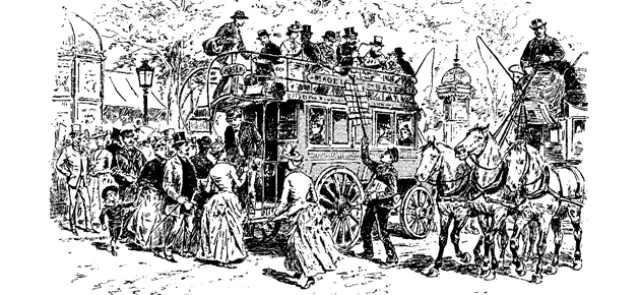
Did Pascal invent public transport? | Tangente
A great many websites hail Pascal as the brilliant inventor of public transport. Is there any basis for this claim? Was Pascal one of the architects of this revolutionary, modern system of travel?
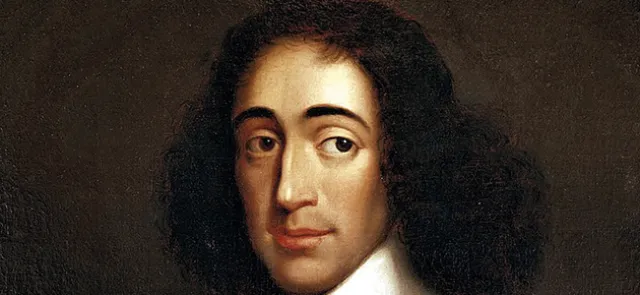
Spinoza and mathematical order in philosophy | Tangente
The Dutch philosopher Baruch Spinoza drew inspiration from mathematicians’ methods of inquiry and exposition in his "search for truth." Otherwise, he maintained, we prove nothing, merely supporting preconceived theses with plausible arguments.
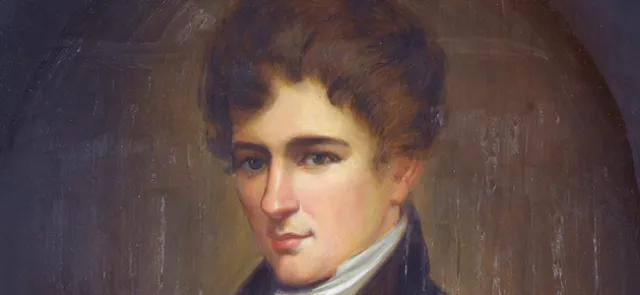
François Plantade: Abel, a mathematical genius | Tangente
For Tangente, François Plantade looks back at the life of Niels Henrik Abel, a 19th-century Norwegian mathematician who remains little known despite his major influence on the mathematics of his day. He died at 26, and his work only began to gain recognition toward the end of his life.
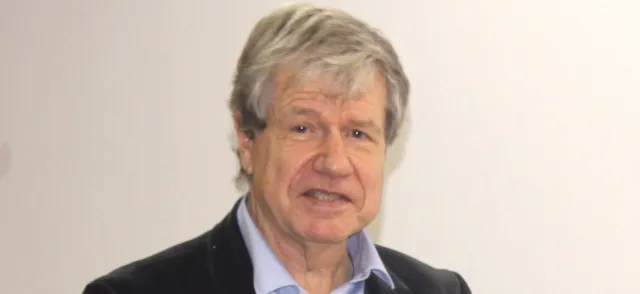
Hervé Lehning, a popularizer of mathematics | Tangente
It is impossible to sum up the scientific and educational work of a man such as our colleague and friend Hervé Lehning. More than a thousand articles bear his name! One way to gain a sense of the man is through his vast body of writing.

Draining the Marais Poitevin in the 17th century | Tangente
Known far beyond France’s borders, the Marais Poitevin has become a haven for many plant and animal species: today, the “Green Venice” covers nearly 100,000 hectares of lush natural landscape! But do you know its history?
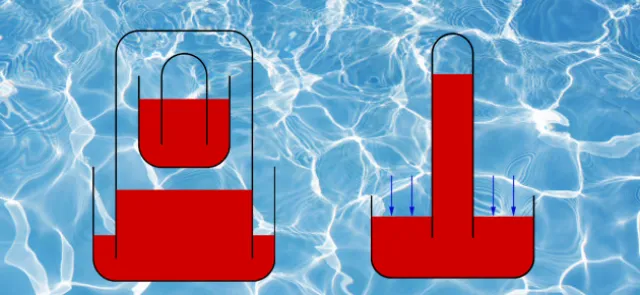
Pascal: The man who wasn't afraid of the void | Tangente
In the 17th century, following the Ancients, it was held that "nature abhors a vacuum." By restoring physical experimentation to the heart of scientific inquiry, French scholars of the period would thoroughly reassess this claim. Pascal would devise an ingenious apparatus for "creating a vacuum."
The fifth operation
Although the four operations—addition, subtraction, multiplication and division—are studied from elementary school onward, students must wait until their third year of secondary school to discover a fifth: raising a number to a power.
The birth of Pascal — Niklaus Wirth | Tangente
The Pascal programming language was specified in 1968 and designed in the 1970s by Niklaus Wirth (born 1934) at the Swiss Federal Institute of Technology (ETH) in Zurich, Switzerland.
A brief history of Grandi's series
Grandi's series is the infinite sum 1 – 1 + 1 – 1 + 1 – 1 + … Mathematicians have studied it for more than three hundred years. Its history can be divided into three stages.
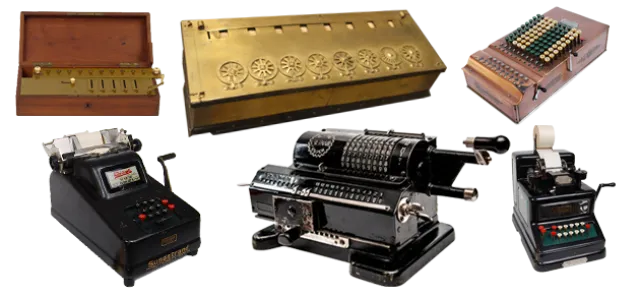
Mechanical secrets of the 1642 Pascaline | Tangente
Electronic calculators, now built into our phones, have made us forget the mechanical marvels that came before them. At just 19, Blaise Pascal developed the first calculating machine and, after a hard struggle to perfect his invention, captivated his contemporaries.