



History and Culture
History of mathematics and cultural connections
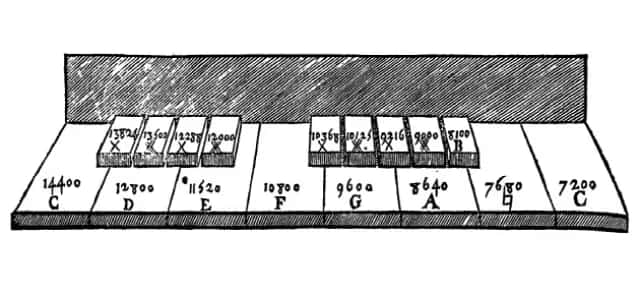
Writing a treatise on sound at the age of 11 | Tangente
The links between music and mathematics are well established. There was a time when it was not unusual for the most learned minds to pursue both with equal delight. Pascal, too, is said to have explored questions relating to sound, further evidence of his astonishing precocity.
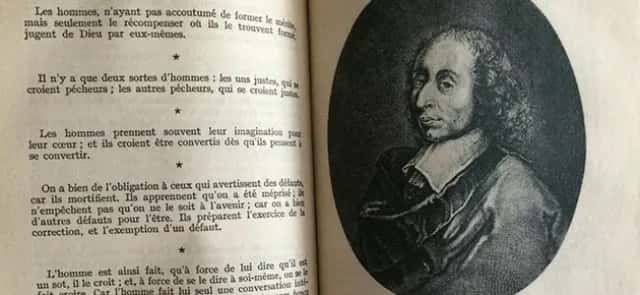
Pascal's rhetoric of chiaroscuro | Tangente
Pascal's dialectic consists in identifying the paradoxes and contradictions in another person's discourse. He thus unsettles his readers, making them realize that where they thought they had knowledge, they know nothing. Antithesis is one of his favorite weapons.
Betting on God's existence—Pascal's Pensées | Tangente
Pascal's Pensées abounds in arguments and reflections that assess the probability of a supreme being's existence. A careful, unabridged reading of the various fragments reveals a philosopher steeped in doubt and possessed of extraordinary subtlety.

Properties of the arithmetic triangle
Although Blaise Pascal did not invent the triangle that bears his name, the name pays tribute to his study of it in a treatise that has remained famous in the history of mathematics. Let's delve into this extraordinary text!
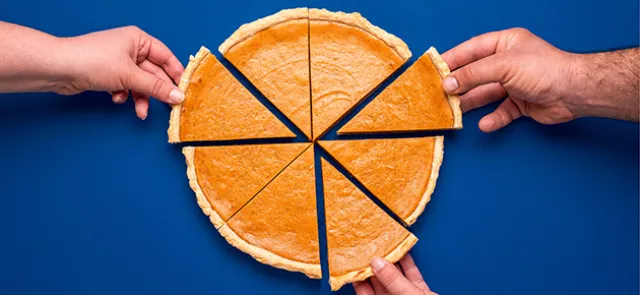
The art of fair division
Blaise Pascal had a gift for illuminating all manner of situations through sound, precise analysis, pinpointing the difficulties and explaining himself with unsurpassable clarity. One of the most famous questions in probability—the problem of points—was a case in point.
Pierre de Fermat, Pascal's famous contemporary | Tangente
Who was Pierre de Fermat? Pascal regarded him as the greatest mathematician of his time. He was a very modest man, probably aware of his extraordinary mathematical abilities, who readily shared his often original ideas. We know that he was a man of great learning, capable of translating works from Latin and Greek and writing sophisticated poetry, even… in Spanish.
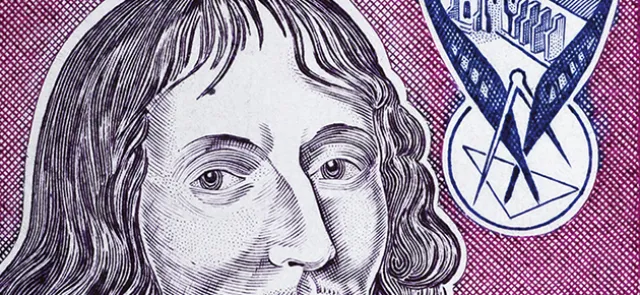
A master of mathematical induction
Mathematical induction is a major tool in mathematical proofs. On at least three occasions, Pascal explicitly uses reasoning that is "almost" mathematical induction, making him one of the method's inventors.
Pascal and geometry: the mystic hexagram | Tangente
Blaise Pascal's earliest work in geometry has passed into legend. He was only 16 when he published his Essay pour les coniques (Essay on Conics) in 1640.
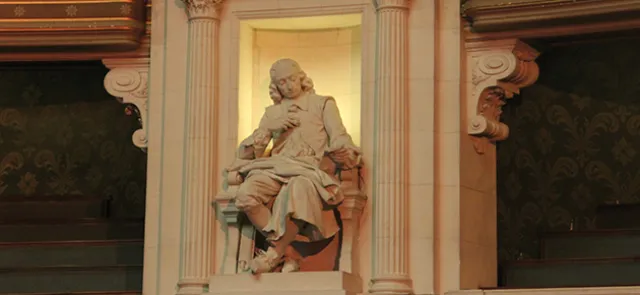
An extraordinary mind — The life of Pascal | Tangente
Blaise Pascal was no universal scholar, but he developed a rigorous, experiment-based scientific method that enabled him to transcend the prevailing orthodoxy and open up new avenues in both mathematics and physics.
Pascal on stage — Descartes and Pascal on stage | Tangente
The mathematician is also one of the central characters in a philosophical comedy by Jean-Claude Brisville (1922–2014), best known to the general public for Le Souper (1989), featuring Talleyrand and Fouché, whose film adaptation was a memorable success.
Pascal, hero of Italian cinema — Rossellini's film | Tangente
The film is little known to general audiences today, but Blaise Pascal is the title character of a feature film directed in 1971 by Roberto Rossellini, a leading figure of Italian neorealism.
Pascal on a 500-franc banknote | Tangente
Known as the "Pascal", this 500-franc note bearing the scholar's portrait had a long career: it remained legal tender from 1969 to 1997.
Pascal in space: a lunar crater | Tangente
Astronomy has paid tribute to Pascal twice.
Centre international Blaise-Pascal (CIBP) | Tangente
Among its missions, the Centre international Blaise-Pascal is compiling a comprehensive bibliography of research on Blaise Pascal.
A prize for mathematics theses | Tangente
The prize awarded by Clermont Auvergne University's Blaise-Pascal Laboratory honors a thesis in pure or applied mathematics.
Blaise Pascal prize — Researcher award | Tangente
The Blaise Pascal Prize recognizes work carried out in France on the application of mathematics to engineering and industry.
Fondation Blaise-Pascal—Maths for all | Tangente
The Fondation Blaise-Pascal was launched in 2016 by the CNRS, Université de Lyon and Inria. Its aim is to support mathematics and computer science outreach organizations, enabling them to develop and sustain their activities over the long term.
Pascal's 400th anniversary in Clermont | Tangente
In Auvergne, the city of Clermont-Ferrand, Clermont Auvergne Métropole and the University of Clermont Auvergne (UCA), together with their many partners, are preparing to celebrate the 400th anniversary of Blaise Pascal's birth in 2023.
Sidon sets
Number theory is a branch of mathematics that still contains questions that are easy to state yet remain unsolved. Sidon sets, in which the differences between pairs of terms are all distinct, are a case in point.
Numbers at the heart of mathematics—and our lives | Tangente
The Mathematics Forum held at UNESCO last November took stock of the role of mathematics in our societies, students' attainment—which, according to various international comparative studies, is plummeting—and the place of women in mathematics.