



History and Culture
History of mathematics and cultural connections
Statistics comes into vogue: music and maths | Tangente
Largely independently of scientific development, a craze for statistics swept through France from 1827 onward.
Karl Pearson and the Birth of Correlation | Tangente
The British mathematician Karl Pearson (1857–1936) was a socialist-leaning freethinker and feminist.
Margaret Hogg, pioneer of random sampling | Tangente
Margaret Hope Hogg was born in Scotland on October 15, 1894. After studying statistics, she joined the London School of Economics, where she worked from 1919 to 1925 under Arthur Lyon Bowley (1869–1957), renowned for his research into surveys conducted by "representative sampling."
Adolphe Quetelet and the average man in statistics | Tangente
Born in Ghent on February 22, 1796, French, then Dutch, and finally Belgian after 1830, Adolphe Quetelet (1796–1874) was the very model of a cultured polymath. After defending a thesis in geometry, he worked in scientific fields beyond pure mathematics.
Florence Nightingale and medical statistics | Tangente
Born in Florence, in the Grand Duchy of Tuscany, Florence Nightingale (1820–1910) came from a wealthy, upper-class British family. From an early age, she was deeply concerned about the living conditions of the poor and about healthcare.
Conway's Game of Life: The complete guide | Tangente
The many devotees of the Game of Life, devised by John Conway in 1970, now have their bible.
Golden ratio: mathematical properties | Tangente
An evocative subtitle, "La proportion magique" (The magic proportion), a foreword by Cédric Villani, a preface by Étienne Ghys, a glossy cover, high-quality paper, meticulous geometric drawings and understated but well-chosen illustrations: everything about this book invites you to open it.
Wittgenstein and the philosophy of mathematics | Tangente
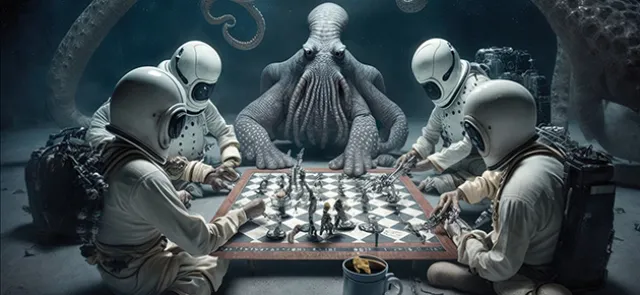
The relationship between language and reality lies at the heart of Wittgenstein's thought. The issue takes on its full significance when it comes to mathematical entities. What if philosophers speculating about the rigorous logical foundations of these abstractions were on the wrong track?
Artists’ visions: knots in art and maths | Tangente
Three artists share their visions of knots.
Club Tangente celebrates its 10th anniversary | Tangente
The Tangente Awards have been held every year for the past decade. Tangente Days take place at prestigious venues such as the Musée des arts et métiers. These events were the brainchild of Club Tangente. We take a closer look at the work of this organization, which is celebrating its tenth anniversary in 2023.
Stereographic projection
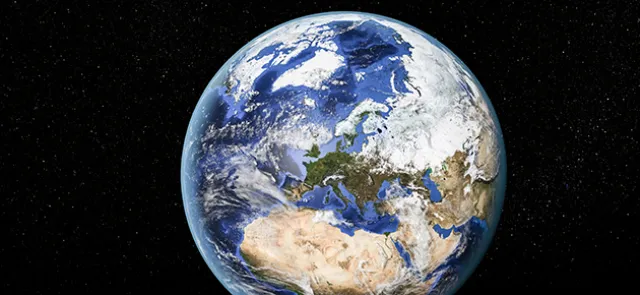
Since 2021, the Bourse de commerce in Paris has been open to the public, showcasing contemporary art from the Pinault Collection. Its superbly renovated interior offers mathematicians an opportunity to explore… stereographic projections!
Art and the sphere: when mathematics inspires | Tangente
A brief look at several artists who have made the sphere their subject.
Vaughan Jones, a "pure genius" of knot theory
If ever there was a knot theorist, it was Vaughan Jones. This New Zealand-American mathematician, a 1990 Fields Medalist, is now renowned worldwide for his contributions to knot theory. French mathematician Alain Connes (born in 1947 and himself a Fields Medalist) described his discoveries as "work of pure genius".
Aperiodic tiling: the ein stein tile | Tangente
Some craftspeople have become masters of the art of tiling, such as those who were commissioned to decorate the Alhambra palace in Granada, Spain. This inevitably raises geometric questions. Which tiles can cover the plane? What symmetries emerge?
Terence Tao: Académie des sciences medal | Tangente
On March 21 in Paris, the mathematics world was abuzz: Terence Tao, a true "star" in the field to whom Tangente will devote a special feature in its next issue, was awarded a particularly prestigious honor for a researcher—the Grand Medal of the Académie des sciences.
A stamp honoring Blaise Pascal | Tangente
To mark the 400th anniversary of his birth, La Poste will issue a stamp bearing the likeness of Blaise Pascal (1623–1662) on June 19, 2023.
Charred manuscripts and maths | Tangente
The devastating eruption of Mount Vesuvius in AD 79, described by Pliny the Younger (61–c. 113), not only destroyed Pompeii but also ravaged the nearby city of Herculaneum.
Optimal control and Zermelo problems | Tangente
A particularly important class of optimal control problems consists of Zermelo-type problems: their applications have proved rich and fruitful in mathematics… and beyond. They are studied using a combination of geometric and numerical methods.
The sphere effect
The sphere came to be seen as a model of the world because of its perfection. Greek mathematicians soon sought to measure its properties, laying the groundwork for calculation techniques that would not bear fruit until centuries later.
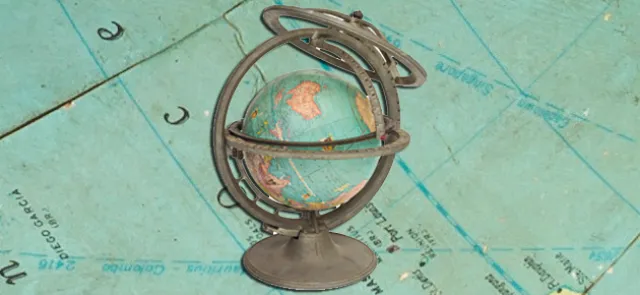
Mapping and the geometry of the Earth | Tangente
Understanding the shape of the planet we live on, and then depicting it, has been an adventure since the earliest days of antiquity. At every stage, the model has been refined and improved, drawing ever closer to the one we use today: the geoid.