At seventeen, she discovered mathematics. Then, under the influence of the American physician Samuel Gridley Howe (1801–1876), a former surgeon who had turned to helping communities in need, she became a nurse.
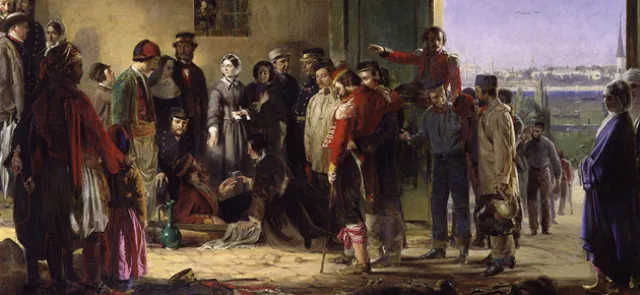
In 1853, she took up the post of superintendent at the Institute for the Care of Sick Gentlewomen in London, where she earned a reputation for her ability to innovate in nursing practice. During the Crimean War (1853–1856), with the support of her friend Herbert, then in charge of the War Office, she travelled to Turkey, where the British troops were based, leading a group of thirty-eight volunteer nurses. This experience would enable her to advance the sanitary design of hospitals.
After her triumphant return to Britain in August 1856, she wrote a report of more than a thousand pages, containing a wealth of statistical data summarized in charts that supported her recommendations. Her "coxcomb" diagram, since known as the Nightingale rose, is often cited, but other charts also owe much to her. William Farr (1807–1883), known for his research in demographic statistics and epidemiology, advised her on this work.
References:
• A contribution to the sanitary history of the British army during the late war with Russia. Florence Nightingale, John W. Parker and Son, 1859.
• Florence Nightingale. Mervyn Stone, in Statisticians of the Centuries, Christopher Charles Heyde and Eugene Seneta, Springer, 2001.