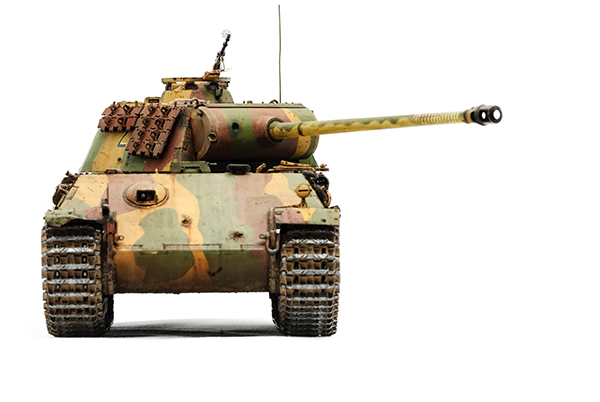
Serial numbers from the chassis and engines of captured or destroyed tanks, as well as from wheels and tires, made it possible to reconstruct the production sequence of these vehicles.
Suppose the German tanks are numbered 1, 2, 3… N, where N is the total number of tanks. The aim is therefore to estimate N. To do so, statisticians used captured enemy equipment. For example, suppose you have five tank serial numbers—30, 51, 43, 92, and 26. Let k denote the sample size (here, k = 5) and m the largest value (here, m = 92). Then a "good" estimator of the number N of tanks is N\ = m – 1 + m/k. In our example, this gives N\ = 92 – 1 + 92/5 = 109.4, or approximately 109 tanks.
This is a point estimate—that is, the "most likely" value of N based on a sample of size k. With 95% confidence, the unknown number N is less than 20m1/*k. The accuracy of the estimator N\ increases rapidly with sample size k: the bound is 20m when k = 1, but only 1.35m when k = 10.