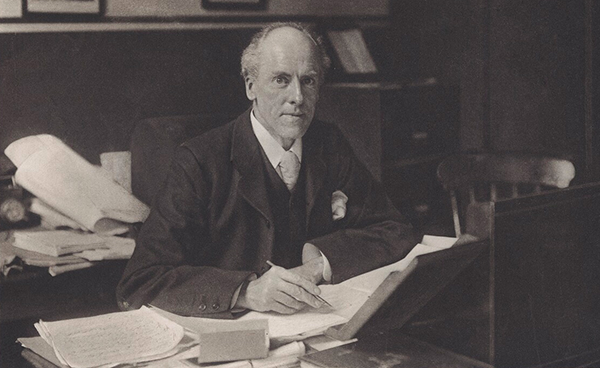
After turning his attention to the philosophy of science in 1892, he moved into mathematics applied to biology and founded the Biometric Laboratory and the journal Biometrika.
For Pearson, scientific work begins with the classification of observed facts and culminates in the formulation of laws. Moreover, the notion of cause must be replaced by the broader notion of contingency, measured by correlation.
As early as 1900, Pearson proposed the mean square contingency φ2 = χ2/n as a measure of the degree of association between two characteristics, along with the chi-squared test. His most important research, however, remains his work on simple and multiple regression. For Pearson, a scatterplot reflects the contingency of the observations, but can be summarized by an a posteriori linear fit.
Pearson tried in vain to convince his peers that human characteristics were heritable and that nature prevailed over nurture (the "Nature vs Nurture" debate concerns the respective influence of genes and the environment on an individual's development; it is also framed as a debate between innate and acquired traits).
References
*• The Grammar of Science*. Karl Pearson, Walter Scott, 1892.
*• Notes on the History of Correlation. Karl Pearson, Biometrika* 13, 1920.