



History and Culture
History of mathematics and cultural connections
The mind-bending properties of infinity
Infinity abounds in paradoxes of every kind. For example, the terms of certain numerical series can be rearranged so that they converge… to any number chosen in advance! Skeptical? Follow Bernhard Riemann's reasoning…

Applications of the second derivative
The concept of acceleration corresponds to a second derivative. It therefore seems only natural that a mathematical concept as sophisticated as the derivative should have concrete applications. Such applications arise in questions involving the profiles of roads and railway tracks.

Differences in notation: are mathematicians and physicists irreconcilable?
The differences between physicists' and mathematicians' notation might seem like mere turf wars, and thus reconcilable with a little common sense. There are several reasons for these differences
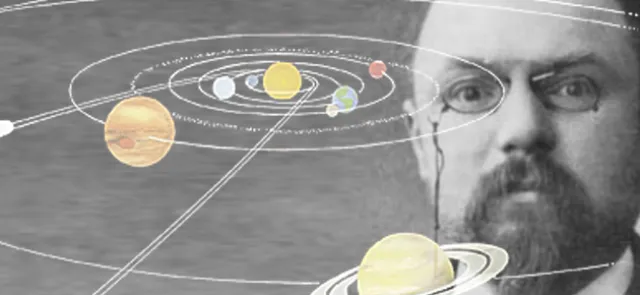
From the three-body problem to mathematical chaos
The elusive three-body problem saw spectacular progress thanks to Henri Poincaré. The French mathematician went further, devising new, more geometric methods for studying dynamical systems. His research has shaped our understanding of the stability of the solar system.
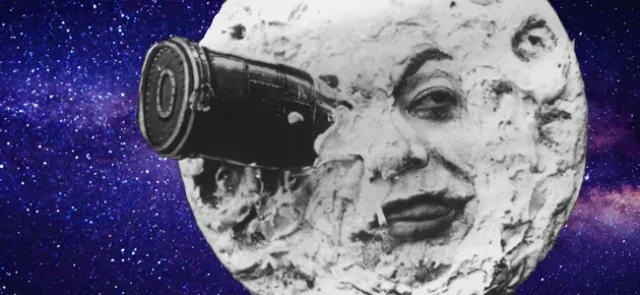
Lagrange and the analytical method
At the time of his death, Isaac Newton was proud to have found a method for solving problems in natural philosophy, but he was aware of its limitations. The Moon's trajectory is described only very approximately by the two-body problem. It fell to Joseph-Louis Lagrange to make a spectacular breakthrough.
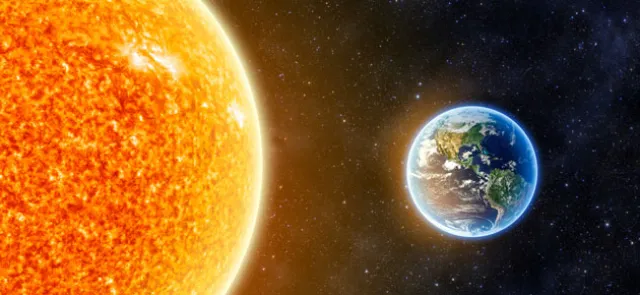
Newton's synthetic method
How does the Earth, of mass m, move around the Sun, of mass M, under gravity alone? To answer this question with something more than philosophical assertions, Newton proposed a synthetic method inspired by the description of motion.
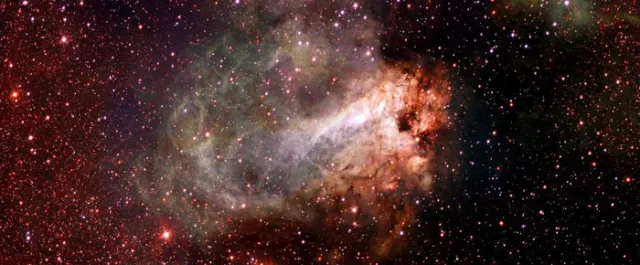
A science in motion | Tangente
Neither mathematics nor physics stands still! Until recently, the two disciplines went hand in hand, offering a natural philosophy. They sought to uncover, describe, and explain nature's hidden laws.

Approximations in physics | Tangente
They trouble mathematicians, for whom sin(x) can never equal x when x is a nonzero but "small" real number. Yet they are useful! "They"? Approximations!

James Clerk Maxwell
In 1865, with four equations that have since become legendary, Maxwell unifies magnetism, electricity and optics—fields that had until then remained separate. The way is now open for wireless telegraphy, radio broadcasting and, later, the development of electronics.
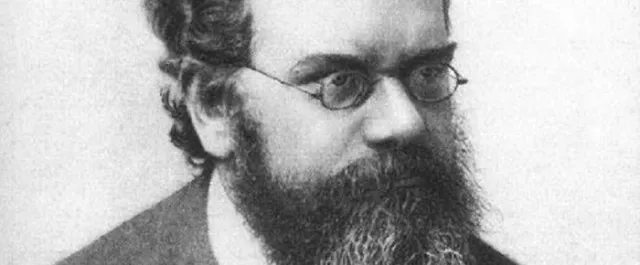
Ludwig Boltzmann
Ludwig Boltzmann was one of the most important scientists of the 19th century. Boltzmann's interpretation of entropy inspired Max Planck and Albert Einstein in their work on the statistical theory of radiation and on the quantum and photon hypotheses.

Joseph Fourier
At a time when the nature of heat was still being debated in the 18th century, Joseph Fourier established an equation describing how heat propagates through a solid of arbitrary shape. His methods make the French scientist a founder of mathematical physics.

Claude Mydorge:
A keen enthusiast for geometry, Claude Mydorge collaborated with René Descartes. His interest in conic sections led him to study the laws of optics and astronomy. He also developed a particular fondness for mathematical games and recreations.

A controversy over gears
What shape should gear teeth have to get the most out of gears? The question preoccupied 17th-century scholars so intensely that tempers sometimes flared. Philippe de La Hire and Gottfried Wilhelm Leibniz were two of the protagonists in this historic scientific dispute.
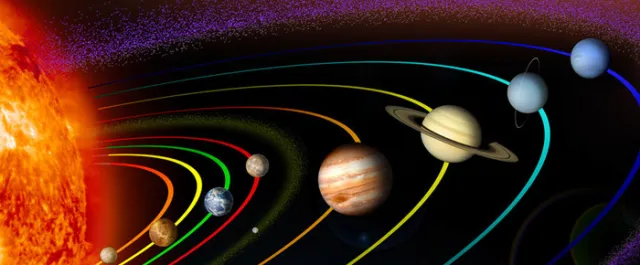
Newton's fluxions
With his theory of fluxions, Newton explained Kepler's laws describing planetary motion. Yet because it was less convenient to use than Leibniz's infinitesimal calculus, it ultimately held back research in Britain.
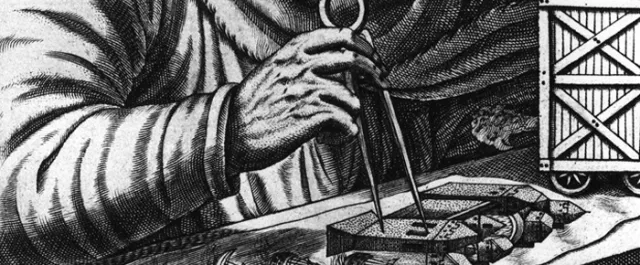
The geometry of measurement
The concept of measurement evolved over a long period, from concrete practice to abstraction, in a process initiated by Archimedes. This required mastering the concept of infinity.
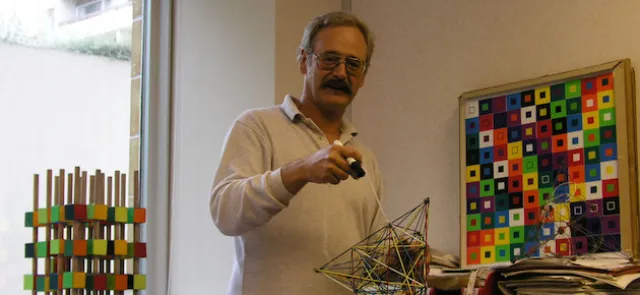
Combinatorics, past and present: An interview with Pierre Duchet
The study of combinatorial structures is a recent branch of mathematics, rich in counting problems. A journey into a far too little-known realm.

South America: Fondation Cartier's ode to geometry | Tangente
Until 24 February 2019, Fondation Cartier is exploring the presence of geometry in art across South America, from Mexico to Tierra del Fuego, spanning pre-Columbian and contemporary art as well as Indigenous American cultures.

Michel Serfati: a passion for the history of | Tangente
Mathematician, philosopher and historian of science, Michel Serfati, who died on September 30 last year, was all three.

Pierre Duchet: research in action | Tangente
Mathematician Pierre Duchet died on October 27 last year at his home in Mexico City. A friend of the editorial team at Tangente, this specialist in combinatorics, discrete mathematics and especially graph theory was always eager to share his work with younger generations.
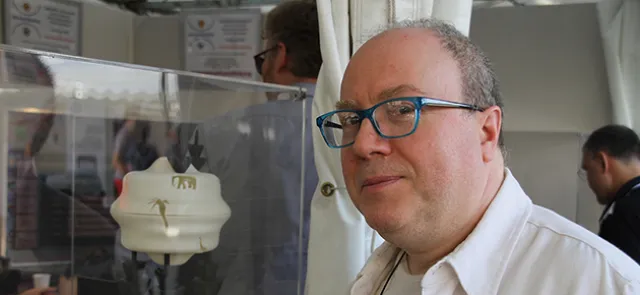
Christian Lavigne | Tangente
Visual artist Christian Lavigne's work achieves a beautiful alchemy of mathematics, art, poetry and, above all, digital sculpture, a field in which he is a leading figure. He created the first French digital sculpture produced using additive manufacturing.