



Interview
Interviews with mathematicians and personalities from the scientific world

A deep connection with determinism
Many physical and economic phenomena are described by differential equations. This implies, in particular, that the functions we seek are differentiable, but also that the phenomena concerned are locally deterministic.

Pierre Samuel, the first scientifically minded environmentalist | Tangente
Pierre Samuel (1921–2009) was one of the greatest French mathematicians of the 20th century. He became deeply interested in environmental issues.

The difficult question of forecasting | Tangente
How can we predict likely changes in temperature and precipitation twenty years, fifty years or a century from now?

The Leslie model
Modeling changes in an animal population is a frequently studied topic in mathematics and biology. But how can we account for the fact that individuals produce different numbers of offspring depending on their age? The Leslie model addresses these questions.

Models for responsible water management
Who is entitled to use and manage the waters of rivers that cross several States? How can this precious resource be shared equitably and sustainably? Multi-criteria programming, a powerful decision-support tool, offers a rational solution to these questions.

The Archimedean hairspring at the heart of watchmaking
Once again, we turn to a "spiral"—not in a field or on a canvas, but… inside a watch.

Objects that embody knowledge
A mathematical object is a concept arising from... mathematics. The objects featured in this saga are physical ones, of interest not only mathematically but also historically, educationally and aesthetically. They illustrate concepts and make them easier to understand.

Taking action against gender stereotypes
We met Véronique Slovacek-Chauveau and Annick Boisseau, the vice-president and secretary, respectively, of Femmes et mathématiques, who kindly agreed to answer our questions.

Intelligence agencies: the world's largest employers of mathematicians
In the popular imagination, intelligence agencies are staffed by muscle-bound spooks, not exactly refined intellectuals—and certainly not computer scientists sitting behind screens or fully trained mathematicians with degrees. In reality, precisely the opposite is true!

First examples of vector spaces (1)
Before we get to the heart of the matter, it is worth remembering that we have all encountered a vector space at school.
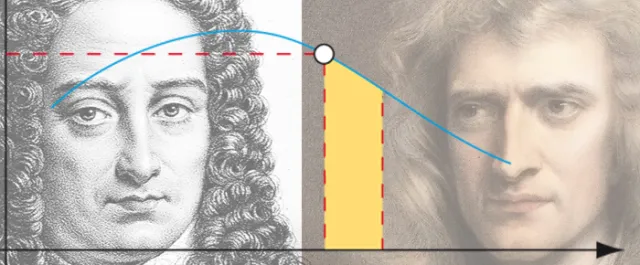
Areas and antiderivatives: a close connection
Areas and antiderivatives have been linked ever since the foundational work of Leibniz and Newton in the 17th century. This connection has simplified the calculation of the areas of many regions in the plane, but the relationship between area and the integral goes far deeper than this computational question.

Why not base 12? The advantages of the duodecimal system
If you talk to people about the history of arithmetic, whatever your specific subject, you can expect someone to ask this question at the end: why is our numeral system base 10 when base 12 would be so much more practical?

The inverse of the exponential function
The introduction of logarithms can be traced back to the Renaissance, when they were used to solve computational problems. They have since found more theoretical applications and today even lie at the heart of some cryptographic systems—and hence of our computers.

Complex numbers aren't so complicated
What do complex numbers really represent? How can we "picture" i² being equal to −1? A striking visual answer comes from interpreting multiplication geometrically. The icing on the cake is that the same model explains why "a negative times a negative makes a positive."

Conjugates, moduli and arguments
Once we accept the existence of a number i such that i² = −1, do we risk losing touch with physical reality? Quite the opposite: a profound and fruitful correspondence emerges, allowing questions of pure geometry to be solved through simple algebraic manipulations.

Speeding up integer multiplication | Tangente
Complex numbers seem very far removed from the modern world’s concerns about profitability. Yet they underpin methods used to speed up the multiplication of large integers. They save time—a great deal of time—and therefore money!

The circles of Apollonius of Perga: harmonic ratios
The set of points whose ratio of distances to two fixed points A and B is constant is called the Circle of Apollonius. Three ways to approach it: classical geometry, analytic geometry, and electricity

Algebraic identities in series
What happens if we try to calculate sums containing an ever-increasing number of terms? That is the challenge tackled by the study of sequences and series.

What consumers prefer
How can we model the behavior of a particular consumer? Their tastes, needs and available budget all help shape their choice. The mathematical concepts of preference, indifference and utility should help us...

Economics in question
What is economics? Can it be regarded as a science? What role do mathematical models play in its analysis and development? Can they counterbalance decisions based exclusively on a dogmatic approach?