



Amazing Math
Surprising or counterintuitive mathematical results and proofs

Classifying knots: topology and invariants | Tangente
Knots can be combined to form new ones—or, conversely, simplified. We can borrow the vocabulary of number theory and classify them rather like the chemical elements. What varied and unexpected facets knot theory has!
Converging to a number: is there only one way?
Traditional mathematics provides a precise definition of convergence for a numerical series, explored in the main body of this article. But this should not rule out less conventional approaches, discussed in the box and in several articles in this special issue.
Infinite sums: a matter of convention
Equality between two numbers poses no difficulty when both are defined by "finitary"* methods. But as soon as infinity enters the picture—represented by ellipses in formulas—the door opens to all manner of paradoxes. (* Finitism is an approach to mathematics that considers only finite objects.)
Catalan's problem
In 1844, Franco-Belgian mathematician Eugène Catalan published his famous conjecture in Crelle's Journal.
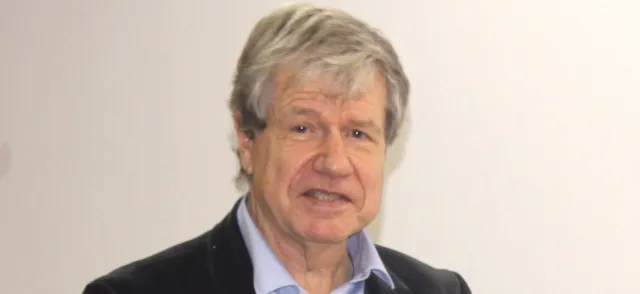
Hervé Lehning, a popularizer of mathematics | Tangente
It is impossible to sum up the scientific and educational work of a man such as our colleague and friend Hervé Lehning. More than a thousand articles bear his name! One way to gain a sense of the man is through his vast body of writing.
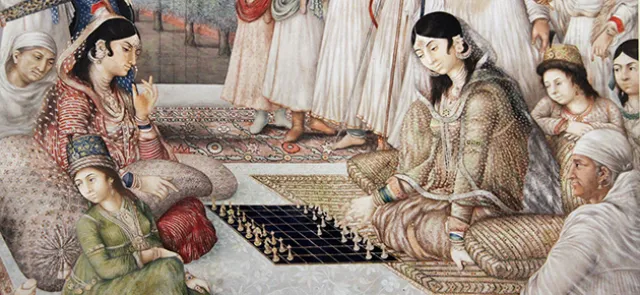
From Sissa to RSA
What use is there in raising numbers to powers, except for the fun of uncovering some arithmetical property of the natural numbers? Unexpectedly, this ancient computational art lies at the heart of modern cryptography and secure data transmission.
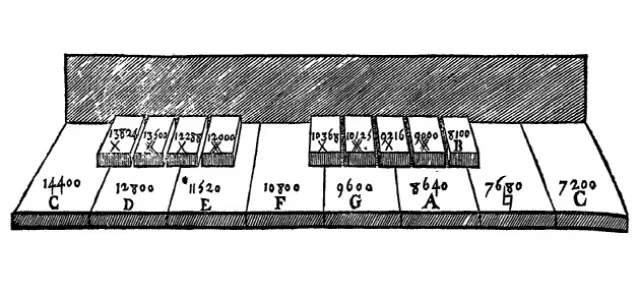
Writing a treatise on sound at the age of 11 | Tangente
The links between music and mathematics are well established. There was a time when it was not unusual for the most learned minds to pursue both with equal delight. Pascal, too, is said to have explored questions relating to sound, further evidence of his astonishing precocity.
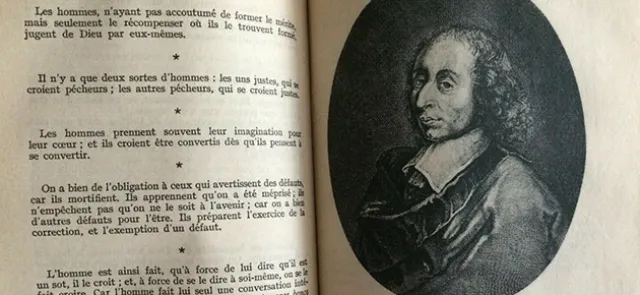
Pascal's rhetoric of chiaroscuro | Tangente
Pascal's dialectic consists in identifying the paradoxes and contradictions in another person's discourse. He thus unsettles his readers, making them realize that where they thought they had knowledge, they know nothing. Antithesis is one of his favorite weapons.

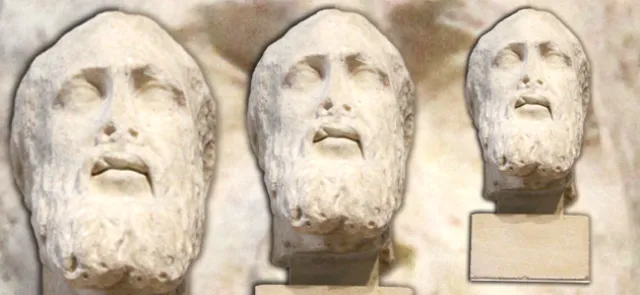
Pierre de Fermat, Pascal's famous contemporary | Tangente
Who was Pierre de Fermat? Pascal regarded him as the greatest mathematician of his time. He was a very modest man, probably aware of his extraordinary mathematical abilities, who readily shared his often original ideas. We know that he was a man of great learning, capable of translating works from Latin and Greek and writing sophisticated poetry, even… in Spanish.
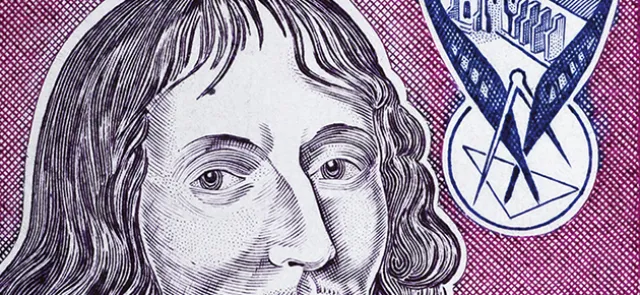
A master of mathematical induction
Mathematical induction is a major tool in mathematical proofs. On at least three occasions, Pascal explicitly uses reasoning that is "almost" mathematical induction, making him one of the method's inventors.
A prize for mathematics theses | Tangente
The prize awarded by Clermont Auvergne University's Blaise-Pascal Laboratory honors a thesis in pure or applied mathematics.
Sidon sets
Number theory is a branch of mathematics that still contains questions that are easy to state yet remain unsolved. Sidon sets, in which the differences between pairs of terms are all distinct, are a case in point.
Happy New Year! The properties of 2023
As is now customary, the Tangente team explores the properties of the year number in our Gregorian calendar. What can we say about 2023? We will examine it in particular through the Josephus sieve.

The barber was a woman
The barber paradox is said to be just the thing for dazzling people at parties. Although it serves an educational purpose by illustrating one of the most fundamental results in set theory, taken out of context it may well backfire on you!
A passion for Goldbach's conjecture | Tangente
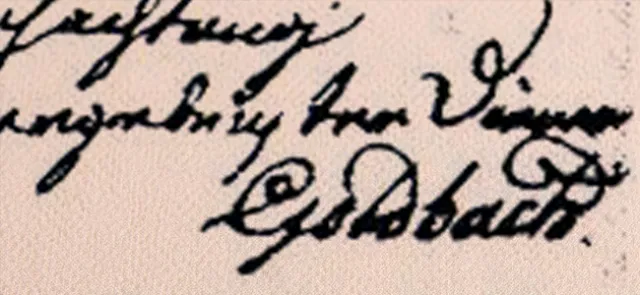
In set theory, which Cantor founded, intuition has little place. Yet his approach to open mathematical problems relied more on intuition than on rigorous reasoning. His interest in Goldbach's conjecture is a case in point.
Cantor−Bernstein:
Georg Cantor left his mark on the history of mathematics through his study of infinite sets. The Cantor–Bernstein theorem shows how a few results that are obvious for finite sets generalize to infinite sets… provided one takes a serious look at the question.
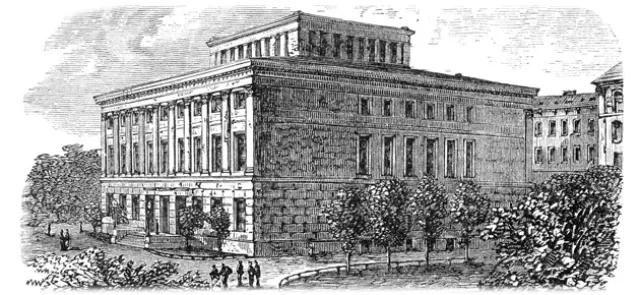
A journey into infinity | Tangente
While many mathematicians toiled in the footsteps of their predecessors, Cantor opened up an entirely new field that many of his colleagues refused to enter. This journey through the different infinities proved to be both fascinating and fruitful.

A remarkable line: the asymptote
A look back at some properties of asymptotes...
Yitang Zhang's long, solitary quest | Tangente
Born in China in 1955, Yitang Zhang developed an interest in mathematics at an early age: at the age of 10, he discovered prime numbers and the puzzle of Fermat's Last Theorem. But during the Cultural Revolution, he was sent to work in the countryside with his mother and was unable to continue his studies.
The factorization of large integers:
The most widespread cryptography system relies on the use of very large integers, whose factorization remains beyond the reach of our computers. As early as the 17th century, Mersenne and Fermat were investigating the prime factorization of very large numbers; their work inspired modern factorization algorithms.