

New
Problems presented in the form of a short story or narrative account

AI for training | Tangente
The training landscape now includes a wide range of stakeholders. AI can be used in many ways, both in schools and in the workplace.

Mickaël Launay wins D'Alembert Prize | Tangente
The awards are pouring in for Le Grand Roman des maths. The D'Alembert Prize, awarded by the French Mathematical Society, recognizes efforts to popularize mathematics.
Tim Gowers: Polymath, combinatorics, open science | Tangente
Sir William Timothy Gowers was born in England on 20 November 1963. A professor of mathematics at the University of Cambridge (Great Britain), he is one of today's leading mathematicians and has received several prestigious awards, including the Fields Medal in 1998.

Where do the figures come from? | Tangente
Public authorities and the media release all kinds of figures, presenting them as indisputable facts. Where do all these numerical data come from? Where can we find them—in online sources, studies or elsewhere? How can we form an informed opinion?

Riverside road closures backfire | Tangente
The City of Paris decided to close the riverside roads. Tangente's editorial team asked the City of Paris to comment on the contents of this page. At the press deadline, we had not yet received a reply. If we do, we will add it to the digital edition of this issue.
Best illusion of 2017: Dynamic Müller-Lyer
The 2017 edition of the Best Illusion of the Year Contest, an annual international optical-illusion competition, took place in early October.

Mathematics in fiction films
The world of mathematics is sometimes represented on screen, with varying degrees of success. Films offer a jumble of simple plot devices, biopics, realistic or imagined depictions of the mathematical world, and even the scientific fiction theorized by Denis Guedj.
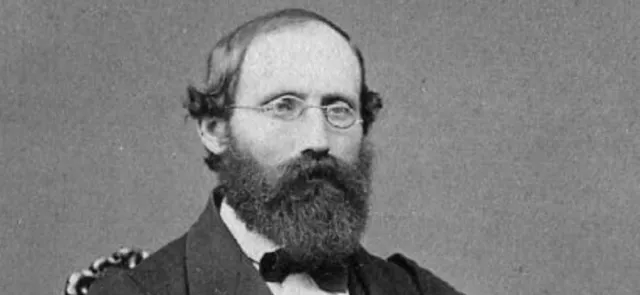
The zeta function and the Riemann hypothesis
The most important problem in contemporary mathematics can be stated in entirely elementary terms, requiring only a rudimentary knowledge of complex analysis. Despite mathematicians' titanic efforts, the Riemann hypothesis remains stubbornly out of reach.
? is an algebraically closed field
The field ? of complex numbers was constructed to provide solutions to every quadratic equation. Surprisingly, it also contains the solutions to all algebraic equations with coefficients in ?. In technical terms, it is algebraically closed.
Famous paradoxes: Pascal's wager & St. Petersburg | Tangente
Let's rediscover the famous Pascal's wager, a line of reasoning as questionable mathematically as it is theologically!
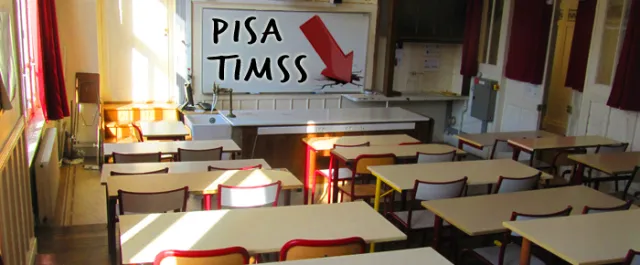
TIMSS and PISA: The latest developments in mathematics assessments
The recent publication of the PISA and TIMSS results unleashed a media storm, so poor were the scores of young people in France. But rather than settling for a few simplistic figures and reductive statistics, what if we took a closer look at what these assessments actually measure?
The multiplicity of infinities
Actual infinity is a mathematical fiction, useful in calculations and proofs alike. We may reject it and make do with potential infinity. But if we accept the notion of infinity, there must be more than one. Georg Cantor—him again!—proved it.
Lewis Carroll: toward modern logic | Tangente
The marvelous storyteller behind Alice's Adventures in Wonderland was also a photographer, a mathematics teacher at the University of Oxford and… an inspired logician.
Autonomous vehicles: life-or-death maths | Tangente
How can morality be programmed into autonomous vehicles? The question, worthy of science-fiction novels, is topical today.
Equations of a line
What defines a line, and in what geometric setting? Each possible answer leads to a representation from which the corresponding equations follow.
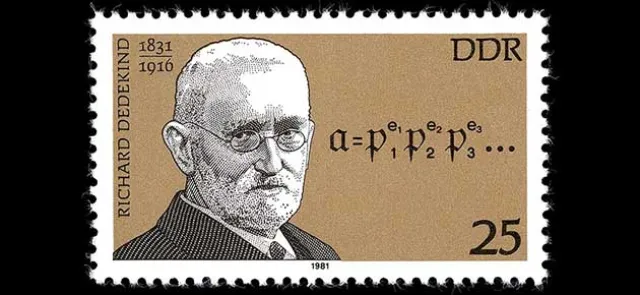
Richard Dedekind: Numbers and concepts
Richard Dedekind died on February 12, 1916. This gives Tangente an opportunity to profile a German mathematician fascinated by numbers, whose legacy continues to shape mathematics today. The concepts he introduced lie at the heart of modern algebra.

Euler's correspondence with his contemporaries | Tangente
Leonhard Euler maintained an extensive network of correspondents across Enlightenment Europe. His exchanges with Christian Goldbach, of particular interest for number theory, have just been published.