



Knowledge
In-depth articles on mathematical knowledge and theories

Matrices and graphs in accounting
Accountants are not known for using sophisticated mathematical tools. Yet modern techniques enable them to handle many situations arising in what is known as "complex accounting".
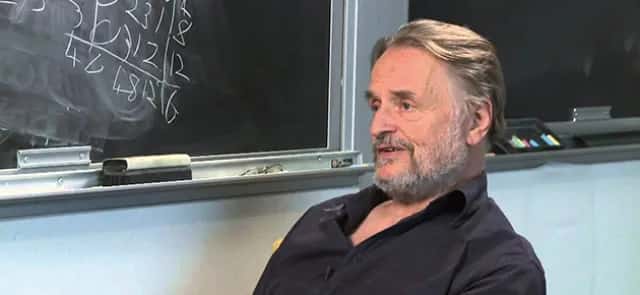
The audioactive sequence
Self-describing sequences are fairly well known among mathematics enthusiasts, but their history often is not. Even less familiar, no doubt, is the work of the man who helped bring them into the mathematical mainstream: John Conway, who devoted his life to having fun with mathematics.

Self-reference and fixed points in logic | Tangente
Self-reference is paradoxical and connected with the mathematical notion of a fixed point, the method of successive approximations, and recursive definitions. Together, these connections make this fundamental idea a natural subject for mathematics enthusiasts.

When 60 divides 9
Divisibility can be considered in sets of numbers other than the integers. One such set, introduced as early as fourth grade, lends itself perfectly to this generalization: the terminating decimals.
Pascal's ribbons
In the past, arithmetic mattered as much to merchants and accountants as it did to scholars. In the 17th century, Blaise Pascal devised a method for automatically testing whether one integer is divisible by another.
Finding divisors... without dividing
Telling almost at a glance whether one integer is divisible by another can sometimes be quite a challenge. Yet there are perfectly reliable ways to do so, even with fairly large numbers!

Gradient descent: skiing your way to a minimum
You are on a ski slope, surrounded by fog. Which route should you take to get all the way down? One approach is to follow the steepest slope—that is, the gradient. This idea yields both a numerical method and a way of finding optima.
Heilbronn triangles
How should points be placed in a region of the plane to maximize the smallest area determined by any three of them? Despite the elementary nature of this geometry problem, no general solution is known even today!

D'Arcy Thompson and the geometry of nature
Can the forms we see in nature be explained mathematically? Physics has had its principle of least action since Maupertuis in the 18th century, but biology had to wait until the early 20th century for anyone to attempt a synthesis.
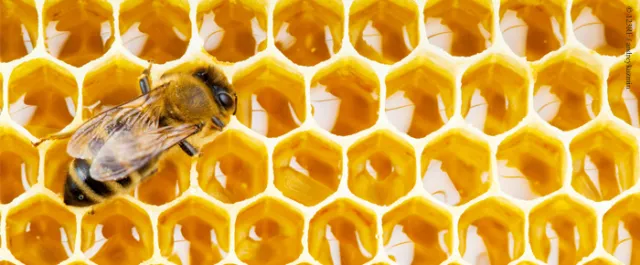
Thrifty bees
Optimize, optimize! That seems to be the bees' motto when they build their honeycombs. Let's take a closer look at their thrifty "methods." Geometry will prove invaluable in calculating the areas and angles of the cells.

Linear programming
Linear programming deals with problems that seem elementary in formulation: optimizing linear functions over a set defined by linear inequalities. Yet this theory has many highly practical applications.

The Monte Carlo method
In practice, finding an optimal value often involves computing demanding integrals. How can this be done? Physicists developed the Monte Carlo method, whose complexity does not increase with the dimension of the integrals involved.

Good divisions
Beautiful problems are like delicious dishes: we love to share them. Sometimes the question of how to share them out becomes interesting in its own right, especially when we are generous by nature and want to be able to let as many people as possible enjoy them.

Shortest paths: graph algorithms | Tangente
Is the shortest path from A to B always a straight line? Usually, yes. But when we must follow the network of roads and intersections in a city, we need a different perspective. That is where Dijkstra's algorithm comes to the rescue!
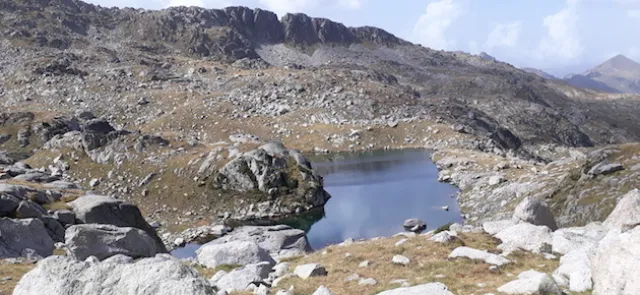
Using the derivative to hit bottom
Finding the lowest point on a given curve requires considering how the curve is approximated by a line near one of its points. This is where the tangent enters the picture

The art of avoiding crossings
Artists using mathematics: nothing new there. But artists posing optimization problems that mathematicians still cannot solve: now that is surprising! One seemingly innocuous conjecture about drawing graphs has resisted all attempts at proof for fifty years.
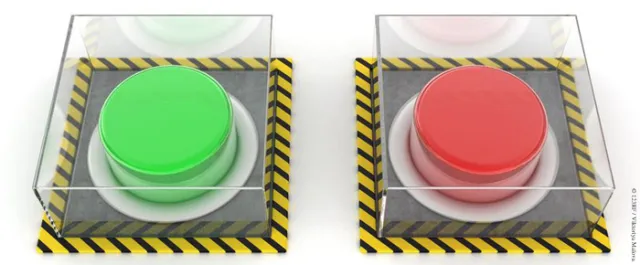
Randomness to the rescue of satisfiability
The Boolean universe is a small mathematical world in which only two values exist: True and False. Yet achieving satisfaction is already complicated! Fortunately, randomness comes to our rescue: choosing by a coin toss can sometimes bring us surprisingly close to the maximum we seek.
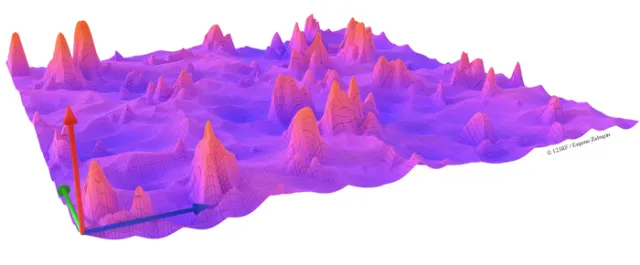
Hills and valleys
A real-life situation or a physics experiment generally depends on several parameters, not just one. We therefore need a deeper understanding of variation in this multidimensional setting. Partial derivatives provide just that.
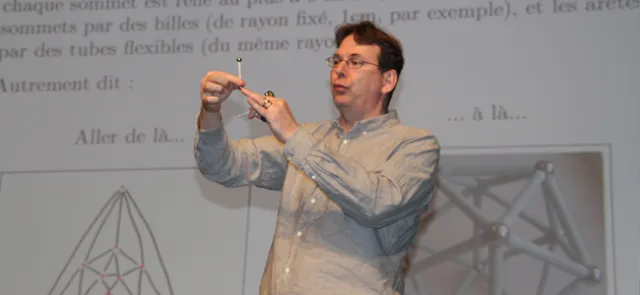
Expander graphs
Combinatorial graphs are among the most intuitive and universal concepts in mathematics and computer science. Graphs crop up everywhere, modeling all kinds of relationships between a wide variety of objects.
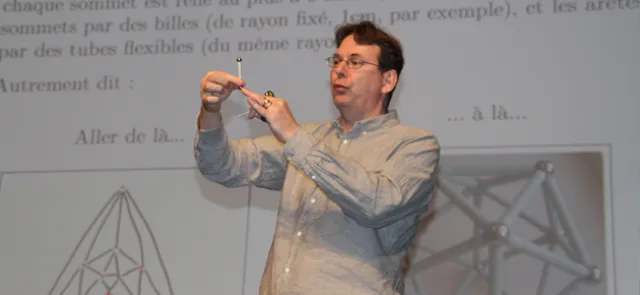
Expander graphs – Network theory | Tangente
The notion of a combinatorial graph is one of the most intuitive and universal in mathematics and computer science. Graphs crop up everywhere, modelling an extraordinarily wide range of relationships between all kinds of objects.