



Knowledge
In-depth articles on mathematical knowledge and theories
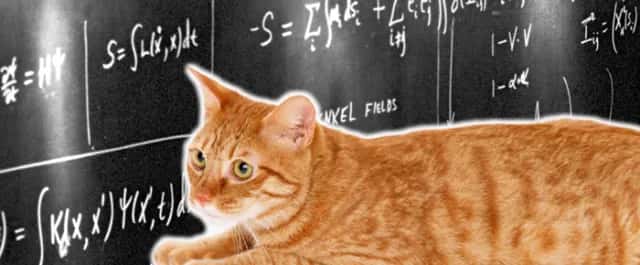
Erwin Schrödinger's cat
In its century of existence, quantum physics has proved extraordinarily effective and has never been found wanting. Yet many difficulties remain when it comes to interpreting it. One emblematic example of its strangeness is a famous feline thought experiment.

The mathematics of physics
Mathematical models enable us to understand and master the universe. But how far can this mastery extend? What are its limits? Mathematics allows us to devise models of the world around us and test them against reality.
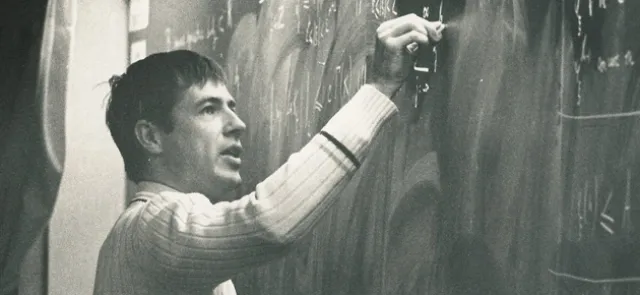
Jean Bourgain, exceptional Fields medallist | Tangente
The prodigious Belgian mathematician Jean Bourgain (1954–2018) worked in many fields of mathematics, forging wholly unexpected links between seemingly separate areas. His outstanding results earned him numerous awards.
Acoustics and computer music: Helmholtz | Tangente
Thanks to the work of Joseph Sauveur and later Hermann von Helmholtz on sound phenomena, we can analyze a sound in terms of its pitch, intensity and timbre. This is the analysis used in computer music, which is so popular with contemporary composers.
A free ticket to the stars: Newton | Tangente
How far we have come since Newton's famous apple! Recently discovered remarkable properties of the gravitational field raise the prospect of space missions requiring almost no energy—not only to the Moon, but to other planets as well…

An invariant under central projection
The need to model visual perception gave rise to a new geometry. Renaissance painters felt compelled to study it closely in order to depict depth. Lengths, angles: nothing seemed to be preserved, apart from a curious relation linking four collinear points…
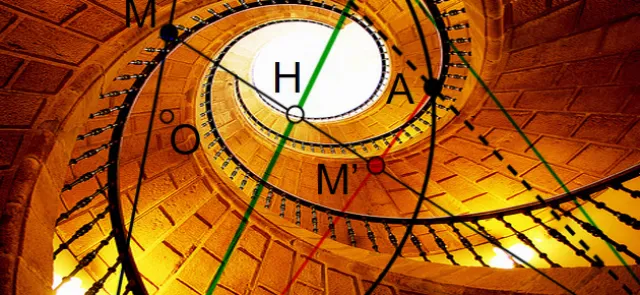
A cross-ratio from another world
During the 19th century, the search for quantities invariant under a particular group of transformations became the main focus of the various branches of geometry. The cross-ratio, a fundamental invariant of projective geometry, also appears in non-Euclidean geometries and their models.

A geometric tool of unparalleled power
The harmonic range, like the more general notion of cross-ratio, has proved essential to geometric reasoning, particularly when dealing with cocyclicity—the property of points in the plane lying on the same circle—or pencils of lines.
Breakthrough in quasi-linear multiplication | Tangente
Multiplying two integers dates back several thousand years. In 2019, at last, the algorithm was improved!
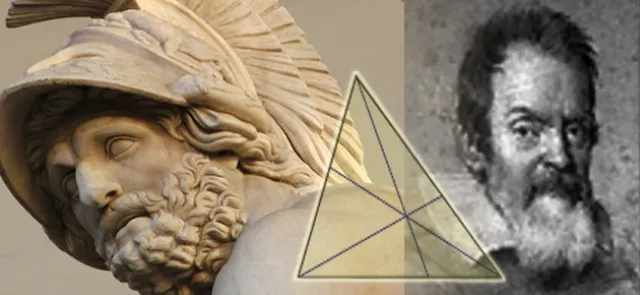
The theorems of Menelaus and Ceva
Menelaus's and Ceva's theorems, two classics of plane geometry, are similar in form. This resemblance becomes clearer when the notion of cross-ratio is introduced.
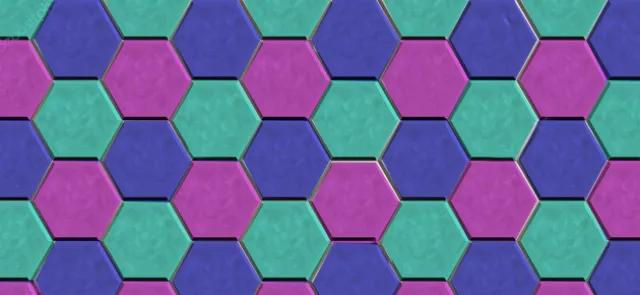
Coloring planar tilings: four colors | Tangente
The proof of the four-color theorem caused quite a stir! Results on colorings using only two or three colors have proved less controversial. By considering how to make a beaded necklace, we can take a fresh look at these coloring questions.
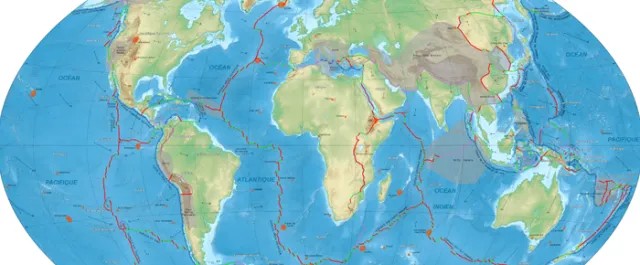
From plate tectonics to dressing a sphere
The surface of our planet seems to consist of a hard crust. But how can we picture a sphere being covered? Plate tectonics shows that the Earth's surface is made up of moving rigid plates that rub against one another.
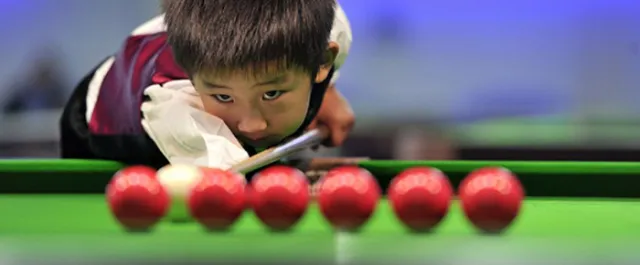
Operations in billiards
One of the arts and pleasures of mathematics is finding different ways to represent problems. Some problems in dynamics can profitably be replaced by the study of trajectories on a billiard table, revealing hidden structures—and hence hidden logical beauty.
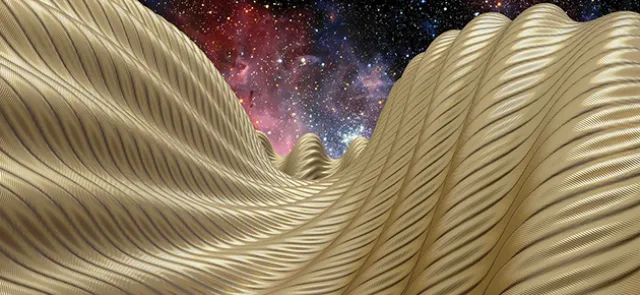
The smooth fractal revolution
How can a sphere be made to occupy less volume? Or how can an object be brought from the fourth dimension into the third? The corrugation technique meets such geometric constraints and produces surfaces both strange and unprecedented: "smooth fractals."
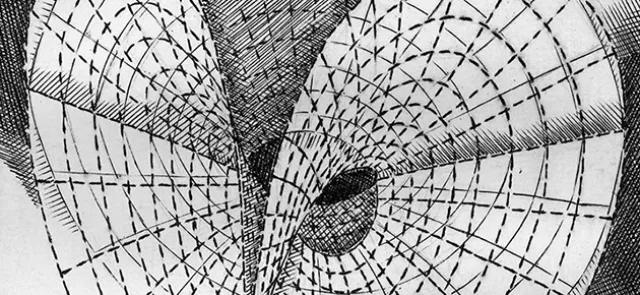
Exquisite minimal surfaces
A surface is minimal when, for a fixed boundary, its area is as small as possible. Soap bubbles provide a physical model of minimal surfaces.
Measuring areas
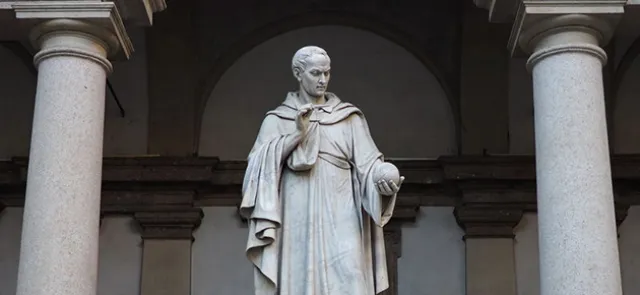
As soon as we move beyond elementary figures, calculating area brings us up against the concept of infinity. After Archimedes and his skilful use of potential infinity, it was not until the Renaissance that this obstacle was finally overcome.

Round balls
Round, are they? It is not that simple! Each ball is made differently, depending on how it will be used. A survey of their construction offers an opportunity to revisit some lesser-known principles of geometry.
Worlds without thickness
First defined as parts of space described using two parameters, surfaces can also be viewed as worlds in their own right: self-contained universes whose intrinsic properties can be studied without looking at them from the outside.
The cycloidal pendulum
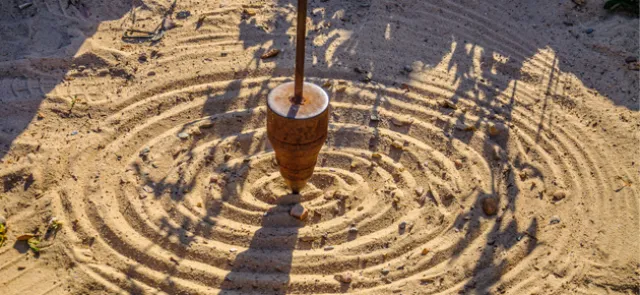
The cycloidal pendulum has three key properties: it is isochronous, tautochronous and brachistochronous. Behind these learned names lie fundamental properties—so fundamental, in fact, that we owe nothing less than the birth of clockmaking to the pendulum!
The envelope of a family of curves
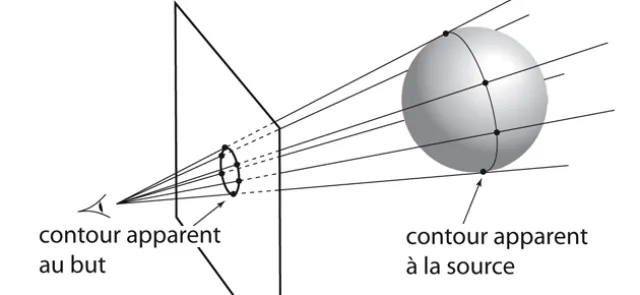
Defining the envelope of a family of lines precisely is subtler than it appears. This becomes clear when we try to extend the idea to an arbitrary family of curves. René Thom's approach provides a way around the difficulties.