



Knowledge
In-depth articles on mathematical knowledge and theories
Radical-X: combinatorics in play | Tangente
Radical X is a compact game packaged in a rectangular box with edges measuring less than 5 cm.
Elliptic curves
An elliptic curve is an algebraic curve of genus 1, defined by a polynomial equation in Cartesian coordinates with real coefficients.
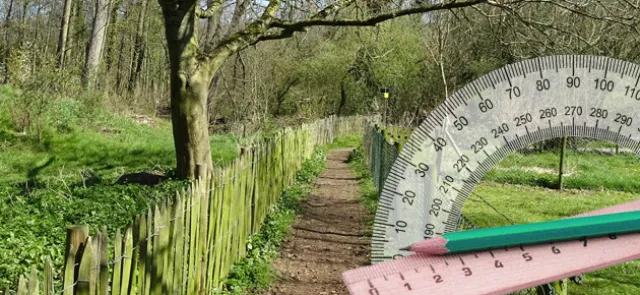
An algebraic stroll
Algebraic curves come in every degree and every variety. They can be represented in the real plane, the complex plane or even the projective plane. How can we find our way around? Learn to recognize them and navigate this rich geometric universe!
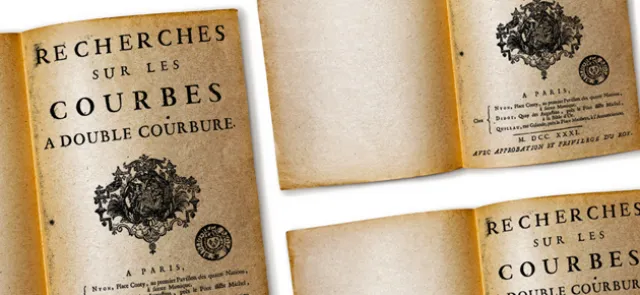
Curves that leave the plane
Not all curves in space are confined to a plane. To study these "space curves," several new concepts—curvature and torsion—are introduced using a carefully chosen frame of reference. Get to grips with them and learn how to use them!
Getting to grips with polar coordinates
Polar coordinates are particularly well suited to plotting and studying circles, rose curves, and other spirals.
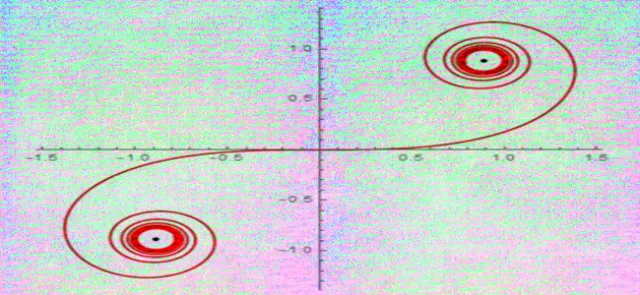
Equations for curves
There are essentially two ways to define a plane curve using equations: with a Cartesian (or implicit) equation, or with parametric equations.

A precise definition? Not so simple!
Surely the modern era has finally given us a precise, rigorous and general definition of a curve. Yet it has not! Neither analysis nor topology has so far produced a definition of "curve" on which everyone agrees.

In logic and combinatorics
In mathematical and logical puzzles, often inspired by observations of everyday life, polynomials can crop up in surprising ways. Geometry, binary logic and algorithms, peg games, combinatorics… no field is immune!

Polynomials that make a difference | Tangente
A polynomial can be evaluated without any multiplication, using addition alone. Charles Babbage based his famous "Difference Engine" on this remarkable property.

Approximating functions efficiently
Most physical phenomena involve transcendental functions such as the exponential and trigonometric functions. To minimize computation times, we try to replace them with polynomials.

Gödel's incompleteness theorems
In mathematics, although there are many conjectures and hypotheses, it is generally assumed that any well-formed statement must have either a proof or a refutation. Kurt Gödel showed that this is not so. His proof uses self-reference.

Distributions:
The idea of discontinuity is epitomized by two “functions” named after the physicists Heaviside and Dirac. An economic problem offers an opportunity to introduce the fundamentals of the underlying mathematical theory intuitively.
The Gibbs phenomenon
When an image is compressed, it not only becomes slightly blurred: wherever there is strong contrast, its discontinuities are accentuated. This is known as the Gibbs phenomenon, and understanding it requires knowing how a wave can be decomposed into harmonics.
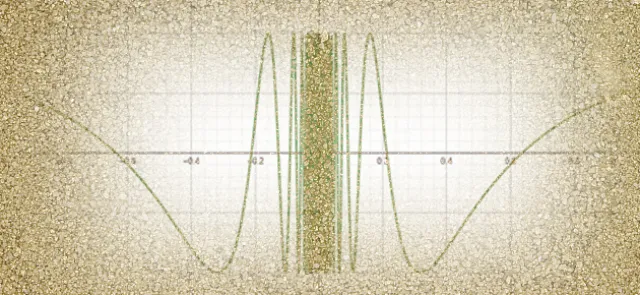
Discontinuities and series of functions
The introduction of series of functions, followed by theorems establishing when continuity or differentiability is preserved in the limit, made it possible to construct objects with unusual, counterintuitive properties. Some famous mathematicians had tremendous fun with them!
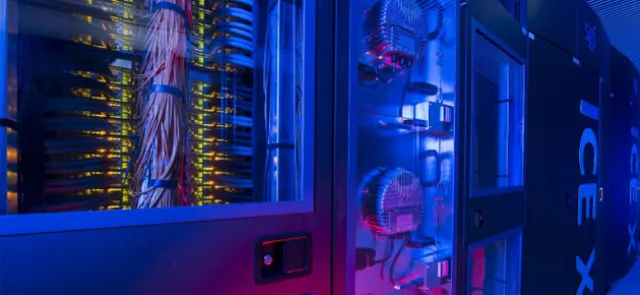
Total and mathematics: high-performance computing
HPC, or high-performance computing, harnesses multiple processing units, such as CPUs (central processing units) and GPUs (graphics processing units used for computation), to carry out computationally intensive tasks. The Total group has always been a pioneer in the field.
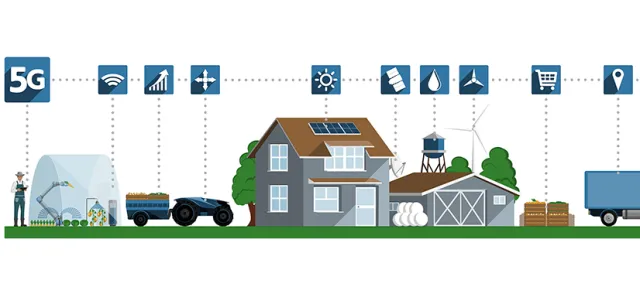
The mathematics of 5G | Tangente
Large companies are beginning to understand that they cannot survive in the long term without funding fundamental research. A career as a mathematician in the private sector is therefore possible, provided you have some understanding of technological challenges.
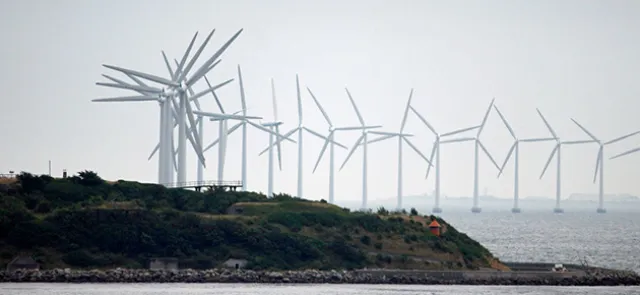
Modélisation des écoulements d'air autour des éoliennes : équations de Navier-Stokes et simulations numériques
The energy sector needs advanced mathematical expertise. In wind energy, modeling airflow means grappling with the formidable Navier–Stokes equations. Numerical simulation draws on a variety of discretization techniques.
Information geometry
Information geometry grew out of a desire to give geometric form to spaces of probability distributions. It draws on differential geometry and the study of invariance in statistics. Today, it lies at the heart of many technologies.

Taking to the skies with mathematics
An aircraft is an extraordinarily complex system. Have you ever considered how much mathematics goes into making your flight possible—and enjoyable? Come aboard! Let's take a quick look at the specific demands of aeronautics.

Blockchain in all its mathematical forms | Tangente
Blockchain technology is among the technologies to watch in the years ahead, as it could revolutionize several sectors of the economy. It draws on recent mathematical developments through increasingly sophisticated processes.