



Mathematical Themes
Explore the major mathematical themes: geometry, algebra, analysis, arithmetic, logic, and many other fascinating fields.

Happy is one who, like a number... | Tangente
Starting with an integer, apply a simple rule to obtain a new number. Repeat the process with the result, and so on... Depending on the pattern followed by this sequence—cyclic, constant from some point onward, and so on—the starting number is described as happy, perfect... But sometimes the pattern is still unknown.

Proving a program | Tangente
Writing a computer program is one thing. Proving that it actually produces the expected result is another! One major advantage of recursion is that it produces programs whose correctness is easy to prove. There is a link between writing a program and proving it correct.

Iterative processes at the heart of mathematics | Tangente
Repeating computational or logical procedures is one of the defining features of mathematical activity. The advent of computing gave fresh impetus to this technique, which has been used since antiquity.

A sequence of ideas: Ulam and Recamán | Tangente
Algorithms for constructing integer sequences from a given number are diverse. Many were devised in the 20th century by well-known mathematicians (Ulam, Kaprekar, Sloane...) and sometimes produce surprising results, some of which remain conjectures.

A little etymology
Proofs by induction were given long before this form of reasoning was formalized, let alone named.

Editorial | Tangente
Iterate, iterate... As the Shadoks proclaimed in their day, only by trying again and again do we eventually succeed. In other words, the more often it fails, the greater the chance that it will work. This may raise a smile, yet iterative processes prove to be as simple as they are effective.

A powerful tool for reasoning
By drawing infinitely many conclusions from a single principle, proof by induction is one of mathematics’ great achievements. Constructing recursively defined sequences makes it possible to model objects of practical interest and solve a wide variety of problems.
Magic every which way | Tangente
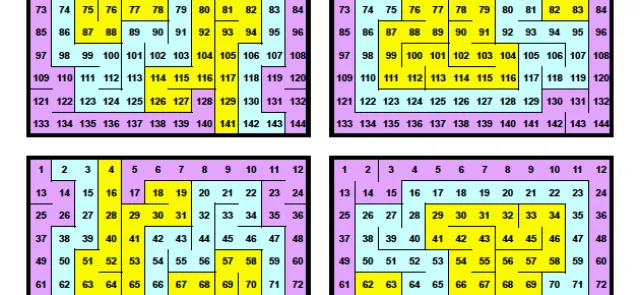
Magic squares have inspired wonder since antiquity. Mathematicians, artists and enthusiasts of every stripe have racked their brains to find forms of magic within a square beyond the "ordinary" classical arithmetic variety.

When an error bears fruit
Many mathematicians have made mistakes, whether through inadvertence, a miscalculation, a flaw in a proof, or a temporarily mistaken belief.
The unreasonable effectiveness of mathematics
In the latest physical theories, mathematical models have achieved such descriptive and predictive power that the question inevitably arises: is this mysterious fit a miracle, or does it have a deeper meaning?

Little square puzzles | Tangente
Square-grid number puzzles appeal to enthusiasts of recreational mathematics. This selection comes from the "Affaire de logique" column in the newspaper Le Monde.

Marvelous logarithms
Logarithms emerged at the very beginning of the 17th century, thanks to the eccentric Scottish mathematician and theologian John Napier. By dramatically speeding up calculations, they paved the way for extraordinary scientific advances, particularly in astronomy.

Square snippets | Tangente
Did you know that literary magic squares exist? Have you heard of nested magic squares? But where exactly does the adjective "magic" in "magic square" come from?
Albert Ayme | Tangente
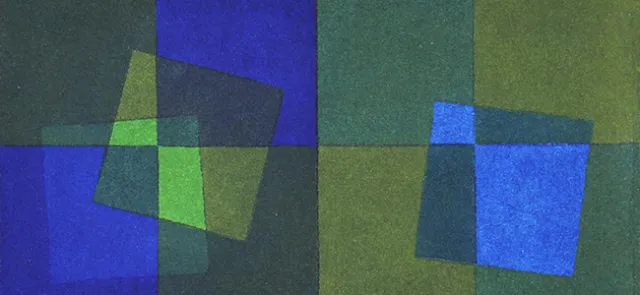
Albert Ayme left his engineering post in 1960 to devote himself to painting and sculpture. His scientific training led him to devise a combinatorial system of variations on the square, combining visual pleasure with mathematical rigor. He made the square magical!

Frances Allen (1932–2020), computing pioneer | Tangente
Frances Allen was the first woman to receive the Turing Award. She died last August, on her 88th birthday.

Would you like a slice of a sphere? | Tangente
John Conway passed away this year, but the profound questions he raised across many fields remain as relevant as ever (see Tangente 194).

196: a very curious number! | Tangente
A palindrome, or palindromic number, reads the same from right to left as from left to right, like 514,415. Here is a simple recipe for finding one.
Multiplications—for a change! | Tangente
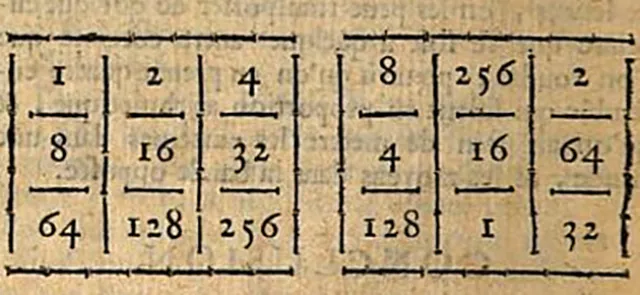
The world of magic squares is still very much alive and remains an active field of research. Access to computing power has rekindled enthusiasts’ interest in these arithmetical objects. What happens if we try to define a multiplicative form of magic?

Numbers in computers | Tangente
Many kinds of software, from scientific computing to video games, need numbers to perform their tasks. These numbers may be integers or real numbers. Despite the enormous power of computers, approximations are inevitable; as they accumulate, they can be harmful and sometimes even catastrophic.
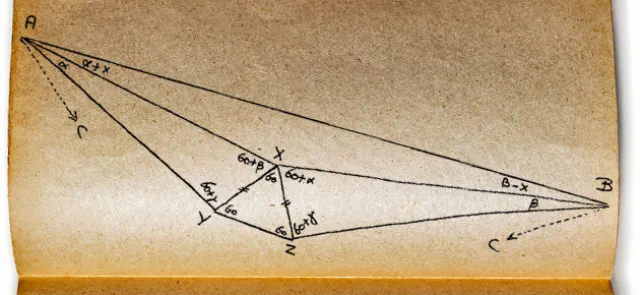
Morley's "miracle"
A symmetry appearing out of nowhere, an equilateral triangle emerging amid the trisectors of a completely arbitrary triangle: that is the whole "miracle" of Morley and his theorem. The many proofs of this beautiful property are marvels of geometry and trigonometry.