



La compagnie Terraquée, établie à Saint-Denis, est désormais bien implantée et rayonne au-delà de la Seine-Saint-Denis ; son festival annuel « Maths en ville » est aujourd’hui un évènement attendu par de nombreux fidèles.
Tangente : Vous organisez en octobre prochain la septième édition du festival Maths en ville [voir un aperçu du programme en encadré en fin d’article], quelles sont les spécificités de cet évènement annuel ?
Terraquée : Maths en ville mobilise beaucoup d’acteurs du monde culturel hors culture scientifique. Des évènements ont lieu dans des librairies, des cinémas, des médiathèques… Provoquer des rencontres est pour nous quelque chose d’essentiel. Cette année, il y aura parmi les invités des personnes bien connues des lecteurs de Tangente, comme Carole Trébor, lauréate du prix Tangente des lycéens en 2021 [pour son roman Combien de pas jusqu’à la lune ?, Albin Michel, 2019], Avner Bar-Hen et Quentin Lazzarotto, lauréats du prix Tangente 2022 [pour Dingue de maths, EPA Éditions, 2021], ou encore la conteuse Marie Lhuissier et la compagnie de clowns L’Île Logique (voir Tangente 204, 2022). Les livres et les spectacles sont de bons moyens pour investir des lieux fréquentés par des personnes qui ne seraient pas spontanément attirées par les mathématiques. Nous sommes aussi particulièrement fiers cette année de compter dans le programme du festival une avant-première nationale pour le film Le Théorème de Marguerite (Anna Novion, 2023). Ce sera le 12 octobre, en présence d’Ariane Mézard, conseillère mathématique pour le film.
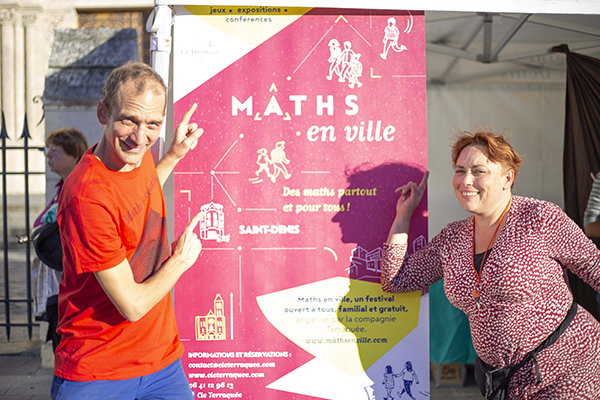
François Perrin et Meriem Zoghlami.
Changer les idées préconçues
Comment est venue l’idée de ce festival ?
Meriem : Nous sommes bien implantés à Saint-Denis, j’aime parler aux gens, provoquer des discussions. On me demande souvent ce que je fais dans la vie. Quand je dis que je dirige une compagnie qui allie théâtre et mathématiques, les réactions sont souvent vives : il y a ceux qui peinent à croire que ça existe, ceux qui disent combien ils détestent les maths… ou le théâtre… ou les deux ! Malgré ces réactions qui semblent négatives, la discussion dure souvent un moment. En 2017, je me suis dit qu’on pouvait essayer de montrer aux habitants de la ville ce qu’on fait, les convaincre que voir une pièce de théâtre, faire des mathématiques, sont des activités dans lesquelles ils peuvent prendre du plaisir, en famille, avec leurs voisins ou même avec des personnes qu’ils ne connaissent pas ! Par ailleurs, les métiers que j’ai exercés avant de créer la compagnie avec François, m’ont permis de bien connaître le tissu associatif, les commerçants et aussi les pédagogues à Saint-Denis. Nous avons conçu un premier programme et quand nous l’avons présenté à toutes ces personnes, la plupart se sont tout de suite montrées très enthousiastes.
Quelle a été le retour des habitants de la ville après cette première édition ?
Meriem : Avant même que le festival ait lieu, quand on arpentait les rues et les cafés pour distribuer des prospectus, les bras se tendaient spontanément : « C’est le truc autour des maths ? Je le veux ! » Puis, très vite, les gens nous ont demandé ce qu’il y aurait l’année suivante.
Comment décririez-vous le festival ? Comment cela se passe concrètement ?
François : Très rapidement le festival a attiré un public varié, venant de toute l'Ile-de-France. Nous sommes toujours très attentifs à l’équilibre du programme, tout le monde doit s’y retrouver. Nous travaillons aussi en amont avec les personnes qui interviennent, pour que les contenus soient adaptés à la fois pour les personnes qui aiment les mathématiques et qui les connaissent un peu et à la fois pour les personnes qui les redoutent. « Maths en ville » est une fête populaire, tout est en entrée libre, dans des lieux ouverts.
Quels seront les grands moments de « Maths en ville » 2023 ?
Terraquée : Le samedi 30 septembre, nous ouvrirons le festival avec l’après-midi « Les maths sont dans la place » (place du 8-Mai-1945). Ce moment est important, très familial. Des tapis et des fauteuils sont installés pour que tout le monde se sente à son aise. Certaines animations sont devenues de vrais rendez-vous et sont très attendues, comme les constructions de polyèdres géant de l’association Science ouverte ou le planétaire humain d’Emmanuel Rollinde. Il y aura aussi des jeux classiques (échecs, awalé…) et plus spécifiquement mathématiques (avec l’association 2AMAJ Val-de-France ‒ Association pour l’approche des mathématiques par l’art et le jeu ‒ en particulier), de la cryptographie (avec l’association ARCSI ‒ Association des réservistes du chiffre et de la sécurité de l’information ‒), les ludothèques de la ville sont aussi impliquées. Peut-être plus inhabituel, l’unité d’archéologie de la ville et l’association Suivez la Flèche proposent trois activités en lien avec la basilique… Vous pourrez notamment vous initier à la géométrie médiévale et à la taille de pierre ! Et Tangente sera, pour la première fois, présent parmi les exposants (et partenaire de l’évènement).
Autour du patrimoine de Saint-Denis
Le mardi 10 octobre, ce sera la première édition de « Les maths sont dans la fac ! ». Il s’agira d’une journée entière, ouverte à tous, à l’université Paris-VIII située à Saint-Denis. Nous nous réjouissons d’organiser ce moment consacré aux mathématiques dans cette université majoritairement orientée vers les sciences sociales et les arts, et de contribuer ainsi au rapprochement de la ville et de l’université. En collaboration avec le département de mathématiques et informatique, nous avons pu concevoir un programme riche avec des jeux dans le hall (dont notre nouveau jeu « Qui veut gagner des élections ? »), la diffusion de films mathématiques, des exposés et des spectacles.
Le programme complet est disponible sur notre site Internet (www.mathsenville.com).
Comment le festival s’inscrit-il dans le travail de la compagnie Terraquée ?
Meriem : « Maths en ville » est né de notre travail quotidien et de l’envie de le partager ; en retour, les rencontres et les échanges lors du festival nourrissent le travail de la compagnie tout au long de l’année. Terraquée et « Maths en ville » s’inscrivent progressivement dans le paysage, nous faisons désormais partie du patrimoine de Saint-Denis et nous sommes assez fiers de ça, et heureux d’accueillir des gens qui viennent de partout !
François : Il s’agit d’un moment fort qui permet d’ouvrir et d’entretenir des chemins, des possibles. Par exemple, la collaboration avec le cinéma L’Écran pour le festival a incité son directeur à faire une veille sur les mathématiques avec l’idée d’organiser des évènements tout au long de l’année. On peut aussi penser aux projets que nous menons avec l’unité d’archéologie : lors de la première édition du festival, une visite d’un chantier archéologique a été menée conjointement par une médiatrice de l’association d’archéologie et un charpentier de la Compagnie Terraquée… De fil en aiguille, la rencontre s’est affinée et nous nous sommes associés pour faire une création théâtrale avec des jeunes de Saint-Denis sur les mathématiques et l’archéologie. Le thème de cette pièce d’« archéo-mathéâtre » concerne les mesures, en lien avec la célèbre foire médiévale du Lendit.
Quelle est votre recette pour attirer le public ?
Meriem : Il faut une proposition stimulante, construite et même co-construite avec les habitants de la ville. Nous nous appuyons pour cela sur notre travail de tous les jours. Le choix des lieux est aussi très important. Par exemple, pour amener nos spectacles vers les gens qui n’iraient par forcément au théâtre, nous organisons dans l’année des soirées pour les parents et les enfants dans les écoles. Pendant le festival, au-delà de la première journée « Les maths sont dans la place », nous nous appuyons beaucoup sur les médiathèques. Par exemple, lorsque Marie Lhuissier viendra conter La Faiseuse de neige à la médiathèque Flora-Tristan de la commune voisine de Pierrefitte-sur-Seine le mercredi 11 octobre, seront présents des habitants de la ville motivés par les contes, des personnes venues spécialement (par exemple parce qu’elles auront eu l’information dans Tangente) et d’autres qui seront là de manière plus accidentelle. C’est important aussi que ces publics se rencontrent.
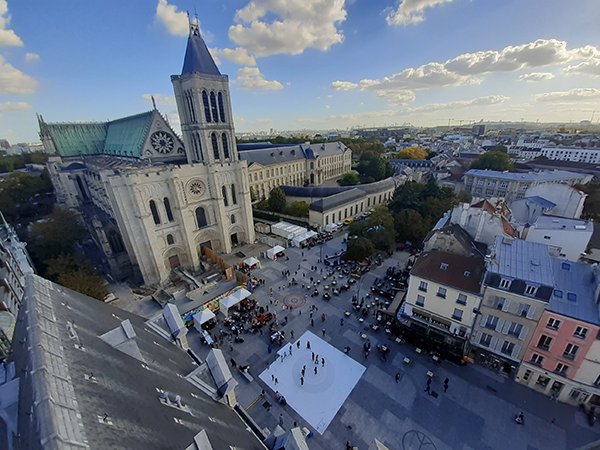
Le festival « Maths en ville », à l’ombre de la basilique Saint-Denis.