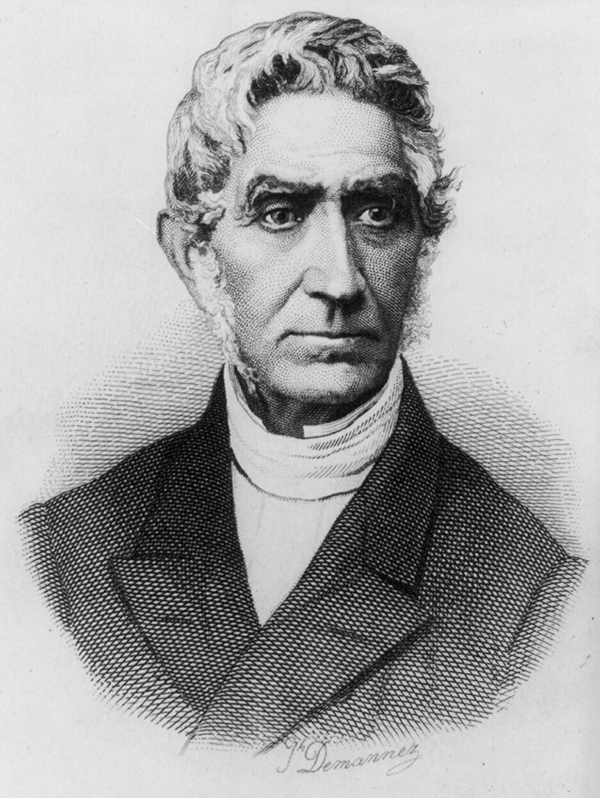
The natural sciences came first, centered on astronomy and meteorology; he founded the observatory in Brussels and then served as its director. He then turned to the human sciences, which he developed using statistical data. His book Sur l’homme et le développement de ses facultés ou Essai de physique sociale (On Man and the Development of His Faculties, or An Essay on Social Physics), published in 1835, laid the foundations for several emerging disciplines—sociology, demography, anthropometry, and criminology. Finally, probability theory was another of his interests.
Quetelet adapted the tools of the theory of errors in astronomy to develop a theory of averages for the human sciences: under certain conditions relating to the distribution of observations, averages can be interpreted in terms of the characteristics of the "average man," regarded as the center of gravity of social groups.
State statistics and political arithmetic: A common cause
----------------------------------------------------------
Quetelet played a dual role in the development of statistics. First, he succeeded in unifying two traditions. The first concerned the description of a state's characteristics, an approach developed at German universities and later adopted by statistical offices and departmental surveys during the Napoleonic period. The second was political arithmetic, which sought to quantify social phenomena.
Quetelet created two institutions: the Central Statistical Commission at the national and regional levels (1841), and the International Statistical Congress, whose sessions from 1853 to 1876 played a crucial role in professionalizing statistical work, improving its reliability, and harmonizing statistical practices—surveys, censuses, registers, tables, and publications.
From the mid-19th century onward, growing interest in variability, fostered by the German statistical school (with Wilhelm Lexis) and the British statistical school (with Francis Galton, Francis Ysidro Edgeworth, and Karl Pearson), challenged Quetelet's excessive emphasis on the mean. Yet despite this swing of the pendulum and the mathematical statistics that followed, the mean has continued to shape both our thinking and the social indicators derived from it.
References:
• Adolphe Quetelet (1796–1874). L’œuvre probabiliste. Michel Armatte and Jean-Jacques Droesbeke, Ined Éditions, 2023.
• Adolphe Quetelet, passeur d’idées. Jean-Jacques Droesbeke, Académie royale de Belgique, 2021.