



All articles
Dive into the fascinating world of mathematics with our captivating articles, written by passionate experts. Whether you are a curious amateur or a seasoned mathematician, our articles cover a wide range of topics, from fundamental concepts to the latest discoveries, including practical applications and philosophical reflections.
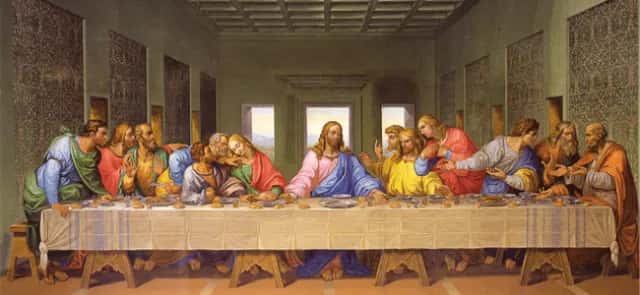
Leonardo da Vinci: various perspectives | Tangente
Among Leonardo da Vinci's many talents, his ability to reveal the many facets of perspective—all explored in his work—was by no means the least. Having mastered vanishing-point perspective, he went on to explore atmospheric perspective and then the technique of sfumato.

Luca Pacioli, Leonardo's mathematician friend | Tangente
Luca Pacioli would play a major role in the life of Leonardo da Vinci, who used his mathematical knowledge both to depict polyhedra and to improve techniques of perspective drawing.
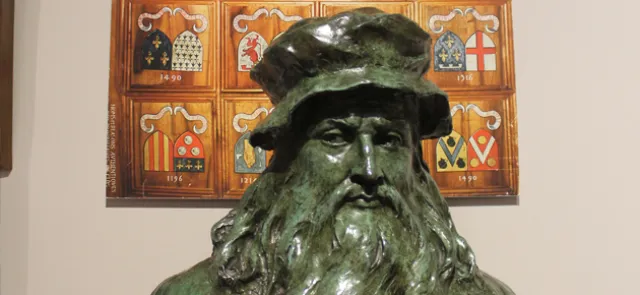
The artist as geometer
Artist, genius and gifted inventor, Leonardo da Vinci was a visionary. In a world only just emerging from the Middle Ages, and long before René Descartes, he understood the importance of the scientific method and the role of mathematics in understanding the world.

Bernard Novelli, master of logic puzzles | Tangente
No Tangente feature on mathematical games would be complete without acknowledging the role Bernard Novelli played on our magazine's team (see Tangente 141, 2011)
In the press too…
Mathematical games, familiar from the scientific press, are few and far between in the mainstream press. Some newspapers have nevertheless taken the plunge, often with success! There is indeed an audience for recreational mathematics—provided it is not schoolwork in disguise.
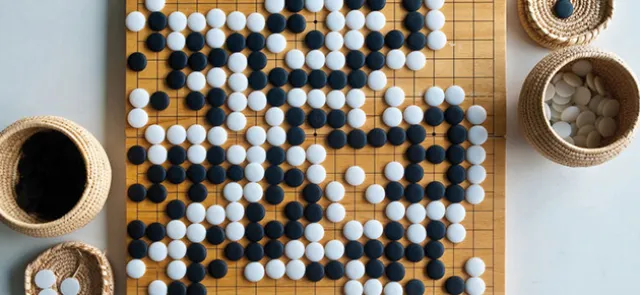
Tabletop games, games in society
Board games, solitaire games, tabletop games, games of chance, video games, traditional games… There is something for everyone, whatever their tastes! As cultural products, games reflect the societies that produce them. But they can also help us develop our mental abilities.
Mathematics lends itself to play
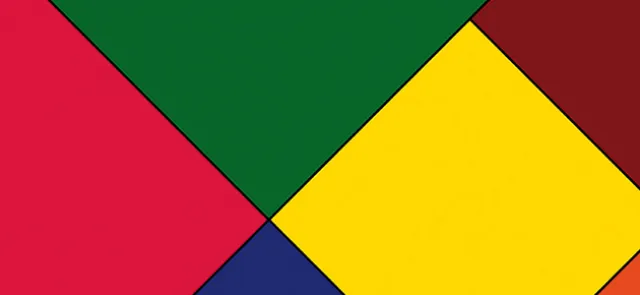
Play does not seem more closely linked to one discipline than another. Yet mathematics and play enjoy a special relationship. Mathematics lends itself remarkably well to play, and play returns the favour.

The mind-bending properties of infinity
Infinity abounds in paradoxes of every kind. For example, the terms of certain numerical series can be rearranged so that they converge… to any number chosen in advance! Skeptical? Follow Bernhard Riemann's reasoning…
Playing games in mathematics class
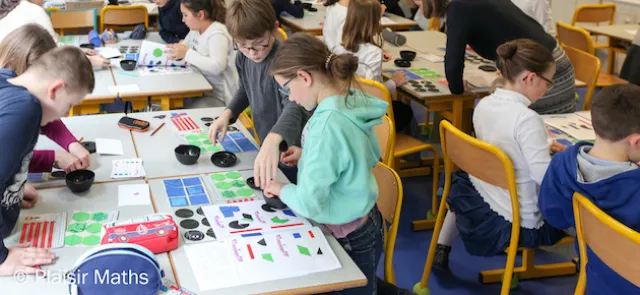
Games can play an important role in school mathematics. What if every problem took the form of a game? Here is how, in just a few playful steps, to move beyond the confines of a high-school curriculum.

Applications of the second derivative
The concept of acceleration corresponds to a second derivative. It therefore seems only natural that a mathematical concept as sophisticated as the derivative should have concrete applications. Such applications arise in questions involving the profiles of roads and railway tracks.

Finding your position at sea | Tangente
On Earth, a position is identified by two coordinates: latitude and longitude. Finding your position means determining these two values.
A new definition of the International System of Units
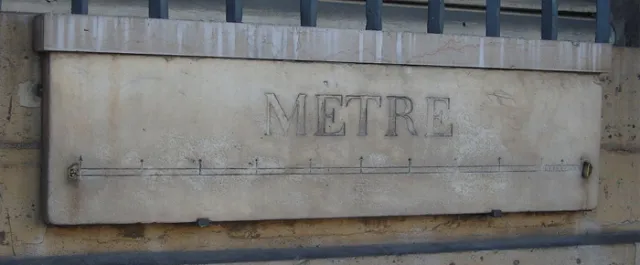
The conference held in Versailles in November 2018 changed four units of measurement, including the kilo. These new units will no longer depend on specific experiments. Their definitions will take effect in May 2019. What better opportunity to look back at the origins and evolution of our units of measurement?

Differences in notation: are mathematicians and physicists irreconcilable?
The differences between physicists' and mathematicians' notation might seem like mere turf wars, and thus reconcilable with a little common sense. There are several reasons for these differences

Physics on one side, mathematics on the oth... | Tangente
It would be misleading to regard mathematics and physics as entirely separate disciplines, given the many exchanges and interactions between them. Mathematical physics is, moreover, a nonempty intersection of the two.
When physics “proves”
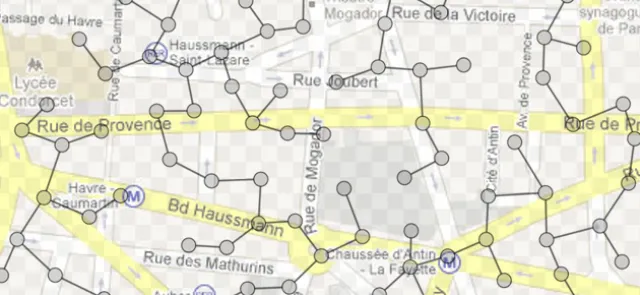
Some mathematical results are so vivid, so “concrete,” that they lend themselves beautifully to physical experiments. With a little ingenuity, they can even be “proved” physically! This is true of the Pythagorean theorem, the law of cosines and, indeed, triangle geometry as a whole.
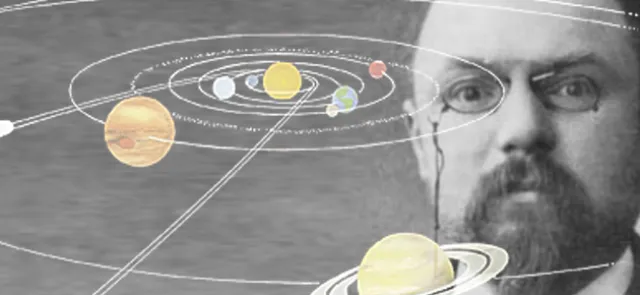
From the three-body problem to mathematical chaos
The elusive three-body problem saw spectacular progress thanks to Henri Poincaré. The French mathematician went further, devising new, more geometric methods for studying dynamical systems. His research has shaped our understanding of the stability of the solar system.
Lagrange and the analytical method
At the time of his death, Isaac Newton was proud to have found a method for solving problems in natural philosophy, but he was aware of its limitations. The Moon's trajectory is described only very approximately by the two-body problem. It fell to Joseph-Louis Lagrange to make a spectacular breakthrough.
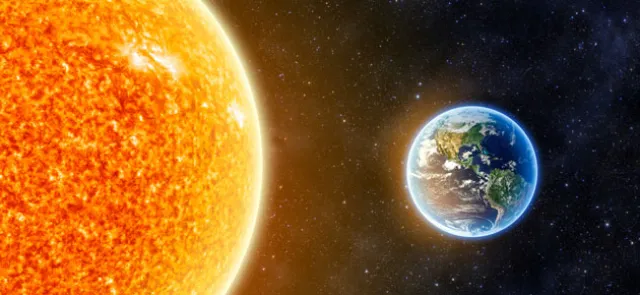
Newton's synthetic method
How does the Earth, of mass m, move around the Sun, of mass M, under gravity alone? To answer this question with something more than philosophical assertions, Newton proposed a synthetic method inspired by the description of motion.
A science in motion | Tangente
Neither mathematics nor physics stands still! Until recently, the two disciplines went hand in hand, offering a natural philosophy. They sought to uncover, describe, and explain nature's hidden laws.

Approximations in physics | Tangente
They trouble mathematicians, for whom sin(x) can never equal x when x is a nonzero but "small" real number. Yet they are useful! "They"? Approximations!