



All articles
Dive into the fascinating world of mathematics with our captivating articles, written by passionate experts. Whether you are a curious amateur or a seasoned mathematician, our articles cover a wide range of topics, from fundamental concepts to the latest discoveries, including practical applications and philosophical reflections.

Intelligence agencies: the world's largest employers of mathematicians
In the popular imagination, intelligence agencies are staffed by muscle-bound spooks, not exactly refined intellectuals—and certainly not computer scientists sitting behind screens or fully trained mathematicians with degrees. In reality, precisely the opposite is true!

Passwords… not so secret
From Dupont00 to 2r67W@SBZX2!r9, we all use passwords, and their apparent complexity is usually deceptive. If our current passwords are so ineffective, how can we keep our data and privacy secure?

Mobile phones: location, networks and mathematics
A spy's dream would be for the target—the person under surveillance—to carry a microphone and a camera and be locatable. In fact, this is no longer a dream: everyone now owns a smartphone, complete with a microphone, a camera and GPS. The spy's life has become so easy…

Codebreaking in intelligence: history and methods
Throughout history, decrypting coded messages has played a major—though often overlooked—role. From the first battle won through cryptography alone to the breaking of Enigma, examples abound, but they have often been kept hidden. That remains true today.

Linear equations and linear recurrences are one and the same!
One of a mathematician's skills is recognizing the same structures in different guises. A similarity in the calculations used in two ostensibly separate areas is often an early sign of this… Let's look at certain differential equations and sequences.
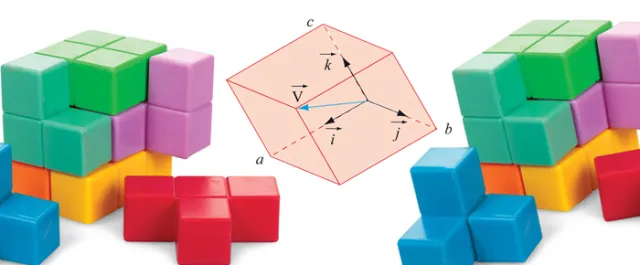
Polynomials... viewed as vectors
What could a quadratic polynomial possibly have in common with a vector in three-dimensional space? At first glance, nothing: they are different kinds of objects. Yet both have the same form—each is described by a triple of numbers. Better still, calculations with one correspond to calculations with the other!
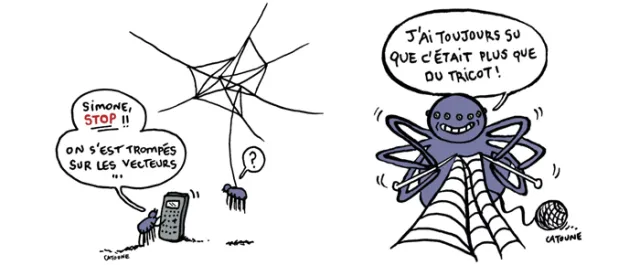
Drawing a spider's web
Have you ever found yourself doodling spiderwebs in the margin of a calculation that was going nowhere? Not like an entomologist (since spiders are not insects), but however you please, subject to a few simple geometric rules...
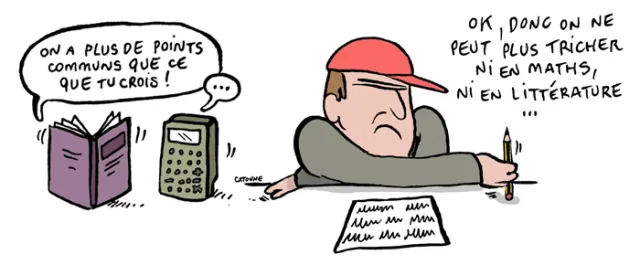
Words are vectors!
Comparing two vectors is rather like comparing two texts. This analogy proves highly relevant to the study of a literary corpus: combined with computing power, the tools of linear algebra can be used to compare two texts or measure their similarity.

Composing geometric transformations
Some geometric problems, however complicated they may look, quickly become clear once geometric transformations are brought in, and are often solved by composing them. To do this, it helps to recast them in vector terms.

Collinearity, coplanarity, concurrency... it's all the same story!
Points and lines in the plane are dual notions: theorems about collinear points correspond to theorems about concurrent lines. This duality can be defined geometrically. It even extends to space, through coplanarity.

Geometry without figures
Michel Chasles dreamed of it; the theory of vector spaces now makes it possible: we can do geometry without drawing a single figure. Geometric and algebraic viewpoints thus coexist, and everyone can choose whichever feels most comfortable!

From vector spaces to affine spaces… and back again!
Linear algebra arose from the need to provide a framework for ordinary geometry. From a computational standpoint, it has been a success! By making certain operations and manipulations simpler and more systematic, it streamlines geometric reasoning and makes it more rigorous.
Linear maps: the "hard core" of linear… algebra
Linear maps are an essential concept in the theory of vector spaces. They have many uses, including designing and solving games.
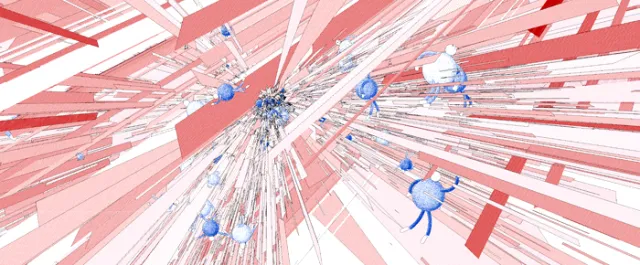
“The” dimension: not such an obvious idea!
The notion of dimension can be glimpsed in Euclid, then takes clearer shape with Descartes before branching out according to the subject at hand: analytic geometry, vector spaces or topology. There is a whole host of “dimensions”! Here, the focus is on the dimension of vector spaces, due to Georg Hamel.
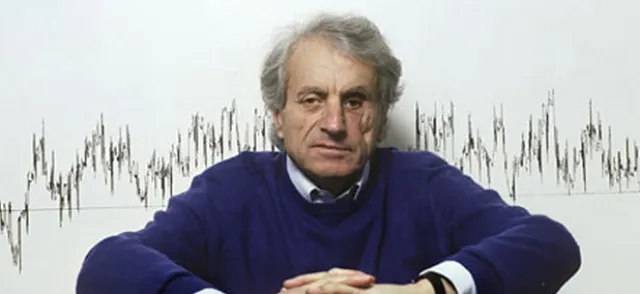
Yannis Xenakis's "musical vector spaces" | Tangente
In 1963, the celebrated composer Yannis Xenakis introduced a kind of arithmetic for musical composition, based on the notion of mathematical structure—in particular, that of a vector space. This artistic contribution lends itself wonderfully to scientific analysis.

Matrix algebra in our images – Maths brief | Tangente
Matrices and vectors have become indispensable mathematical and computational tools for digital image processing.

The vector art manifesto – Maths brief | Tangente
The Scowcza collective creates works of vector art. You have already come across several of them in the articles in this issue
Drawing a line: not so simple! – Maths brief | Tangente
How can straight lines be drawn on a screen made up of pixels? Several algorithms can solve this thorny problem.

Gram–Schmidt method – Math brief | Tangente
Discover the celebrated Gram–Schmidt method for constructing orthonormal bases of vector spaces

Cross product and scalar triple product
Defined on three-dimensional Euclidean space, these two products grew out of Hamilton's quaternions. They have become useful tools in geometry and mechanics.