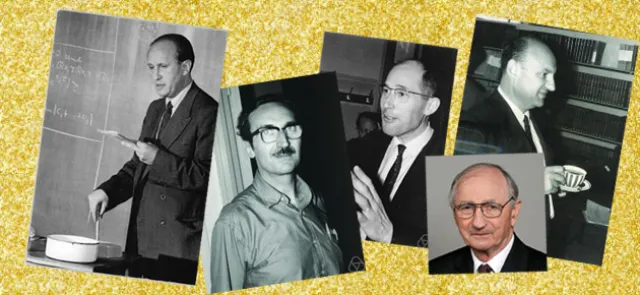
Paul Halmos (1916–2006)
-----------------------
Born in Budapest in March 1916, Paul Halmos joined his physician father in Chicago at the age of 13, then left to study philosophy at the University of Illinois at 16, before turning to mathematics. After earning his doctorate in 1938 on invariants in stochastic processes, under the supervision of the great probabilist Joseph Leo Doob (1910–2004), one of the founders of martingale theory, he assisted his fellow Hungarian John von Neumann at Princeton for two years. Of this giant, Halmos would say that "his quickness, his depth, his insight and his inspiration stimulated [him]". It was thanks to him that he wrote, from his lecture notes, his first book, Finite-Dimensional Vector Spaces, which established him de facto as a remarkable writer of mathematics. Clarity, concision and originality are the main characteristics of this author, who was also a talented professor, editor and lecturer. Besides his textbooks on mathematical pedagogy in set theory and functional analysis, he published, following the example of two other Hungarians, György Pólya (1887–1985) and Gábor Szegő (1895–1985), problem books for all levels.
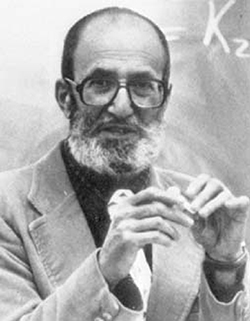
For Halmos, mathematicians are not mere calculators but artists, since mathematics is a creative art. Thus, doing mathematics is not limited to reading it, but to engaging with it! Ask your own questions, find your own examples, work out your own proofs. Is this assumption necessary? Is the converse true? What happens in the classic cases? And in the degenerate cases? Where does the proof use the assumption?
John Conway credits Halmos with coining the abbreviation iff for if and only if, the English-language equivalent of our ssi for si et seulement si. The symbol marking the end of a proof is also called a halmos.