Founded in 923 on (and in) the rock, the monastery of San Martín de Albelda, in what is now northern Spain, quickly became a center of culture and scholarship. Between 974 and 976, the Codex Vigilanus was written there in Latin and named after its principal author, Vigila. It contains the following passage: "It should be known that the Indians possess a most subtle genius, and that all peoples are inferior to them in arithmetic and geometry as well as in all the liberal arts; this is abundantly clear from the nine figures by which they denote every number, however large, whose forms are as follows: 9 8 7 6 5 4 3 2 1." Thus, when Indian numerals were first imported into the Latin West, zero was left out!
From Gerbert to Bernelin
---------------------
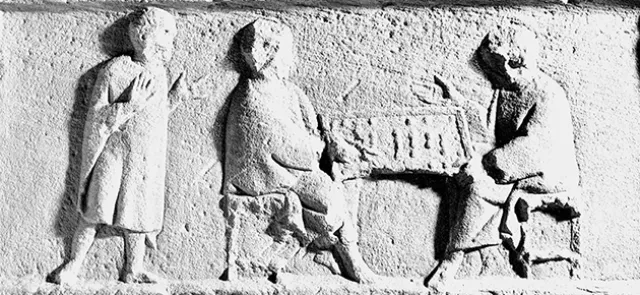
The young Gerbert of Aurillac (c. 945–1003) spent time at the monastery of Ripoll around 967–970. It was probably there that he encountered Indian numerals through someone who, we may imagine, was also the source behind the Codex Vigilanus. We later learn from one of his students in Reims that Gerbert had made a calculating board—an abacus—consisting of 27 vertical columns numbered with nine new symbols. Although this abacus has disappeared, it is reasonable to assume that these were the nine Indian digits. Nine, not ten—once again showing that Gerbert, too, had failed to import zero.
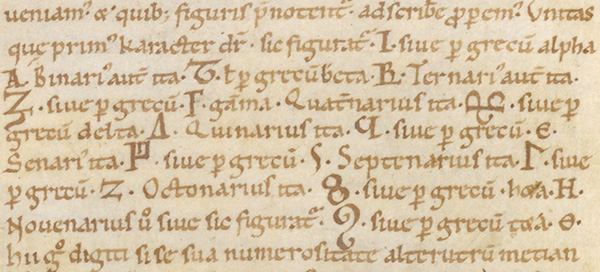
Bernelin of Paris, one of Gerbert's disciples, then wrote a treatise introducing Indian numerals in a highly instructive way: he gave his readers the Latin name of each number (unitas, binarius, etc.) along with its equivalent in the Greek numeral system (alpha, beta, etc.). Yet this manuscript—the oldest surviving manuscript in France to feature Indian numerals—still contains no zero!