



Famous figures
Portraits of famous mathematicians, historical and contemporary
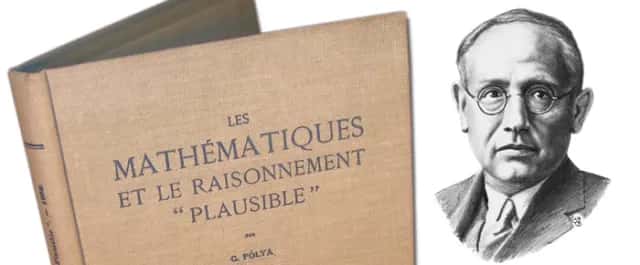
Psychological experiments in arithmetic
Like any other scientist, a mathematician makes use of experiments. But these do not necessarily resemble those conducted in other sciences: carried out mentally or on a sheet of paper, they are usually psychological in nature!

2016 Awards: the winners
The 2016 Tangente Awards were presented on November 28 at the Palais du Luxembourg. Here is our report on awards that are gaining ever greater prominence in France's scientific and cultural landscape.

The ternary Cantor set
Cantor constructed a fractal set before fractals had a name, showing that a subset of the real line can have the cardinality of the continuum, have measure zero, and have empty interior.

Dedekind and sets — Mathematical brief | Tangente
One of the earliest champions of set theory was the German Dedekind, who famously corresponded with Cantor.
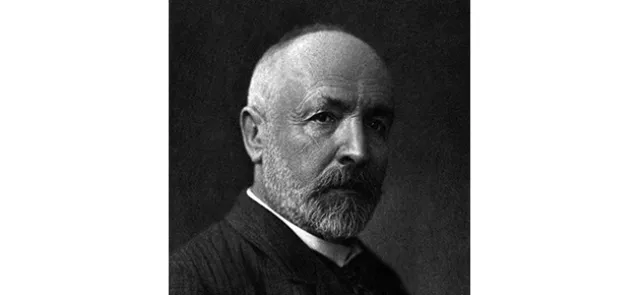
An unsettling approach to mathematics | Tangente
Set theory, iconoclastic in Cantor's day, has become universal. Nothing like it had been seen since Euclid: it provides a foundation for mathematics! That foundation seemed solid—until paradoxes emerged. So what is this highly controversial mathematical construction?
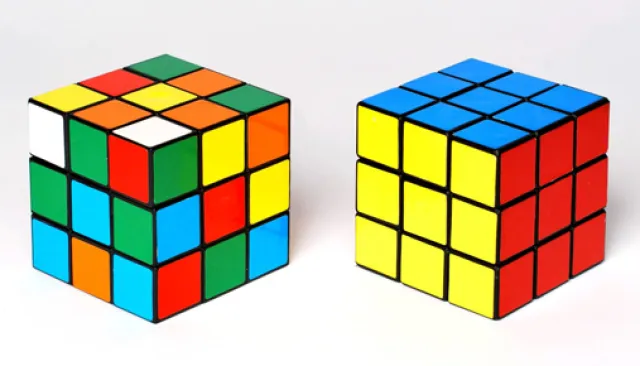
Join the groups!
The concept of a group first emerged from efforts to solve equations in the 19th century and soon became indispensable, highlighting parallels between situations that at first seem quite different. Let's see why mathematicians are so group-minded.
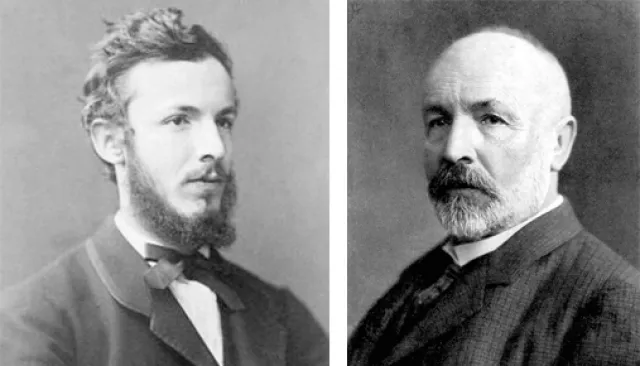
Georg Cantor: from finite to infinite
To extend useful results about finite sets to infinite sets, Cantor defined equality of cardinalities in terms of bijections, and hence inequality in terms of injections and surjections. Remarkably, this yields an order relation.

Pythagoras without words: visual proofs | Tangente
How many students can prove the Pythagorean theorem? Yet there is certainly no shortage of proofs.
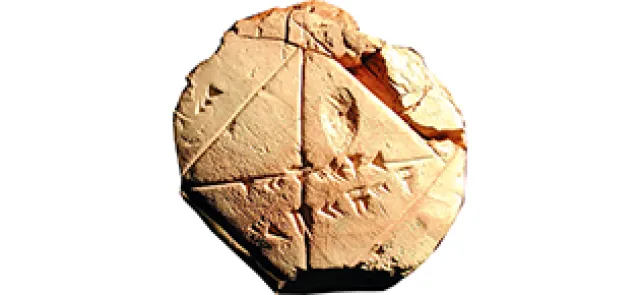
Proofs of the Pythagorean theorem through the ages
The Pythagorean theorem began as a result about squares constructed on the sides of a right triangle. Those geometric squares later became arithmetic squares, before the theorem ventured into abstract spaces. Would Pythagoras recognize his theorem if he came back to life today?
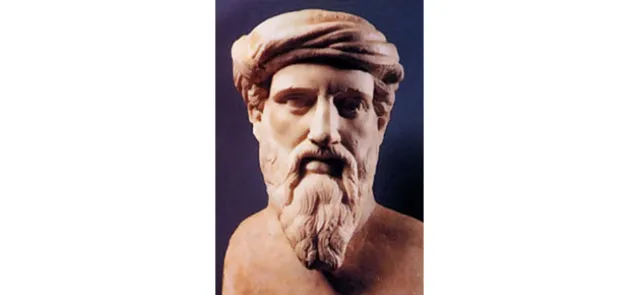
Pythagoras: much more than a theorem
Pythagoras is more than the name of a famous theorem: he inspired an entire philosophical tradition that would influence not only mathematics and astronomy but music itself. Beyond the sciences, history has not heard the last of the "long-haired Samian"!

A few classic paradoxes
Paradoxes are fun to explore and require no specialist knowledge. They help us better understand rationality, truth, probability, uncertainty and information… along with the many theories built around them. Prepare to be surprised by a few spectacular classics.

Yoccoz: thirty years in dynamical systems | Tangente
The French mathematician Jean-Christophe Yoccoz died on September 3; he was 59.

Roger Godement: an extraordinary mathematician | Tangente
Who has not had Roger Godement's monumental Cours d'algèbre on their shelves—the textbook that introduced generations of budding mathematicians to linear algebra and undoubtedly taught them to love it?
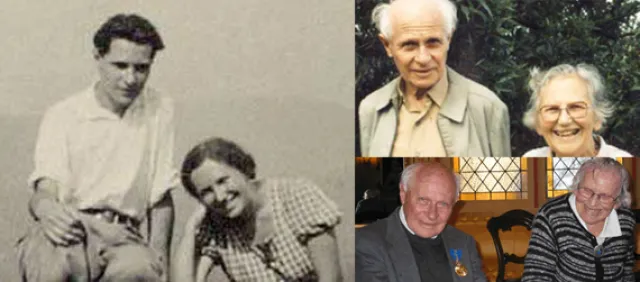
The "happy ending" problem
In 1933, Hungarian mathematician Eszter Klein posed an apparently elementary geometry problem to a group of young colleagues. It would lead to the birth of a new field of mathematics, discrete geometry, and... a marriage.

Cancer: maths to beat the disease | Tangente
"At a time when medicine can join forces with mathematics to predict how a cancer develops, it is high time we rethought our prejudices about maths — and, while we're at it, about women mathematicians…"

Solar System stability: the KAM theorem | Tangente
Jürgen Moser belongs to the long line of mathematicians who have tackled the problem of the Solar System's stability. He is the "M" in the KAM theorem's trinity—Kolmogorov, Arnold and Moser—which links number theory and celestial mechanics.

Celebrating mathematical literature | Tangente
As has become tradition, Tangente readers are invited to vote from July until the end of September to select the nominees for the Tangente Book Prize, from whom the jury will choose the 2016 winner. The inaugural Tangente High School Students' Prize will be announced at the same time.

Plaque in memory of Évariste Galois in Paris | Tangente
Passersby on the rue des Bernardins will now be able to pause and wonder at this plaque, which was missing from the capital.

Rademacher's error on the Riemann hypothesis | Tangente
The German-born mathematician Hans Adolph Rademacher (1892-1969), a professor at the University of Pennsylvania, was a giant of number theory.

Babies love numbers too: an innate number sense | Tangente
"At three days old, babies are sensitive to a ratio of 3 to 1. They can tell 3 and 9 apart, 4 and 12. At six months, it's 2 to 1. At nine months, 3 to 12."