



Famous figures
Portraits of famous mathematicians, historical and contemporary

A sculptor of polyhedra in Paris: art & geometry | Tangente
In the "Village Saint-Paul" in Paris is a shop called Cabinet de curiosités géométriques, where numerous polyhedra pile up. Our editorial team got in touch with its owner, Sylvain Calvier.

Euclid, master of division
With the Greek mathematicians—Euclid in particular—numbers moved from the concrete to the abstract. One key concept endured: Euclidean division and the host of developments it spawned. These methods have not aged a bit: Euclid's algorithm is still used today... by computer scientists!

Number theory in 2016: a wealth of news | Tangente
An unexpected bias in the distribution of prime numbers has just come to light. At the same time, Andrew Wiles receives the Abel Prize.

APB software: post-bac placement algorithm | Tangente
A software program assigns students who have just passed the baccalauréat according to their preferences. But the opacity of how it works leaves room for a number of concerns.
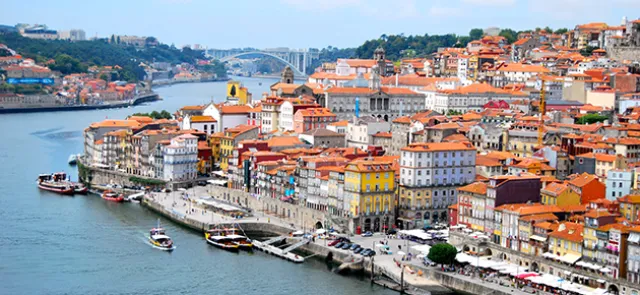
Porto: in Gomes Teixeira's footsteps | Tangente
When we think of Porto, we think of its wine, its river and bridges, or the much-missed filmmaker Manoel de Oliveira. We never think of its mathematician, Francisco Gomes Teixeira Costa! Let's revisit the Portuguese city by following in his footsteps.

The Liouville Journal: a key mathematics publication | Tangente
In 1832, the Annales de mathématiques pures et appliquées, better known as the Annales de Gergonne, ceased publication after twenty-two years.

Heine and the rigorous study of continuous functions | Tangente
Eduard Heine is not among the best-known mathematicians, even though his name is attached to a theorem on the uniform continuity of continuous functions on a closed interval.

On the trail of a forgotten book: 19th-century textbooks | Tangente
The Éléments de trigonométrie rectiligne (Elements of Rectilinear Trigonometry), written by a mysterious F.J., were found in the trash of a religious institution in Damascus in the early 1990s.
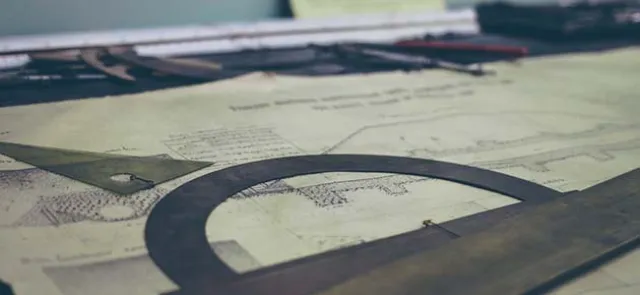
From Euclid to Bourbaki: perpetual reform
Mathematics has undergone waves of reform in the past, is undergoing them now, and will continue to do so. This applies to schools of mathematical thought and major research movements, but also to elementary mathematics—the mathematics taught in secondary schools in most countries around the world.

Mathematician and pianist: a winning composition | Tangente
The final of the 27th international competition for great amateur pianists, bringing together 92 candidates from 27 different countries, took place on April 10 at the grand amphitheater of Assas in Paris.

Lines that have a name (2)
Some lines have a name, and some mathematicians have their own line.
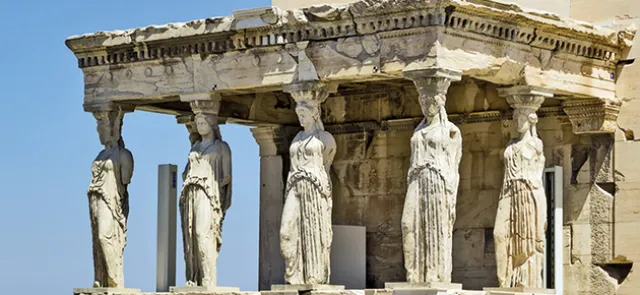
Euclid: an introduction to the straight line
Written more than two thousand years ago, Euclid's Elements is a foundational text of classical geometry. The concept of the straight line is central to it. Let's meet this scholar of ancient Greece and take a closer look at his view of the straight line.

These lines that bear a name (1)
Some lines carry a mathematician's name. They are generally lines associated with the triangle, linked to certain notable points.

Descartes and Cartesian coordinates | Tangente
To locate points in a plane, Cartesian coordinates are generally used. Descartes is credited with inventing this method, so much so that it bears his name. Wrongly?

Without straightedge, without compass: Mascheroni | Tangente
Every straightedge-and-compass construction can be carried out with compass alone. This rather extraordinary result comes as a surprise.
The number line: definitions versus intuition
In the 19th century, mathematicians sought rigorous definitions of the quantities that make up the continuum of the line. How did they rigorously characterize the real continuum?

The definition of the straight line through the ages
You thought you knew what a straight line is? Read on, and you may well start to doubt it…
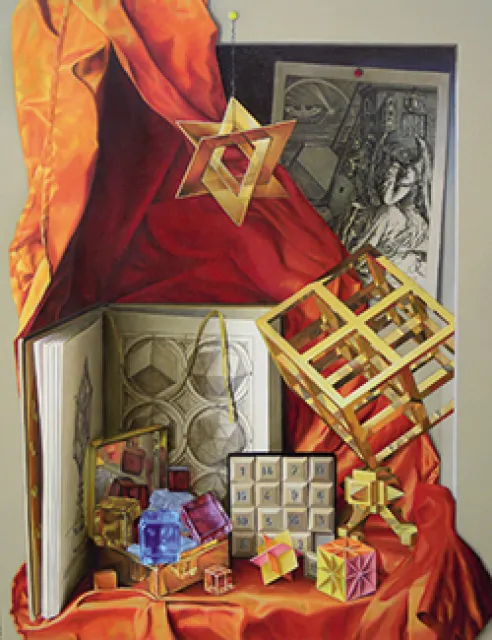
Sylvie Donmoyer, an artist fascinated by mathematics
An artist, not a mathematician, Sylvie Donmoyer is fascinated by geometric forms. In one engraving after another, inspired by Dürer and above all by Escher, she weaves connections between the two worlds of art and mathematics.
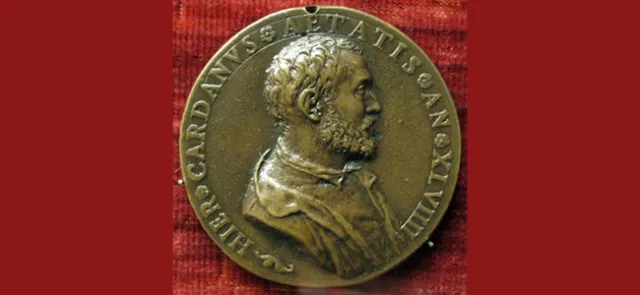
Scientists tempted by astrology
Astrology appealed to scientists when the origin of gravitational forces was still unknown. Since the advent of the scientific method, championed by Galileo and Descartes, and Newton's discoveries, it has been no more than an obscurantist pursuit.

April Fools' math: humor and science | Tangente
Let's take advantage of April Fools' jokes to revisit, with Stephen Leacock, a few mathematical classics in a lighthearted way…