



Famous figures
Portraits of famous mathematicians, historical and contemporary

Jolygons: iterative polygonal spirals | Tangente
This is not a polygon

The one-cut theorem: any polygon in a single cut | Tangente
Can a polygon be cut from a sheet of paper with a single straight cut? Surprisingly, the answer is yes! More surprisingly still, this also applies to other objects.

Pentagonal architecture: towers, castles and the Pentagon | Tangente
The pentagonal tower has stood since the 14th century in Castellane, a fortified town and subprefecture of Alpes-de-Haute-Provence.

Squaring polygons
Archimedes' Stomachion, the world's oldest puzzle, can produce thousands of shapes from fourteen polygonal tiles. But what about the inverse problem? Under what conditions do two given polygons have a common polygonal dissection, and how can one be found?
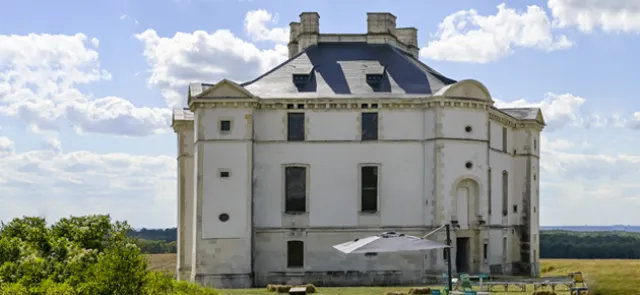
Maulnes Castle: Renaissance architecture on a pentagonal plan | Tangente
Few people know that less than 200 km from Paris stands a Renaissance castle built to a pentagonal design. Only a handful of such buildings can be found anywhere in the world...
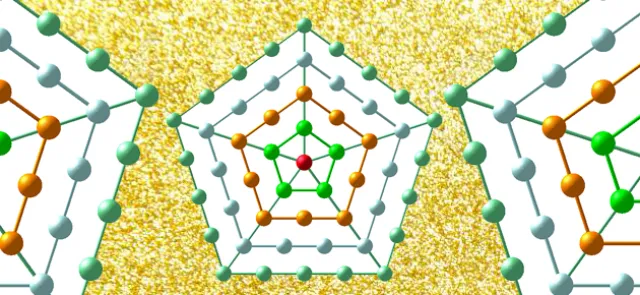
When polygons form numbers
All is number! The Pythagorean school established many properties of numbers from their geometric representations. First developed for triangles and squares, this way of arranging numbers was later extended to all kinds of polygons.
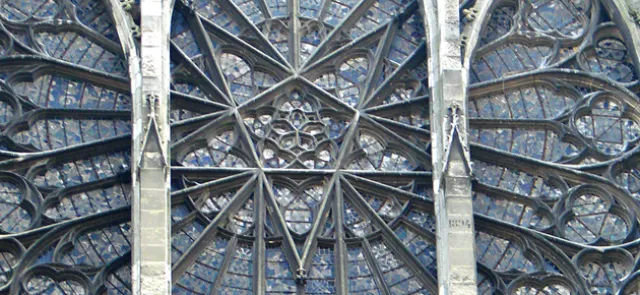
Pentacles and pentagrams: symbols and mathematics | Tangente
The pentagram, also known as the star pentagon, is a non-convex pentagon formed by joining every other vertex of a regular pentagon. It has journeyed through the ages and across civilizations, always shrouded in mystery.

A little gem from Gauss
Triangles and quadrilaterals have inspired a wealth of mathematical literature. Yet few people seem to have taken a close interest in pentagons before a certain Carl Friedrich Gauss, who gave us a little gem for calculating their areas.

Pythagoras and Heron
Heron's formula emerges when we seek to express the area of a triangle in terms of its side lengths. A variation of the argument recovers the Pythagorean theorem.
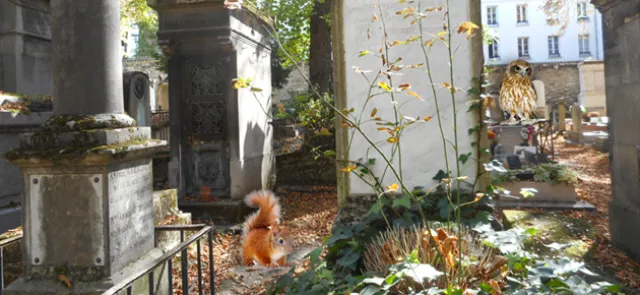
The mathematicians of Père-Lachaise | Tangente
At this time of year, around All Saints’ Day, tradition calls for visits to cemeteries. So let's take the opportunity to visit the graves of mathematicians in the most iconic cemetery of all: Père-Lachaise.

Daniel Litt's probability problems
The young mathematician Daniel Litt currently holds a position at the University of Toronto. His research usually explores the interplay between algebraic geometry and arithmetic. Yet in recent months, he has attracted attention in an entirely different field, even earning an interview with the renowned online publication Quanta Magazine.

Working environments for mathematicians
The abstract notion of space in mathematics is very different from what intuition suggests. Depending on the type of structure available, we can work with concepts from algebra, analysis, or geometry.
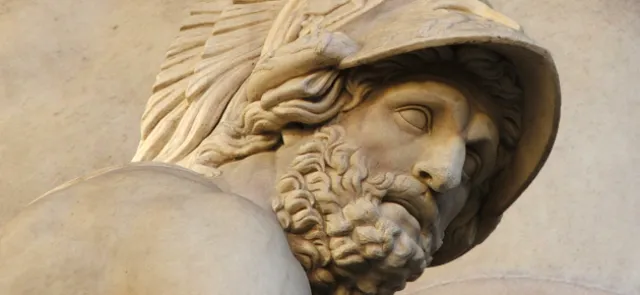
Thales’ children
Many proofs in elementary geometry rely on proportionality. Almost all of geometry’s classic theorems involve it: Thales, Ptolemy, Menelaus, Ceva, Pappus… Here is a brief tour of these great problems.
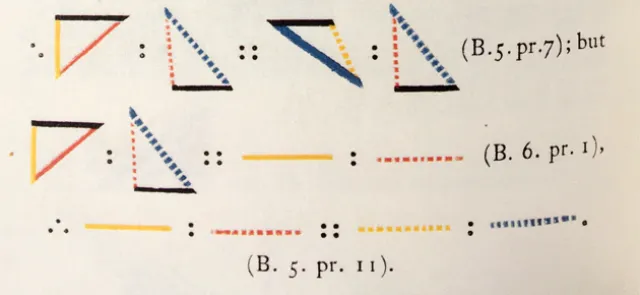
In Euclid's work
Ancient geometers struggled to handle ratios of lengths or areas that were not necessarily commensurable, because they could not conceive of irrational numbers. The definition found in Euclid's Elements remained in use until the 19th century.

Grothendieck: mathematics' rebel legend | Tangente
On the Radio France website, the programme "Les grandes traversées" explores the lives of people who embarked on momentous journeys, whether literal, political or intellectual.

Pierre Cartier (1932–2024): a tribute | Tangente
Nicolas Bourbaki himself announced it in "Le Carnet" in the September 1–2 issue of Le Monde: the group "pays tribute to Pierre Cartier, who died on August 17 and was a contributor to and voice of the group for many years. A wide-ranging, voluble and mischievous mathematician (he announced Bourbaki's death forty years ago), he leaves behind a rich and varied legacy."
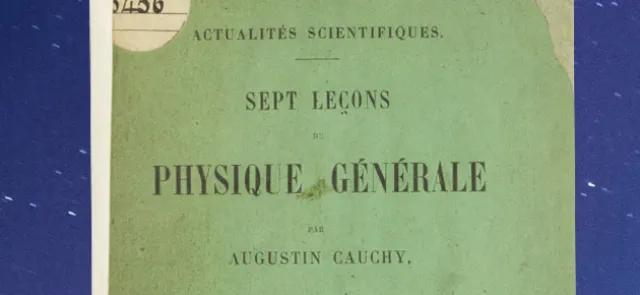
How Cauchy saw the world: science and faith | Tangente
In a series of lectures, Cauchy reveals his vision of the real world through the science of his day. They reveal a scholar wrestling with his religious convictions.

Complex analysis in fluid mechanics | Tangente
When Cauchy, ever the theoretician, developed complex analysis, he could hardly have imagined that his results would lead to so many powerful methods for designing aircraft wings or studying fracture mechanics.
Origins of group theory: Cauchy and Galois | Tangente
Cauchy the analyst is well known; Cauchy the algebraist, much less so. Cauchy's contribution to group theory long went unrecognized, even though his research on algebraic structures was highly influential.

Inflating polyhedra
In his early work, Cauchy revived the study of polyhedra. Ever since his results on the rigidity of convex polyhedra, mathematicians have sought to learn more about more general cases. The quest has produced a new concept, the flexahedron, and a fascinating property: the bellows theorem.