



History and Culture
History of mathematics and cultural connections

Integer polygons
The discovery that so simple a figure as a square cannot have both sides and diagonals of integer length troubled several great scholars of antiquity. Can polygons with this property nevertheless be found? This seemingly innocent question continues to open up new avenues of research today.

Grothendieck: mathematics' rebel legend | Tangente
On the Radio France website, the programme "Les grandes traversées" explores the lives of people who embarked on momentous journeys, whether literal, political or intellectual.

Pierre Cartier (1932–2024): a tribute | Tangente
Nicolas Bourbaki himself announced it in "Le Carnet" in the September 1–2 issue of Le Monde: the group "pays tribute to Pierre Cartier, who died on August 17 and was a contributor to and voice of the group for many years. A wide-ranging, voluble and mischievous mathematician (he announced Bourbaki's death forty years ago), he leaves behind a rich and varied legacy."
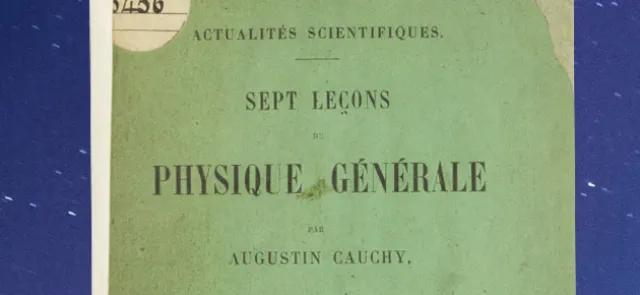
How Cauchy saw the world: science and faith | Tangente
In a series of lectures, Cauchy reveals his vision of the real world through the science of his day. They reveal a scholar wrestling with his religious convictions.
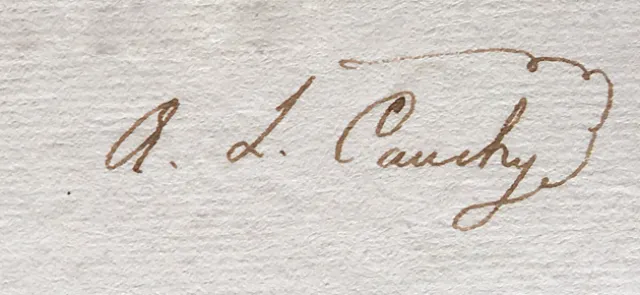
Origins of group theory: Cauchy and Galois | Tangente
Cauchy the analyst is well known; Cauchy the algebraist, much less so. Cauchy's contribution to group theory long went unrecognized, even though his research on algebraic structures was highly influential.

The battle over infinity: Cauchy and limits | Tangente
For more than two centuries, scholars and mathematicians debated infinitesimals: could they be handled safely, or were the paradoxes they generated insoluble? Amid this debate, Cauchy ushered analysis into the modern era while maintaining a nuanced position.

Geometry and philology: Cauchy's limits | Tangente
The mathematician Olry Terquem's review of Cauchy's paper on polyhedra ends in a most curious fashion.

A mathematical password: sin x in 1830 | Tangente
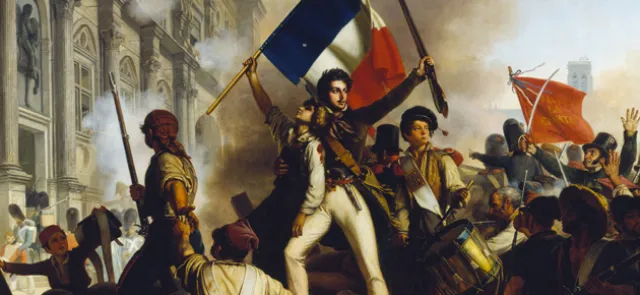
In their 1894 book on the slang of the École polytechnique, Albert Lévy and Gaston Pinet recount an anecdote illustrating the atmosphere that could prevail in Paris during the revolutions of 1830 and 1848.
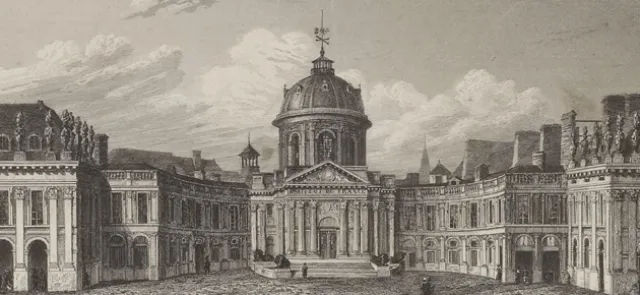
Cauchy: Conviction, maths and politics | Tangente
Cauchy's century was a veritable political laboratory: France passed through a succession of radically different regimes. Amid this constant change, Cauchy, a Legitimist, showed no lack of courage in defending his beliefs. Yet he remained steadfastly devoted to science, even when it meant helping regimes for which he had little sympathy.
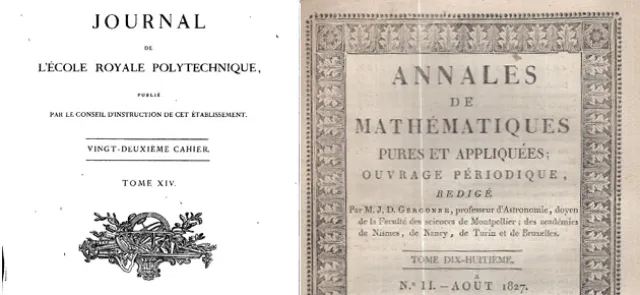
Cauchy and the rise of mathematical journals | Tangente
As the press expanded dramatically in the 19th century, advances in science prompted the creation of new publications devoted to scientific research.
Cauchy: A man of contradictions | Tangente
Cauchy's teaching and research left a profound mark on the history of mathematics. Yet both his work and personality were full of contradictions and did not always meet with universal approval.

Cauchy's rigidity theorem and polyhedra | Tangente
Cauchy's earliest work concerned polyhedra, including his foundational rigidity theorem.

Counting by substitution
At barely 25, Cauchy puts the finishing touches to a paper on symmetric functions that is eventually published as two articles. In it, he introduces new concepts, notation and methods, and creates the calculus of substitutions, which will play a central role in the development of group theory.
Cauchy and his rivals: a man of controversy | Tangente
Disputes over the authorship of theorems reflect the bitter controversies that pitted Cauchy against some mathematicians of his time.
The origins of complex analysis
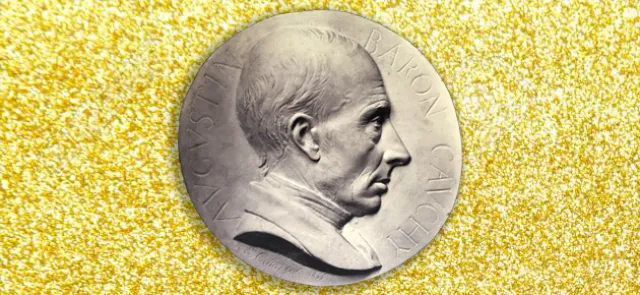
Cauchy is often credited with single-handedly founding complex analysis. The reality is subtler: although Cauchy gave the subject its structure and rigor, he drew on a wealth of earlier research, notably dating back to d’Alembert. Moreover, his involvement was prompted by debates between Laplace and Poisson over whether the use of complex numbers in integral calculations was legitimate. To understand Cauchy’s work, then, we must reconstruct its entire intellectual context.
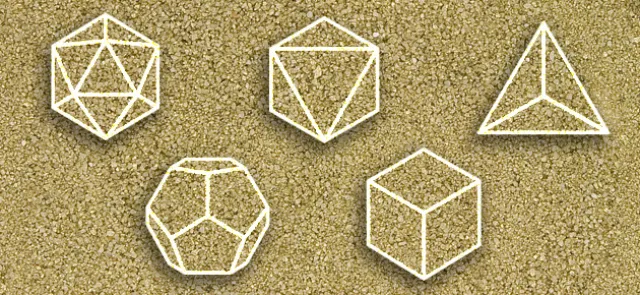
Cauchy’s first discoveries: polyhedra | Tangente
Although Cauchy is widely regarded as a highly abstract thinker, the first chapter of his work is, by contrast, strikingly visual. His study of regular polyhedra marked his entry into the world of mathematical research.
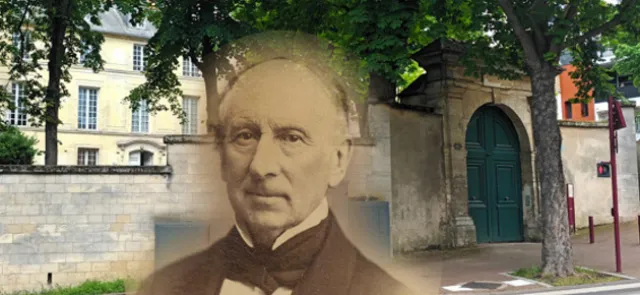
From Arcueil to Sceaux: in Cauchy's footsteps | Tangente
Cauchy had close ties to the southern suburbs of Paris. After growing up in Arcueil, he spent his holidays in Sceaux, where he produced some of his mathematical work. He also died and was buried there.
Cauchy the poet: defending maths in verse | Tangente
Although his name means only one thing to us—that of a mathematician—Cauchy also had a solid classical education. Having won distinction in the literary papers of the Concours général, he even tried his hand at poetry to explain the value of his science.
The other bicentenary: Cauchy commemorated in 1989 | Tangente
In France, 1989 was a year of major celebrations marking the bicentenary of the 1789 Revolution. Yet it was also the bicentenary of Cauchy's birth.

A series of errors
Nobody is perfect—not even the greatest mathematicians in their own field. Take Cauchy, who made a mistake concerning the convergence of series of functions—one that no student would dare make today.